TRAPPIST-1
Mga koordinado:  23h 06m 29.383s, −05° 02′ 28.59″
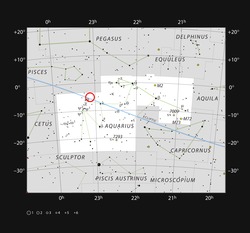 Lokasyon ng TRAPPIST-1 sa konstelasyon Aquarius. | |
| Impormasyon sa pagtingin Epoka Equinox | |
|---|---|
| Konstelasyon | Aquarius |
| Kanang asensiyon | 23h 06m 29.283s[2] |
| Deklinasyon | –05° 02′ 28.59″[2] |
| Maliwanag na kalakhan (V) | 18.80 |
| Katangian | |
| Pag-uuring pambituin | M8V[3] |
| V−R sa talatuntunan ng kulay | 2.33 |
| R−I sa talatuntunan ng kulay | 2.47 |
| Astrometriya | |
| Radyal na hagibis (Rv) | −56.3 km/s |
| Paralaks (π) | 82.58 mas |
| Layo | 39.5 ± 1.3 st (12.1 ± 0.4 pc) |
| Lubusang kalakhan (MV) | 18.4 ± 0.1 |
| Detalye | |
| Bigat | 0.08 ± 0.009 M☉ |
| Bigat | 83.8048 ± 9.428 MJup |
| Radyos | 0.114 ± 0.006 R☉ |
| Luminosidad(bolometriko) | 0.000525±0.000036[4] L☉ |
| Luminosidad(nakikita, LV) | 0.00000373 L☉ |
| Pang-ibabaw na grabidad (log g) | ~5.227[note 1][5] |
| Temperatura | 2550 ± 55 K |
| Metalisidad | 0.04 ± 0.08 |
| Rotasyon | 1.40 ± 0.05 days |
| Rotasyonal na hagibis (v sin i) | 6 ± 2 km/s |
| Edad | > 1 Gyr |
| Iba pang pagtatanda | |
2MASS J23062928-0502285, 2MASSI J2306292-050227, 2MASSW J2306292-050227, 2MUDC 12171 | |
| Sangguniang pangimpormasyon | |
| SIMBAD | data |
TRAPPIST-1, tinatawag din na 2MASS J23062928-0502285,[6] ay isang brown dwarf[4][7] distansya kami 39 light-year (12 parsec; 370 petametro) sa konstelasyon Aquarius.[8]. Noong Pebrero 2017, ang bituin na ito ay may 7 na planeta na tulad ng Earth na nag-oorbit nito, ang pinakamalaking bilang ng mga planetang tulad ng Earth kumpara sa anumang iba pang planeta system.[9][10]
Natuklasan
Ang isang pangkat ng mga astronomo sa ilalim ng utos ni Michaël Gillon (fr) ng Institut d'Astrophysique et Géophysique sa Liège University.[11] sa ang Belgium ay gumagamit ng Trappist telescope (maliit na teleskopyo upang maghanap ng mga maliliit na planeta at mga planeta ng transit) sa La Silla Observatory sa Atacama desert, Chile, [12] upang obserbahan ang mga bituin at maghanap ng mga planeta na nag-oorbit sa paligid. Sa pamamagitan ng paggamit ng photometry, natuklasan nila ang tatlong planeta na may sukat sa Earth na nag-oorbit sa isang dwarf; ang parehong dalawa ay ang tidal lock sa kanilang mga host stars habang ang pinakamalayo na lugar ng sistema ay lumilitaw o sa labas lamang nito. Ang bawat planeta ay may kakayahang maglaman ng ibabaw na tubig at buhay. [7][13] Napagmasdan ng koponan ang mga ito mula Setyembre hanggang Disyembre 2015 at na-publish ang kanilang mga natuklasan sa haligi ng Mayo 2016 Nature.[12][14]
Noong Pebrero 22, 2017, inihayag ng mga astronomo ang apat na iba pang mga dayuhan na planeta sa paligid ng Trappist-1. Natuklasan nila ang kabuuang bilang ng mga planeta na nag-oorbit sa bituin ng pitong planeta, kabilang ang hindi bababa sa dalawang planeta, at posibleng lahat ng mga planeta, sa loob ng lugar na madaling matutugunan.[15][16]
Galley
-
 TRAPPIST-1 is a smaller (11% the size), fainter and redder star than the Sun.
 -
![TRAPPIST-1 planetary system (artist concept)[17]](//upload.wikimedia.org/wikipedia/commons/thumb/1/17/Artist%E2%80%99s_impression_of_the_TRAPPIST-1_planetary_system.jpg/500px-Artist%E2%80%99s_impression_of_the_TRAPPIST-1_planetary_system.jpg) TRAPPIST-1 planetary system (artist concept)[17]
TRAPPIST-1 planetary system (artist concept)[17] -
![Planets transiting TRAPPIST-1 (artist concept)[18]](//upload.wikimedia.org/wikipedia/commons/thumb/5/50/Artist%27s_view_of_planets_transiting_red_dwarf_star_in_TRAPPIST-1_system.jpg/250px-Artist%27s_view_of_planets_transiting_red_dwarf_star_in_TRAPPIST-1_system.jpg) Planets transiting TRAPPIST-1 (artist concept)[18]
Planets transiting TRAPPIST-1 (artist concept)[18] -
 Three planets orbiting TRAPPIST-1 (artist concept).
 -
 TRAPPIST-1c view (artist concept).

![TRAPPIST-1 planetary system (artist concept)[17]](https://dokumen123.com/tl/Talaksan:Artist%E2%80%99s_impression_of_the_TRAPPIST-1_planetary_system.jpg)
![Planets transiting TRAPPIST-1 (artist concept)[18]](https://dokumen123.com/tl/Talaksan:Artist%27s_view_of_planets_transiting_red_dwarf_star_in_TRAPPIST-1_system.jpg)


-
 TRAPPIST-1 planetary system (artist concept).
 -
 TRAPPIST-1 system compared to the solar system; all seven planets of TRAPPIST-1 could fit inside the orbit of Mercury.[19]


-
 Drops in brightness (astronomical transits) of TRAPPIST-1 over 20 days (September/October, 2016; Spitzer Space Telescope and others) due to the seven planets (noted on the bottom) blocking the star's light.
 -
 Dimming of TRAPPIST-1 due to its seven known planets - large planets, more dimming; distant ones, longer (Spitzer Space Telescope).


Magbasa nang higit pa
- Thomas Levenson (ngày 2 tháng 5 năm 2016). "Astronomers Have Found Planets in the Habitable Zone of a Nearby Star". The Atlantic. Nakuha noong ngày 31 tháng 7 năm 2016.
{{cite web}}: Check date values in:|accessdate=at|date=()
Mga panlabas na link
- NASA Discovers 7 Planets Orbiting TRAPPIST 1
- TRAPPIST-1, Planetary system website.
- ESOcast 83: Ultracool dwarf star with planets (video) Naka-arkibo 2016-06-11 sa Wayback Machine.
- NASA Briefing on the Discovery of TRAPPIST-1's 7 Planets
Sanggunian
- ↑ Padron:Site web
- ↑ 2.0 2.1 Cutri, R.M.; Skrutskie, M.F.; Van Dyk, S.; Beichman, C.A.; Carpenter, J.M.; Chester, T.; Cambresy, L.; Evans, T.; Fowler, J.; Gizis, J.; Howard, E.; Huchra, J.; Jarrett, T.; Kopan, E.L.; Kirkpatrick, J.D.; Light, R.M.; Marsh, K.A.; McCallon, H.; Schneider, S.; Stiening, R.; Sykes, M.; Weinberg, M.; Wheaton, W.A.; Wheelock, S.; Zacarias, N. (June 2003). "2MASS All Sky Catalog of point sources". VizieR Online Data Catalog. 2246. European Southern Observatory with data provided by the SAO/NASA Astrophysics Data System. Bibcode:2003yCat.2246....0C.
- ↑ Costa, E.; Mendez, R.A.; Jao, W.-C.; Henry, T.J.; Subasavage, J.P.; Ianna, P.A. (ngày 4 tháng 8 năm 2006). "The Solar Neighborhood. XVI. Parallaxes from CTIOPI: Final Results from the 1.5 m Telescope Program" (PDF). The Astronomical Journal. 132 (3). The American Astronomical Society: 1234. Bibcode:2006AJ....132.1234C. doi:10.1086/505706.
{{cite journal}}: Check date values in:|date=() - ↑ 4.0 4.1 Gillon, M.; Jehin, E.; Lederer, S. M.; Delrez, L.; De Wit, J.; Burdanov, A.; Van Grootel, V.; Burgasser, A. J.; Triaud, A. H. M. J.; Opitom, C.; Demory, B.-O.; Sahu, D. K.; Bardalez Gagliuffi, D.; Magain, P.; Queloz, D. (2016). "Temperate Earth-sized planets transiting a nearby ultracool dwarf star" (PDF). Nature. 533 (7602): 221–224. arXiv:1605.07211. Bibcode:2016Natur.533..221G. doi:10.1038/nature17448. PMID 27135924.
- ↑ Viti, Serena; Jones,, Hugh R. A. (November 1999). "Gravity dependence at the bottom of the main sequence". Astronomy and Astrophysics. 351: 1028–1035. Bibcode:1999A&A...351.1028V. Nakuha noong ngày 6 tháng 5 năm 2016.
{{cite journal}}: Check date values in:|accessdate=()CS1 maint: extra punctuation (link) - ↑ Padron:Chú thích web
- ↑ 7.0 7.1 Padron:Site web
- ↑ {cite journal |last=Chang |first=Kenneth |title=7 Earth-Size Planets Identified in Orbit Around a Dwarf Star |url=https://www.nytimes.com/2017/02/22/science/trappist-1-exoplanets-nasa.html |date=Pebrero 25, 2017 |work=New York Times |accessdate=Pebrero 22, 2017 }}
- ↑ Witze, A. (Pebraro 22, 2017). "These seven alien worlds could help explain how planets form". Nature. doi:10.1038/nature.2017.21512.
{{cite journal}}: Check date values in:|date=() - ↑ Padron:Chú thích web
- ↑ Padron:Site web
- ↑ 12.0 12.1 Sample, Ian. "Could these newly-discovered planets orbiting an ultracool dwarf host life?". The Guardian.
- ↑ "Three New Planets Are the Best Bets for Life". Popular Mechanics.
- ↑ Gillon, Michaël; Jehin, Emmanuël; Lederer, Susan M.; Delrez, Laetitia; De Wit, Julien; Burdanov, Artem; Van Grootel, Valérie; Burgasser, Adam J.; Triaud, Amaury H. M. J.; Opitom, Cyrielle; Demory, Brice-Olivier; Sahu, Devendra K.; Bardalez Gagliuffi, Daniella; Magain, Pierre; Queloz, Didier (2016). "Temperate Earth-sized planets transiting a nearby ultracool dwarf star". Nature. 533 (7602): 221–224. doi:10.1038/nature17448.
- ↑ Padron:Site web
- ↑ "NASA telescope reveals largest batch of Earth-size, habitable-zone planets around single star". Exoplanet Exploration: Planets Beyond our Solar System (Pahayag sa midya). Nakuha noong Pebrero 22, 2017.
- ↑ Padron:Site web
- ↑ "Artist's view of planets transiting red dwarf star in TRAPPIST-1 system". www.spacetelescope.org. Inarkibo mula sa orihinal noong 2018-12-26. Nakuha noong 2019-06-18.
{{cite web}}: Text "accessdate" ignored () - ↑ Shostak, Seth. "This Weird Planetary System Seems Like Something From Science Fiction". NBC News.
Padron:TRAPPIST-1
Maling banggit (May <ref> tag na ang grupong "note", pero walang nakitang <references group="note"/> tag para rito); $2
Content Disclaimer
Informasi ini disarikan dari Wikipedia dan disajikan kembali untuk tujuan edukasi. Konten tersedia di bawah lisensi CC BY-SA 3.0. Kami tidak bertanggung jawab atas ketidakakuratan data yang bersumber dari kontribusi publik tersebut.
- The information displayed on this website is sourced in part or in whole from Wikipedia and has been adapted for the purpose of restating it. We strive to provide accurate and relevant information, however:
- There is no guarantee of absolute accuracy. Wikipedia is an open, collaborative project that can be edited by anyone, so information is subject to change.
- It is not intended to constitute professional advice. The content displayed is for informational and educational purposes only. For important decisions (e.g., medical, legal, or financial), please consult a professional.
- Content copyright. Wikipedia is licensed under the Creative Commons Attribution-ShareAlike License (CC BY-SA). This means that content may be reused with appropriate attribution and shared under a similar license.
- Responsible use. Any risk arising from the use of information from this website is entirely the responsibility of the user.