HD 204018


HD 204018, also designated as HR 8202, is a visual binary located in the southern constellation of Microscopium. The primary has an apparent magnitude of 5.58,[3] making it faintly visible to the naked eye under ideal conditions. The companion has an apparent magnitude of 8.09.[3] The system is located relatively close at a distance of 176 light years based on Gaia DR3 parallax measurements[2][4] but is receding with a heliocentric radial velocity of 18.3 km/s.[10] At its current distance, HD 204018's combined brightness is diminished by 0.13 magnitudes due to interstellar dust.[22]
HD 204018A is an Am star with a stellar classification of kA4hF0 VmF6,[6] indicating that it has the calcium K-line of an A4 star, the hydrogen lines of a F0 main-sequence star and the metallic lines of a F6 star. It has 1.73 imes the mass of the Sun[2] and 2.42 times the Sun's radius.[2] It radiates 12.8 times the luminosity of the Sun[2] from its photosphere at an effective temperature of 6,778 K,[13] giving it a yellowish-white hue. At an age of 1.5 billion years, HD 2014018A is estimated to be on the subgiant branch.[5] An alternate model places it on the main sequence at an age of 1,35 billion years.[2] The object spins at a moderate speed with a projected rotational velocity of 85 km/s.[14]
The companion is an F8 main sequence star[9] located 2+1⁄2" away along a position angle of 151°.[23] It has an angular diameter of 0.186±0.035 arcseconds,[17] which yields a radius of 1.09 R☉ at its estimated distance.[16] It has 102% times the mass of the Sun[15] and an effective temperature of 6,235 K.[17] HD 204018B is estimated to be 3.46 billion years old and is slightly metal deficient.[18]
There is a magnitude 12 co-moving companion located 295.3" away from the system along a position angle of 75°.[23] It is a red dwarf with an estimated spectral class of K6 and any orbit would take over a million years.[24]
References
- ^ Roman, Nancy G. (1987). "Identification of a constellation from a position". Publications of the Astronomical Society of the Pacific. 99 (617): 695. Bibcode:1987PASP...99..695R. doi:10.1086/132034. Constellation record for this object at VizieR.
- ^ a b c d e f g h i j k l Vallenari, A.; et al. (Gaia collaboration) (2023). "Gaia Data Release 3. Summary of the content and survey properties". Astronomy and Astrophysics. 674: A1. arXiv:2208.00211. Bibcode:2023A&A...674A...1G. doi:10.1051/0004-6361/202243940. S2CID 244398875. Gaia DR3 record for this source at VizieR.
- ^ a b c d Fabricius, C.; Høg, E.; Makarov, V. V.; Mason, B. D.; Wycoff, G. L.; Urban, S. E. (March 2002). "The Tycho double star catalogue". Astronomy & Astrophysics. 384 (1): 180–189. Bibcode:2002A&A...384..180F. doi:10.1051/0004-6361:20011822. eISSN 1432-0746. ISSN 0004-6361.
- ^ a b c d e Vallenari, A.; et al. (Gaia collaboration) (2023). "Gaia Data Release 3. Summary of the content and survey properties". Astronomy and Astrophysics. 674: A1. arXiv:2208.00211. Bibcode:2023A&A...674A...1G. doi:10.1051/0004-6361/202243940. S2CID 244398875. Gaia DR3 record for this source at VizieR.
- ^ a b Corbally, C. J. (December 1984). "Close visual binaries. III - Parameters and evolutionary status". The Astronomical Journal. 89: 1887. Bibcode:1984AJ.....89.1887C. doi:10.1086/113700. ISSN 0004-6256.
- ^ a b Abt, Helmut A.; Morrell, Nidia I. (July 1995). "The Relation between Rotational Velocities and Spectral Peculiarities among A-Type Stars". The Astrophysical Journal Supplement Series. 99: 135. Bibcode:1995ApJS...99..135A. doi:10.1086/192182. ISSN 0067-0049.
- ^ a b Feinstein, A. (April 1967). "Multicolor UBVRI observations of metallic-line stars". Publications of the Astronomical Society of the Pacific. 79: 184. Bibcode:1967PASP...79..184F. doi:10.1086/128464. eISSN 1538-3873. ISSN 0004-6280.
- ^ a b c Hardegree-Ullman, Kevin K.; Apai, Dániel; Bergsten, Galen J.; Pascucci, Ilaria; López-Morales, Mercedes (2023). "Bioverse: A Comprehensive Assessment of the Capabilities of Extremely Large Telescopes to Probe Earth-like O2 Levels in Nearby Transiting Habitable-zone Exoplanets". The Astronomical Journal. 165 (6): 267. arXiv:2304.12490. Bibcode:2023AJ....165..267H. doi:10.3847/1538-3881/acd1ec.
- ^ a b c d e Corbally, C. J. (August 1984). "Close visual binaries. I - MK classifications". The Astrophysical Journal Supplement Series. 55: 657. Bibcode:1984ApJS...55..657C. doi:10.1086/190973. eISSN 1538-4365. ISSN 0067-0049.
- ^ a b Gontcharov, G. A. (November 2006). "Pulkovo Compilation of Radial Velocities for 35 495 Hipparcos stars in a common system". Astronomy Letters. 32 (11): 759–771. arXiv:1606.08053. Bibcode:2006AstL...32..759G. doi:10.1134/S1063773706110065. eISSN 1562-6873. ISSN 1063-7737. S2CID 119231169.
- ^ Anderson, E.; Francis, Ch. (May 2012). "XHIP: An extended hipparcos compilation". Astronomy Letters. 38 (5): 331–346. arXiv:1108.4971. Bibcode:2012AstL...38..331A. doi:10.1134/S1063773712050015. eISSN 1562-6873. ISSN 1063-7737. S2CID 119257644.
- ^ Stassun, Keivan G.; et al. (9 September 2019). "The Revised TESS Input Catalog and Candidate Target List". The Astronomical Journal. 158 (4): 138. arXiv:1905.10694. Bibcode:2019AJ....158..138S. doi:10.3847/1538-3881/ab3467. eISSN 1538-3881. hdl:1721.1/124721. S2CID 166227927.
- ^ a b Schofield, Mathew; et al. (14 March 2019). "The Asteroseismic Target List for Solar-like Oscillators Observed in 2 minute Cadence with the Transiting Exoplanet Survey Satellite". The Astrophysical Journal Supplement Series. 241 (1): 12. arXiv:1901.10148. Bibcode:2019ApJS..241...12S. doi:10.3847/1538-4365/ab04f5. eISSN 1538-4365.
- ^ a b Huang, Su-Shu (September 1953). "A Statistical Study of the Rotation of the Stars". The Astrophysical Journal. 118: 285. Bibcode:1953ApJ...118..285H. doi:10.1086/145751. eISSN 1538-4357. ISSN 0004-637X.
- ^ a b c Anders, F.; et al. (February 2022). "Photo-astrometric distances, extinctions, and astrophysical parameters for Gaia EDR3 stars brighter than G = 18.5". Astronomy & Astrophysics. 658: A91. arXiv:2111.01860. Bibcode:2022A&A...658A..91A. doi:10.1051/0004-6361/202142369. eISSN 1432-0746. ISSN 0004-6361.
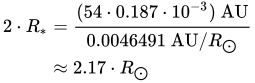
- ^ a b Lang, Kenneth R. (2006). Astrophysical formulae. Astronomy and astrophysics library. Vol. 1 (3 ed.). Birkhäuser. ISBN 3-540-29692-1.. The radius (R*) is given by:
- ^ a b c Stevens, Daniel J.; Stassun, Keivan G.; Gaudi, B. Scott (29 November 2017). "Empirical Bolometric Fluxes and Angular Diameters of 1.6 Million Tycho-2 Stars and Radii of 350,000 Stars with Gaia DR1 Parallaxes". The Astronomical Journal. 154 (6): 259. arXiv:1708.05025. Bibcode:2017AJ....154..259S. doi:10.3847/1538-3881/aa957b. eISSN 1538-3881. S2CID 119191064.
- ^ a b c Gontcharov, G. A. (December 2012). "Dependence of kinematics on the age of stars in the solar neighborhood". Astronomy Letters. 38 (12): 771–782. arXiv:1606.08814. Bibcode:2012AstL...38..771G. doi:10.1134/S1063773712120031. eISSN 1562-6873. ISSN 1063-7737.
- ^ Balona, L. A. (2019). "Evidence for spots on hot stars suggests major revision of stellar physics". Monthly Notices of the Royal Astronomical Society. 490 (2): 2112. arXiv:1910.01584. Bibcode:2019MNRAS.490.2112B. doi:10.1093/mnras/stz2808.
- ^ Gould, Benjamin Apthorp (1878). "Uranometria Argentina : brillantez y posicion de las estrellas fijas, hasta la septima magnitud, comprendidas dentro de cien grados del polo austral : con atlas". Resultados del Observatorio Nacional Argentino. 1. Bibcode:1879RNAO....1.....G.
- ^ "HR 8202". SIMBAD. Centre de données astronomiques de Strasbourg. Retrieved 21 December 2022.
- ^ Gontcharov, George A.; Mosenkov, Aleksandr V. (28 September 2017). "Verifying reddening and extinction for Gaia DR1 TGAS main sequence stars". Monthly Notices of the Royal Astronomical Society. 472 (4): 3805–3820. arXiv:1709.01160. Bibcode:2017MNRAS.472.3805G. doi:10.1093/mnras/stx2219. eISSN 1365-2966. ISSN 0035-8711.
- ^ a b Mason, Brian D.; Wycoff, Gary L.; Hartkopf, William I.; Douglass, Geoffrey G.; Worley, Charles E. (December 2001). "The 2001 US Naval Observatory Double Star CD-ROM. I. The Washington Double Star Catalog". The Astronomical Journal. 122 (6): 3466–3471. Bibcode:2001AJ....122.3466M. doi:10.1086/323920. ISSN 0004-6256.
- ^ Tokovinin, Andrei (23 February 2018). "The Updated Multiple Star Catalog". The Astrophysical Journal Supplement Series. 235 (1): 6. arXiv:1712.04750. Bibcode:2018ApJS..235....6T. doi:10.3847/1538-4365/aaa1a5. eISSN 1538-4365.

Content Disclaimer
Informasi ini disarikan dari Wikipedia dan disajikan kembali untuk tujuan edukasi. Konten tersedia di bawah lisensi CC BY-SA 3.0. Kami tidak bertanggung jawab atas ketidakakuratan data yang bersumber dari kontribusi publik tersebut.
- The information displayed on this website is sourced in part or in whole from Wikipedia and has been adapted for the purpose of restating it. We strive to provide accurate and relevant information, however:
- There is no guarantee of absolute accuracy. Wikipedia is an open, collaborative project that can be edited by anyone, so information is subject to change.
- It is not intended to constitute professional advice. The content displayed is for informational and educational purposes only. For important decisions (e.g., medical, legal, or financial), please consult a professional.
- Content copyright. Wikipedia is licensed under the Creative Commons Attribution-ShareAlike License (CC BY-SA). This means that content may be reused with appropriate attribution and shared under a similar license.
- Responsible use. Any risk arising from the use of information from this website is entirely the responsibility of the user.