Dual object
In category theory, a branch of mathematics, a dual object is an analogue of a dual vector space from linear algebra for objects in arbitrary monoidal categories. It is only a partial generalization, based upon the categorical properties of duality for finite-dimensional vector spaces. An object admitting a dual is called a dualizable object. In this formalism, infinite-dimensional vector spaces are not dualizable, since the dual vector space V∗ doesn't satisfy the axioms.[1] Often, an object is dualizable only when it satisfies some finiteness or compactness property.[2]
A category in which each object has a dual is called autonomous or rigid. The category of finite-dimensional vector spaces with the standard tensor product is rigid, while the category of all vector spaces is not.
Motivation
Let V be a finite-dimensional vector space over some field K. The standard notion of a dual vector space V∗ has the following property: for any K-vector spaces U and W there is an adjunction HomK(U ⊗ V,W) = HomK(U, V∗ ⊗ W), and this characterizes V∗ up to a unique isomorphism. This expression makes sense in any category with an appropriate replacement for the tensor product of vector spaces. For any monoidal category (C, ⊗) one may attempt to define a dual of an object V to be an object V∗ ∈ C with a natural isomorphism of bifunctors
- HomC((–)1 ⊗ V, (–)2) → HomC((–)1, V∗ ⊗ (–)2)
For a well-behaved notion of duality, this map should be not only natural in the sense of category theory, but also respect the monoidal structure in some way.[1] An actual definition of a dual object is thus more complicated.
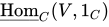
In a closed monoidal category C, i.e. a monoidal category with an internal Hom functor, an alternative approach is to simulate the standard definition of a dual vector space as a space of functionals. For an object V ∈ C define V∗ to be , where 1C is the monoidal identity. In some cases, this object will be a dual object to V in a sense above, but in general it leads to a different theory.[3]
Definition
Consider an object in a monoidal category . The object is called a left dual of if there exist two morphisms



- , called the coevaluation, and , called the evaluation,


such that the following two diagrams commute:

|
and | 
|
The object is called the right dual of . This definition is due to Dold & Puppe (1980).
Left duals are canonically isomorphic when they exist, as are right duals. When C is braided (or symmetric), every left dual is also a right dual, and vice versa.
If we consider a monoidal category as a bicategory with one object, a dual pair is exactly an adjoint pair.
Examples
- Consider a monoidal category (VectK, ⊗K) of vector spaces over a field K with the standard tensor product. A space V is dualizable if and only if it is finite-dimensional, and in this case the dual object V∗ coincides with the standard notion of a dual vector space.
- Consider a monoidal category (ModR, ⊗R) of modules over a commutative ring R with the standard tensor product. A module M is dualizable if and only if it is a finitely generated projective module. In that case the dual object M∗ is also given by the module of homomorphisms HomR(M, R).[4]
- Consider a homotopy category of pointed spectra Ho(Sp) with the smash product as the monoidal structure. If M is a compact neighborhood retract in (for example, a compact smooth manifold), then the corresponding pointed spectrum Σ∞(M+) is dualizable. This is a consequence of Spanier–Whitehead duality, which implies in particular Poincaré duality for compact manifolds.[1]
- The category of endofunctors of a category is a monoidal category under composition of functors. A functor is a left dual of a functor if and only if is left adjoint to .[5]


Categories with duals
A monoidal category where every object has a left (respectively right) dual is sometimes called a left (respectively right) autonomous category. Algebraic geometers call it a left (respectively right) rigid category. A monoidal category where every object has both a left and a right dual is called an autonomous category. An autonomous category that is also symmetric is called a compact closed category.
Traces
Any endomorphism f of a dualizable object admits a trace, which is a certain endomorphism of the monoidal unit of C. This notion includes, as very special cases, the trace in linear algebra and the Euler characteristic of a chain complex.
See also
References
- ^ a b c Ponto, Kate; Shulman, Michael (2014). "Traces in symmetric monoidal categories". Expositiones Mathematicae. 32 (3): 248–273. arXiv:1107.6032. Bibcode:2011arXiv1107.6032P. doi:10.1016/j.exmath.2013.12.003.
- ^ Becker, James C.; Gottlieb, Daniel Henry (1999). "A history of duality in algebraic topology" (PDF). In James, I.M. (ed.). History of topology. North Holland. pp. 725–745. ISBN 978-0-444-82375-5.
- ^ dual object in a closed category at the nLab
- ^ Dold & Puppe 1980, p. 88
- ^ See for example Nikshych, D.; Etingof, P.I.; Gelaki, S.; Ostrik, V. (2016). "Exercise 2.10.4". Tensor Categories. Mathematical Surveys and Monographs. Vol. 205. American Mathematical Society. p. 41. ISBN 978-1-4704-3441-0.
- Dold, Albrecht; Puppe, Dieter (1980), "Duality, trace, and transfer", Proceedings of the International Conference on Geometric Topology (Warsaw, 1978), PWN-Polish Scientific Publishers, pp. 81–102, ISBN 9788301017873, MR 0656721, OCLC 681088710
- Freyd, Peter; Yetter, David (1989). "Braided Compact Closed Categories with Applications to Low-Dimensional Topology". Advances in Mathematics. 77 (2): 156–182. doi:10.1016/0001-8708(89)90018-2.
- Joyal, André; Street, Ross. "The Geometry of Tensor calculus II" (PDF). Synthese Library. 259: 29–68. CiteSeerX 10.1.1.532.1533.
 | This category theory–related article is a stub. You can help Wikipedia by adding missing information. |
Content Disclaimer
Informasi ini disarikan dari Wikipedia dan disajikan kembali untuk tujuan edukasi. Konten tersedia di bawah lisensi CC BY-SA 3.0. Kami tidak bertanggung jawab atas ketidakakuratan data yang bersumber dari kontribusi publik tersebut.
- The information displayed on this website is sourced in part or in whole from Wikipedia and has been adapted for the purpose of restating it. We strive to provide accurate and relevant information, however:
- There is no guarantee of absolute accuracy. Wikipedia is an open, collaborative project that can be edited by anyone, so information is subject to change.
- It is not intended to constitute professional advice. The content displayed is for informational and educational purposes only. For important decisions (e.g., medical, legal, or financial), please consult a professional.
- Content copyright. Wikipedia is licensed under the Creative Commons Attribution-ShareAlike License (CC BY-SA). This means that content may be reused with appropriate attribution and shared under a similar license.
- Responsible use. Any risk arising from the use of information from this website is entirely the responsibility of the user.