Categorical trace
In category theory, a branch of mathematics, the categorical trace is a generalization of the trace of a matrix.
Definition
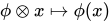
The trace is defined in the context of a symmetric monoidal category C, i.e., a category equipped with a suitable notion of a product . (The notation reflects that the product is, in many cases, a kind of a tensor product.) An object X in such a category C is called dualizable if there is another object playing the role of a dual object of X. In this situation, the trace of a morphism is defined as the composition of the following morphisms: where 1 is the monoidal unit and the extremal morphisms are the coevaluation and evaluation, which are part of the definition of dualizable objects.[1]



The same definition applies, to great effect, also when C is a symmetric monoidal ∞-category.
Examples
- If C is the category of vector spaces over a fixed field k, the dualizable objects are precisely the finite-dimensional vector spaces, and the trace in the sense above is the morphism
- which is the multiplication by the trace of the endomorphism f in the usual sense of linear algebra.

- More generally, in the category of modules over a ring R, the dualizable objects are the finitely generated projective modules. The dual of such a module M is , and the evaluation map , (extended linearly), allows the identification , under which the trace of an endomorphism is, again, given by multiplication with the trace, the value of the map above.[2] Similarly, one can define a trace for endomorphisms of locally free sheaves of finite rank on a ringed space, see Sheaf of modules § Operations.
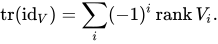
- If C is the ∞-category of chain complexes of modules (over a fixed commutative ring R), dualizable objects V in C are precisely the perfect complexes. The trace in this setting captures, for example, the Euler characteristic, which is the alternating sum of the ranks of its terms:



Further applications
Kondyrev & Prikhodko (2018) have used categorical trace methods to prove an algebro-geometric version of the Atiyah–Bott fixed point formula, an extension of the Lefschetz fixed point formula.
References
- ^ Ponto & Shulman (2014, Def. 2.2)
- ^ Dold, Albrecht; Puppe, Dieter (1980), "Duality, trace, and transfer", Proceedings of the International Conference on Geometric Topology (Warsaw, 1978), PWN-Polish Scientific Publishers, p. 88, ISBN 9788301017873, MR 0656721, OCLC 681088710
- ^ Ponto & Shulman (2014, Ex. 3.3)
Further reading
- Kondyrev, Grigory; Prikhodko, Artem (2018), "Categorical Proof of Holomorphic Atiyah–Bott Formula", J. Inst. Math. Jussieu, 19 (5): 1–25, arXiv:1607.06345, doi:10.1017/S1474748018000543
- Ponto, Kate; Shulman, Michael (2014), "Traces in symmetric monoidal categories", Expositiones Mathematicae, 32 (3): 248–273, arXiv:1107.6032, Bibcode:2011arXiv1107.6032P, doi:10.1016/j.exmath.2013.12.003, S2CID 119129371
Content Disclaimer
Informasi ini disarikan dari Wikipedia dan disajikan kembali untuk tujuan edukasi. Konten tersedia di bawah lisensi CC BY-SA 3.0. Kami tidak bertanggung jawab atas ketidakakuratan data yang bersumber dari kontribusi publik tersebut.
- The information displayed on this website is sourced in part or in whole from Wikipedia and has been adapted for the purpose of restating it. We strive to provide accurate and relevant information, however:
- There is no guarantee of absolute accuracy. Wikipedia is an open, collaborative project that can be edited by anyone, so information is subject to change.
- It is not intended to constitute professional advice. The content displayed is for informational and educational purposes only. For important decisions (e.g., medical, legal, or financial), please consult a professional.
- Content copyright. Wikipedia is licensed under the Creative Commons Attribution-ShareAlike License (CC BY-SA). This means that content may be reused with appropriate attribution and shared under a similar license.
- Responsible use. Any risk arising from the use of information from this website is entirely the responsibility of the user.