CCIR 476
CCIR 476 is a character encoding used in radio data protocols such as SITOR, AMTOR and Navtex. It is a recasting of the ITA2 character encoding, known as Baudot code, from a five-bit code to a seven-bit code. In each character, exactly four of the seven bits are mark bits, and the other three are space bits. This allows for the detection of single-bit errors.
Technical details
The number of possible valid binary code values in CCIR 476 is the number of ways to choose 4 marks for 7 bit positions, and the number can be calculated using the binomial coefficient: Thus CCIR 476 has 3 additional code points available over ITA2's 32 code points.
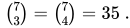
The SITOR protocol uses the additional three code points (denoted as SIA, SIB and RPT below) for idle, phasing, and repeat requests.[1] In addition, some of the ordinary characters are reused as control signals.[2]
Character set
In these tables, the hexadecimal code values are converted from a binary representation, with 1 being mark, 0 being space, and the most significant bit given first. The international version of ITA2 is used here; note also the added non-ITA2 codes SIA, SIB and RPT, used by SITOR.
| 0 | 1 | 2 | 3 | 4 | 5 | 6 | 7 | 8 | 9 | A | B | C | D | E | F | |
|---|---|---|---|---|---|---|---|---|---|---|---|---|---|---|---|---|
| 0x | SIA | |||||||||||||||
| 1x | J | F | C | K | ||||||||||||
| 2x | W | Y | P | Q | ||||||||||||
| 3x | SIB | G | FIGS | M | X | V | ||||||||||
| 4x | A | S | I | U | ||||||||||||
| 5x | D | R | E | N | LTRS | SP | ||||||||||
| 6x | Z | L | RPT | H | BLK | LF | ||||||||||
| 7x | O | B | T | CR |
| 0 | 1 | 2 | 3 | 4 | 5 | 6 | 7 | 8 | 9 | A | B | C | D | E | F | |
|---|---|---|---|---|---|---|---|---|---|---|---|---|---|---|---|---|
| 0x | SIA | |||||||||||||||
| 1x | BEL | ! | : | ( | ||||||||||||
| 2x | 2 | 6 | 0 | 1 | ||||||||||||
| 3x | SIB | & | FIGS | . | / | = | ||||||||||
| 4x | - | ' | 8 | 7 | ||||||||||||
| 5x | ENQ | 4 | 3 | , | LTRS | SP | ||||||||||
| 6x | + | ) | RPT | £ | BLK | LF | ||||||||||
| 7x | 9 | ? | 5 | CR |
References
- ^ Schetgen 1995, p. 12.21
- ^ CCIR Rec. 625 Service Information Signals.
- ^ a b "ARRL 2013 Handbook, Chapter 16; ITA2 (Baudot) and AMTOR Codes" (PDF). 2013. Archived from the original (PDF) on 2022-02-11.
- Schetgen, Robert, ed. (1995), The ARRL Handbook for Radio Amateurs (Seventy-Third (1996) ed.), Newington, CT: The American Radio Relay League, ISBN 0-87259-173-5
Content Disclaimer
Informasi ini disarikan dari Wikipedia dan disajikan kembali untuk tujuan edukasi. Konten tersedia di bawah lisensi CC BY-SA 3.0. Kami tidak bertanggung jawab atas ketidakakuratan data yang bersumber dari kontribusi publik tersebut.
- The information displayed on this website is sourced in part or in whole from Wikipedia and has been adapted for the purpose of restating it. We strive to provide accurate and relevant information, however:
- There is no guarantee of absolute accuracy. Wikipedia is an open, collaborative project that can be edited by anyone, so information is subject to change.
- It is not intended to constitute professional advice. The content displayed is for informational and educational purposes only. For important decisions (e.g., medical, legal, or financial), please consult a professional.
- Content copyright. Wikipedia is licensed under the Creative Commons Attribution-ShareAlike License (CC BY-SA). This means that content may be reused with appropriate attribution and shared under a similar license.
- Responsible use. Any risk arising from the use of information from this website is entirely the responsibility of the user.