Produto diádico
 |
Em álgebra linear, o produto diádico é referido tipicamente ao produto tensorial de dois vetores. O resultado da aplicação do produto diádico a um par de coordenadas de um vetor é uma matriz.
O produto diádico de vetores pode também ser identificado como um caso especial do produto de Kronecker de matrizes.
Definição (produto de matrizes)
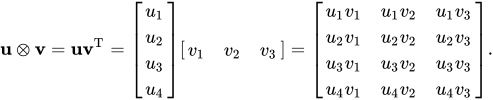
O produto diádico u ⊗ v é equivalente à multiplicação matricial uvT, sendo u representado como um vetor coluna m × 1 e v como um vetor coluna n × 1 (que torna vT um vetor linha).[1] Por exemplo, se m = 4 e n = 3, então
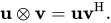
Para vetores complexos, usa-se o conjugado transposto de v (denotado vH):
Referências
- ↑ Linear Algebra (4th Edition), S. Lipcshutz, M. Lipson, Schaum’s Outlines, McGraw Hill (USA), 2009, ISBN 978-0-07-154352-1
Ver também
Produtos
Dualidade
Content Disclaimer
Informasi ini disarikan dari Wikipedia dan disajikan kembali untuk tujuan edukasi. Konten tersedia di bawah lisensi CC BY-SA 3.0. Kami tidak bertanggung jawab atas ketidakakuratan data yang bersumber dari kontribusi publik tersebut.
- The information displayed on this website is sourced in part or in whole from Wikipedia and has been adapted for the purpose of restating it. We strive to provide accurate and relevant information, however:
- There is no guarantee of absolute accuracy. Wikipedia is an open, collaborative project that can be edited by anyone, so information is subject to change.
- It is not intended to constitute professional advice. The content displayed is for informational and educational purposes only. For important decisions (e.g., medical, legal, or financial), please consult a professional.
- Content copyright. Wikipedia is licensed under the Creative Commons Attribution-ShareAlike License (CC BY-SA). This means that content may be reused with appropriate attribution and shared under a similar license.
- Responsible use. Any risk arising from the use of information from this website is entirely the responsibility of the user.