TIROS-1

TIROS-1 (aŭ TIROS I) estis la unua sukcesa vetersatelito (meteorologia satelito) kaj la unua el la serio de Televida Infraruĝa Observa Satelito. Ĝi estis lanĉita la 1-an de aprilo 1960 el Cape Canaveral, Florido, Usono.
TIROS-I estis dediĉita por testi eksperimentajn teknikojn pri elsendoj de televidaj bildoj kaj de veteraj skemoj je alto de 700-750 km (cirkula orbito). Ĝi funkciis 78 tagojn kaj estis pli sukcesa ol Vanguard 2 en demonstrado, ke satelitoj povas sukcese filmigi atmosferan staton kaj plusendi tion al la Tero (22.952 bildoj estis senditaj).
TIROS I larĝis 0,48 m, kaj havis diametron de 1,1 m. Oni enkonstruis du televidajn kameraojn, kun du magnetaj surbendigiloj, kiuj povis stoki fotojn, kiam la satelito estis ekster la komunikada radiuso. La energion donis baterioj, kiujn ŝarĝis 9.200 sunĉelaj unuoj.
-
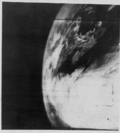
Unua sendita foto de TIROS I -

Foto pri ciklono de fare de TIROS I.


Content Disclaimer
Informasi ini disarikan dari Wikipedia dan disajikan kembali untuk tujuan edukasi. Konten tersedia di bawah lisensi CC BY-SA 3.0. Kami tidak bertanggung jawab atas ketidakakuratan data yang bersumber dari kontribusi publik tersebut.
- The information displayed on this website is sourced in part or in whole from Wikipedia and has been adapted for the purpose of restating it. We strive to provide accurate and relevant information, however:
- There is no guarantee of absolute accuracy. Wikipedia is an open, collaborative project that can be edited by anyone, so information is subject to change.
- It is not intended to constitute professional advice. The content displayed is for informational and educational purposes only. For important decisions (e.g., medical, legal, or financial), please consult a professional.
- Content copyright. Wikipedia is licensed under the Creative Commons Attribution-ShareAlike License (CC BY-SA). This means that content may be reused with appropriate attribution and shared under a similar license.
- Responsible use. Any risk arising from the use of information from this website is entirely the responsibility of the user.