Znám's problem

In number theory, Znám's problem asks which sets of integers have the property that each integer in the set is a proper divisor of the product of the other integers in the set, plus 1. Znám's problem is named after the Slovak mathematician Štefan Znám, who suggested it in 1972, although other mathematicians had considered similar problems around the same time.
The initial terms of Sylvester's sequence almost solve this problem, except that the last chosen term equals one plus the product of the others, rather than being a proper divisor. Sun in 1983 showed that there is at least one solution to the (proper) Znám problem for each . Sun's solution is based on a recurrence similar to that for Sylvester's sequence, but with a different set of initial values.[1]

The Znám problem is closely related to Egyptian fractions. It is known that there are only finitely many solutions for any fixed . It is unknown whether there are any solutions to Znám's problem using only odd numbers, and there remain several other open questions.

The problem
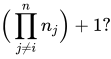
Znám's problem asks which sets of integers have the property that each integer in the set is a proper divisor of the product of the other integers in the set, plus 1. That is, given , what sets of integers are there such that, for each , divides but is not equal to[2] A closely related problem concerns sets of integers in which each integer in the set is a divisor, but not necessarily a proper divisor, of one plus the product of the other integers in the set.[3] This problem does not seem to have been named in the literature, and is referred to here as the improper Znám problem. Any solution to Znám's problem is also a solution to the improper Znám problem, but not necessarily vice versa.[4]


Origin
Znám's problem is named after the Slovak mathematician Štefan Znám, who suggested it in 1972.[5] Earlier, in 1971, Barbeau had posed the improper Znám problem for ,[3] and soon afterward Mordell, independently of Znám, found all solutions to the improper problem for .[6] Then, in 1975, Skula showed that Znám's problem is unsolvable for , and credited J. Janák with finding the solution for .[2]




Examples
Sylvester's sequence is an integer sequence in which each term is one plus the product of the previous terms. The first few terms of the sequence are
Stopping the sequence early produces a set like that almost meets the conditions of Znám's problem, except that the largest value equals one plus the product of the other terms, rather than being a proper divisor.[7] Thus, it is a solution to the improper Znám problem, but not a solution to Znám's problem as it is usually defined.

One solution to the proper Znám problem, for , is .[8] A few calculations will show that

| 3 × 7 × 47 × 395 | + 1 = | 389866, | which is divisible by but unequal to 2, | |
| 2 × 7 × 47 × 395 | + 1 = | 259911, | which is divisible by but unequal to 3, | |
| 2 × 3 × 47 × 395 | + 1 = | 111391, | which is divisible by but unequal to 7, | |
| 2 × 3 × 7 × 395 | + 1 = | 16591, | which is divisible by but unequal to 47, and | |
| 2 × 3 × 7 × 47 | + 1 = | 1975, | which is divisible by but unequal to 395. |
Connection to Egyptian fractions
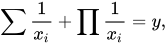
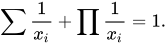
Any solution to the improper Znám problem is equivalent (via division by the product of the values ) to a solution to the equation where as well as each must be an integer, and conversely any such solution corresponds to a solution to the improper Znám problem. However, all known solutions have ,[9] so they satisfy the equation This equation describes an Egyptian fraction representation of the number one as a sum of unit fractions.[10] The solutions to this equation have been applied to the classification of singularities on surfaces,[7] and to the theory of nondeterministic finite automata.[11]



Number of solutions
The number of solutions to Znám's problem for any is finite, so it makes sense to count the total number of solutions for each .[8] Sun showed in 1983 that there is at least one solution to the (proper) Znám problem for each . Sun's solution is based on a recurrence similar to that for Sylvester's sequence, but with a different set of initial values.[1] The number of solutions for small values of , starting with , forms the sequence:[9]
Presently, a few solutions are known for and , but it is unclear how many solutions remain undiscovered for those values of . However, there are infinitely many solutions if is not fixed: Cao and Jing showed in 1998 showed that there are at least 39 solutions for each ,[12] improving earlier results proving the existence of fewer solutions;[13] Sun and Cao conjectured in 1988 that the number of solutions for each value of grows monotonically with .[14]


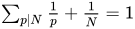
It is unknown whether there are any solutions to Znám's problem using only odd numbers. With one exception, all known solutions start with 2. If all numbers in a solution to Znám's problem or the improper Znám problem are prime, their product is a primary pseudoperfect number.[15]
See also
References
Notes
- ^ a b Sun 1983.
- ^ a b Skula 1975.
- ^ a b Barbeau 1971.
- ^ Brenton & Drucker 1993.
- ^ See the review of Skula 1975 at MR 0539862.
- ^ Barbeau 1971; Mordell 1973
- ^ a b Brenton & Hill 1988.
- ^ a b Janák & Skula 1978.
- ^ a b Brenton & Vasiliu 2002.
- ^ Anne 1998.
- ^ Domaratzki et al. 2005.
- ^ Cao & Jing 1998.
- ^ Cao, Liu & Zhang 1987; Sun & Cao 1988.
- ^ Sun & Cao 1988.
- ^ Butske, Jaje & Mayernik 2000.
Sources
- Anne, Premchand (1998), "Egyptian fractions and the inheritance problem", The College Mathematics Journal, 29 (4): 296–300, doi:10.1080/07468342.1998.11973958, JSTOR 2687685, MR 1648474
- Barbeau, G. E. J. (1971), "Problem 179", Canadian Mathematical Bulletin, 14 (1): 129.
- Brenton, Lawrence; Drucker, Daniel (1993), "On the number of solutions of ", Journal of Number Theory, 44 (1): 25–29, doi:10.1006/jnth.1993.1030, MR 1219482
- Brenton, Lawrence; Hill, Richard (1988), "On the Diophantine equation and a class of homologically trivial complex surface singularities", Pacific Journal of Mathematics, 133 (1): 41–67, doi:10.2140/pjm.1988.133.41, MR 0936356.
- Brenton, Lawrence; Vasiliu, Ana (2002), "Znám's problem", Mathematics Magazine, 75 (1): 3–11, doi:10.2307/3219178, JSTOR 3219178.
- Butske, William; Jaje, Lynda M.; Mayernik, Daniel R. (2000), "On the equation , pseudoperfect numbers, and perfectly weighted graphs", Mathematics of Computation, 69: 407–420, doi:10.1090/S0025-5718-99-01088-1, MR 1648363.
- Cao, Zhen Fu; Jing, Cheng Ming (1998), "On the number of solutions of Znám's problem", J. Harbin Inst. Tech., 30 (1): 46–49, MR 1651784.
- Cao, Zhen Fu; Liu, Rui; Zhang, Liang Rui (1987), "On the equation and Znám's problem", Journal of Number Theory, 27 (2): 206–211, doi:10.1016/0022-314X(87)90062-X, MR 0909837.
- Domaratzki, Michael; Ellul, Keith; Shallit, Jeffrey; Wang, Ming-Wei (2005), "Non-uniqueness and radius of cyclic unary NFAs", International Journal of Foundations of Computer Science, 16 (5): 883–896, doi:10.1142/S0129054105003352, MR 2174328.
- Janák, Jaroslav; Skula, Ladislav (1978), "On the integers for which ", Math. Slovaca, 28 (3): 305–310, MR 0534998.
- Mordell, L. J. (1973), "Systems of congruences", Canadian Mathematical Bulletin, 16 (3): 457–462, doi:10.4153/CMB-1973-077-3, MR 0332650.
- Skula, Ladislav (1975), "On a problem of Znám", Acta Fac. Rerum Natur. Univ. Comenian. Math. (Russian, Slovak summary), 32: 87–90, MR 0539862.
- Sun, Qi (1983), "On a problem of Š. Znám", Sichuan Daxue Xuebao (4): 9–12, MR 0750288.
- Sun, Qi; Cao, Zhen Fu (1988), "On the equation and the number of solutions of Znám's problem", Northeastern Mathematics Journal, 4 (1): 43–48, MR 0970644.






External links
- PrimeFan, "Solutions to Znám's Problem", archived from the original on 2022-10-04
- Weisstein, Eric W., "Znám's Problem", MathWorld
{{cite web}}: CS1 maint: overridden setting (link)
Content Disclaimer
Informasi ini disarikan dari Wikipedia dan disajikan kembali untuk tujuan edukasi. Konten tersedia di bawah lisensi CC BY-SA 3.0. Kami tidak bertanggung jawab atas ketidakakuratan data yang bersumber dari kontribusi publik tersebut.
- The information displayed on this website is sourced in part or in whole from Wikipedia and has been adapted for the purpose of restating it. We strive to provide accurate and relevant information, however:
- There is no guarantee of absolute accuracy. Wikipedia is an open, collaborative project that can be edited by anyone, so information is subject to change.
- It is not intended to constitute professional advice. The content displayed is for informational and educational purposes only. For important decisions (e.g., medical, legal, or financial), please consult a professional.
- Content copyright. Wikipedia is licensed under the Creative Commons Attribution-ShareAlike License (CC BY-SA). This means that content may be reused with appropriate attribution and shared under a similar license.
- Responsible use. Any risk arising from the use of information from this website is entirely the responsibility of the user.