Zbus
 | This article relies largely or entirely on a single source. (August 2022) |
Z Matrix or bus impedance matrix in computing is an important tool in power system analysis. Though, it is not frequently used in power flow study, unlike Ybus matrix, it is, however, an important tool in other power system studies like short circuit analysis or fault study. The Zbus matrix can be computed by matrix inversion of the Ybus matrix. Since the Ybus matrix is usually sparse, the explicit Zbus matrix would be dense and very memory intensive to handle directly.
Context
Electric power transmission needs optimization. Only Computer simulation allows the complex handling required. The Zbus matrix is a big tool in that box.
Formulation
Z Matrix can be formed by either inverting the Ybus matrix or by using Z bus building algorithm. The latter method is harder to implement but more practical and faster (in terms of computer run time and number of floating-point operations per second) for a relatively large system.
Formulation:
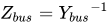
Because the Zbus is the inverse of the Ybus, it is symmetrical like the Ybus. The diagonal elements of the Zbus are referred to as driving-point impedances of the buses and the off-diagonal elements are called transfer impedances.[1]
One reason the Ybus is so much more popular in calculation is the matrix becomes sparse for large systems; that is, many elements go to zero as the admittance between two far away buses is very small. In the Zbus, however, the impedance between two far away buses becomes very large, so there are no zero elements, making computation much harder.
The operations to modify an existing Zbus are straightforward, and outlined in Table 1.
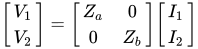
To create a Zbus matrix from scratch, we start by listing the equation for one branch:
![{\displaystyle [V_{1}]=[Z_{a}][I_{1}]}](https://wikimedia.org/api/rest_v1/media/math/render/svg/66138c7cd809fdcbd954f101a6ab76bff22ff773)
Then we add additional branches according to Table 1 until each bus is expressed in the matrix:
References
- ^ Grainger, John; Stevenson, William (2003). Power System Analysis. McGraw-Hill. pp 284
Content Disclaimer
Informasi ini disarikan dari Wikipedia dan disajikan kembali untuk tujuan edukasi. Konten tersedia di bawah lisensi CC BY-SA 3.0. Kami tidak bertanggung jawab atas ketidakakuratan data yang bersumber dari kontribusi publik tersebut.
- The information displayed on this website is sourced in part or in whole from Wikipedia and has been adapted for the purpose of restating it. We strive to provide accurate and relevant information, however:
- There is no guarantee of absolute accuracy. Wikipedia is an open, collaborative project that can be edited by anyone, so information is subject to change.
- It is not intended to constitute professional advice. The content displayed is for informational and educational purposes only. For important decisions (e.g., medical, legal, or financial), please consult a professional.
- Content copyright. Wikipedia is licensed under the Creative Commons Attribution-ShareAlike License (CC BY-SA). This means that content may be reused with appropriate attribution and shared under a similar license.
- Responsible use. Any risk arising from the use of information from this website is entirely the responsibility of the user.