Write–read conflict
 | This article needs additional citations for verification. (February 2024) |
In computer science, in the field of databases, write–read conflict (also known as reading uncommitted data and dirty read), is a computational anomaly associated with interleaved execution of transactions. Specifically, a write–read conflict occurs when "a transaction requests to write an entity, for which an unclosed transaction has already made a read request."[1]
Given a schedule S
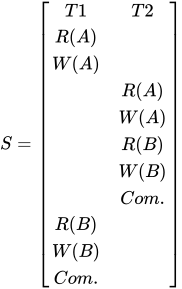
T2 could read a database object A, modified by T1 which hasn't committed. This is a dirty or inconsistent read.
T1 may write some value into A which makes the database inconsistent. It is possible that interleaved execution can expose this inconsistency and lead to an inconsistent final database state, violating ACID rules.
Strict 2PL overcomes this inconsistency by locking T2 out from performing a Read/Write on A. Note however that Strict 2PL can have a number of drawbacks, such as the possibility of deadlocks.
See also
References
- ^ Stearns, Richard E.; Rosenkrantz, Daniel J. (1981). Distributed database concurrency controls using before-values. 1981 ACM SIGMOD International Conference on Management of Data. New York, USA: Association for Computing Machinery. pp. 74–83. doi:10.1145/582318.582330. ISBN 0-89791-040-0.
Content Disclaimer
Informasi ini disarikan dari Wikipedia dan disajikan kembali untuk tujuan edukasi. Konten tersedia di bawah lisensi CC BY-SA 3.0. Kami tidak bertanggung jawab atas ketidakakuratan data yang bersumber dari kontribusi publik tersebut.
- The information displayed on this website is sourced in part or in whole from Wikipedia and has been adapted for the purpose of restating it. We strive to provide accurate and relevant information, however:
- There is no guarantee of absolute accuracy. Wikipedia is an open, collaborative project that can be edited by anyone, so information is subject to change.
- It is not intended to constitute professional advice. The content displayed is for informational and educational purposes only. For important decisions (e.g., medical, legal, or financial), please consult a professional.
- Content copyright. Wikipedia is licensed under the Creative Commons Attribution-ShareAlike License (CC BY-SA). This means that content may be reused with appropriate attribution and shared under a similar license.
- Responsible use. Any risk arising from the use of information from this website is entirely the responsibility of the user.