Wolfe duality
 | This article needs additional citations for verification. (May 2012) |
In mathematical optimization, Wolfe duality, named after Philip Wolfe, is type of dual problem in which the objective function and constraints are all differentiable functions. Using this concept a lower bound for a minimization problem can be found because of the weak duality principle.[1]
Mathematical formulation
For a minimization problem with inequality constraints,

the Lagrangian dual problem is
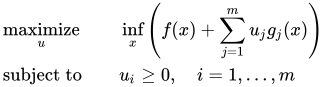
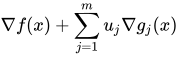
where the objective function is the Lagrange dual function. Provided that the functions and are convex and continuously differentiable, the infimum occurs where the gradient is equal to zero. The problem


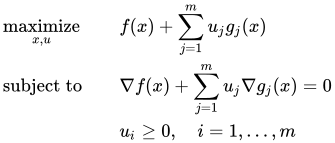
is called the Wolfe dual problem.[2][clarification needed] This problem employs the KKT conditions as a constraint. Also, the equality constraint is nonlinear in general, so the Wolfe dual problem may be a nonconvex optimization problem. In any case, weak duality holds.[3]
See also
References
- ^ Philip Wolfe (1961). "A duality theorem for non-linear programming". Quarterly of Applied Mathematics. 19 (3): 239–244. doi:10.1090/qam/135625.
- ^ Eiselt, Horst A. (2019). Nonlinear Optimization: Methods and Applications. International Series in Operations Research and Management Science Ser. Carl-Louis Sandblom. Cham: Springer International Publishing AG. p. 147. ISBN 978-3-030-19462-8.
- ^ Geoffrion, Arthur M. (1971). "Duality in Nonlinear Programming: A Simplified Applications-Oriented Development". SIAM Review. 13 (1): 1–37. doi:10.1137/1013001. JSTOR 2028848.
 | This applied mathematics–related article is a stub. You can help Wikipedia by adding missing information. |
Content Disclaimer
Informasi ini disarikan dari Wikipedia dan disajikan kembali untuk tujuan edukasi. Konten tersedia di bawah lisensi CC BY-SA 3.0. Kami tidak bertanggung jawab atas ketidakakuratan data yang bersumber dari kontribusi publik tersebut.
- The information displayed on this website is sourced in part or in whole from Wikipedia and has been adapted for the purpose of restating it. We strive to provide accurate and relevant information, however:
- There is no guarantee of absolute accuracy. Wikipedia is an open, collaborative project that can be edited by anyone, so information is subject to change.
- It is not intended to constitute professional advice. The content displayed is for informational and educational purposes only. For important decisions (e.g., medical, legal, or financial), please consult a professional.
- Content copyright. Wikipedia is licensed under the Creative Commons Attribution-ShareAlike License (CC BY-SA). This means that content may be reused with appropriate attribution and shared under a similar license.
- Responsible use. Any risk arising from the use of information from this website is entirely the responsibility of the user.