Wick Mountains
| Wick Mountains | |
|---|---|
 The Wick Mountains are shaded purple. This map also shows the approximate extent of the geological magma origin Darran Suite of gabbronorite and dioritic orthogneiss in red shading which composes most of the mountains. | |
| Highest point | |
| Peak | Mount Elliot |
| Elevation | 1,990 m (6,530 ft)[1] |
| Coordinates | 44°47′40″S 167°53′46″E / 44.79431°S 167.89604°E |
| Geography | |
 | |
| Location | Fiordland, South Island, New Zealand |
| Climbing | |
| Normal route | Homer Tunnel |
| Access | State Highway 94 (New Zealand) |
The Wick Mountains are a range within New Zealand's Fiordland National Park, the country's biggest national park. Their highest peak is Mount Elliot 1,990 metres (6,530 ft),[1] and this can be seen in fine weather from the Milford Track, a popular tourist walking track.
Geography
The range is bounded by the Arthur River to the west, Milford Sound (Piopiotahi) and the valley of the Cleddau River to the west, the Homer Saddle, which separates them from the Darren Mountains to the north west and the valleys of the Neil Burn and Clinton River to the south. The Homer Tunnel lies under the north eastern extreme of the range.[2]
Sheerdown Peak in the range is at the southern end of Milford Sound rising above the airport flat.[2]
The mountains were named by Donald Sutherland after his birthplace in Caithness, Scotland.[3]
| Peak | Height[1] | Coordinate[1] | Picture |
|---|---|---|---|
| Mount Elliot | 1,990 metres (6,530 ft) | 44°46′47″S 167°47′06″E / 44.77979°S 167.78501°E |  |
| Mount Belle | 1,965 metres (6,447 ft) | 44°46′28″S 167°59′06″E / 44.77454°S 167.98501°E |  |
| Mount Moir | 1,965 metres (6,447 ft) | 44°46′22″S 167°58′38″E / 44.77267°S 167.97718°E |  |
| Mount Anau | 1,956 metres (6,417 ft) | 44°51′57″S 167°55′18″E / 44.86588°S 167.92170°E | |
| Mount Mitchelson | 1,936 metres (6,352 ft) | 44°48′04″S 167°53′27″E / 44.80120°S 167.89074°E | |
| Mount Gendarme | 1,931 metres (6,335 ft) | 44°47′08″S 167°56′43″E / 44.78564°S 167.94528°E | |
| Access Peak | 1,865 metres (6,119 ft) | 44°44′10″S 167°54′57″E / 44.73623°S 167.91582°E |  |
| Mount Balloon | 1,847 metres (6,060 ft) | 44°47′59″S 167°47′17″E / 44.79976°S 167.78795°E | |
| Mount Wilmur | 1,710 metres (5,610 ft) | 44°47′07″S 167°47′46″E / 44.78537°S 167.79610°E |  |
Geology
The Wick Mountains are predominantly composed of a biotite from volcanic diorite dated just to their north to 138 ± 2.9 Ma and with younger intusion dykes of say quartz monzodiorite dated at 136 ± 1.9 Ma.[4] These rocks are part of the Median Tectonic Zone that separates the Western and Eastern provinces of Zealandia rocks. They cover an area of about 740 km2 (290 sq mi).[4] The mountains also have components to their southwest of orthogneiss.[5]
Climbing
Some of the mountains have known mountain climbing routes[6] on what has been described as "amazing diorite".[7]
-
![The Hirere Falls on the Milford Track are on the south western extreme of the Wick Mountains. The peaks behind at up to 1,920 metres (6,300 ft) do not have official names.[1]](//upload.wikimedia.org/wikipedia/commons/thumb/e/e2/Milford_Track_Hirere_Falls.jpg/120px-Milford_Track_Hirere_Falls.jpg) The Hirere Falls on the Milford Track are on the south western extreme of the Wick Mountains. The peaks behind at up to 1,920 metres (6,300 ft) do not have official names.[1]
The Hirere Falls on the Milford Track are on the south western extreme of the Wick Mountains. The peaks behind at up to 1,920 metres (6,300 ft) do not have official names.[1] -
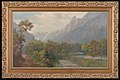 Clinton River Valley showing Wicks Mountains to right in view towards McKinnon Pass (Oil, John Elder Moultray about 1910, Auckland Museum).
![The Hirere Falls on the Milford Track are on the south western extreme of the Wick Mountains. The peaks behind at up to 1,920 metres (6,300 ft) do not have official names.[1]](https://dokumen123.com/en/File:Milford_Track_Hirere_Falls.jpg)
.jpg)
References
- ^ a b c d e NZTopoMap:Wick Mountains
- ^ a b Dowling, P. (ed.) (2004). ’’Reed New Zealand atlas’’. Auckland: Reed Publishing. Map 89. ISBN 0 7900 0952 8
- ^ New Zealand Gazetteer:Wick Mountains Source: Reed, A.W. & Peter Dowling, Place Names of New Zealand, 2010
- ^ a b A Wandres; SD Weaver; D Shelley; JD Bradshaw (1998). "Diorites and associated intrusive and metamorphic rocks of the Darran Complex, Mount Underwood, Milford, southwest New Zealand". New Zealand Journal of Geology and Geophysics. 41 (1): 1–14. doi:10.1080/00288306.1998.9514786.
- ^ NZ 1:250K Geological GNS science
- ^ "ClimbNZ:Wick Mountains (80 routes)". Retrieved 15 March 2023.
- ^ "ClimbNZ:Mt Moir (27 routes)". Retrieved 15 March 2023.
Content Disclaimer
Informasi ini disarikan dari Wikipedia dan disajikan kembali untuk tujuan edukasi. Konten tersedia di bawah lisensi CC BY-SA 3.0. Kami tidak bertanggung jawab atas ketidakakuratan data yang bersumber dari kontribusi publik tersebut.
- The information displayed on this website is sourced in part or in whole from Wikipedia and has been adapted for the purpose of restating it. We strive to provide accurate and relevant information, however:
- There is no guarantee of absolute accuracy. Wikipedia is an open, collaborative project that can be edited by anyone, so information is subject to change.
- It is not intended to constitute professional advice. The content displayed is for informational and educational purposes only. For important decisions (e.g., medical, legal, or financial), please consult a professional.
- Content copyright. Wikipedia is licensed under the Creative Commons Attribution-ShareAlike License (CC BY-SA). This means that content may be reused with appropriate attribution and shared under a similar license.
- Responsible use. Any risk arising from the use of information from this website is entirely the responsibility of the user.