Variables sampling plan
In statistics, a variables sampling plan is an acceptance sampling technique. Plans for variables are intended for quality characteristics that are measured on a continuous scale. This plan requires the knowledge of the statistical model (e.g. normal distribution). The historical evolution of this technique dates back to the seminal work of W. Allen Wallis (1943). The purpose of a plan for variables is to assess whether the process is operating far enough from the specification limit. Plans for variables may produce a similar OC curve to attribute plans with significantly less sample size.
The decision criterion of these plans are
- or


where and are the sample mean and the standard deviation respectively, is the critical distance, and are the upper and lower regulatory limits. When the above expression is satisfied the proportion nonconforming is lower than expected and therefore the lot is accepted.


A variables sampling plan can be designed so that the OC curve passes through two points (AQL,) and (LQL,). AQL and LQL are the Acceptable quality limit and the limiting quality level respectively. and are the producer and consumer's risks. The required sample size () and the critical distance () can be obtained as


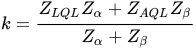
where is the normal distribution function.

When the dispersion is known the required sample size () is obtained from
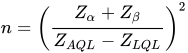
while for unknown the sample size is approximately

The MIL-STD-414 provides tables to obtain the required sample size and the critical distance according to the type of inspection.
External links
See also
References
- Wallis, W. (1947), Use of variables in acceptance inspection for per cent defective. In: Selected Techniques of Statistical Analysis for Scientific and Industrial Research and Production and Management Engineering., Columbia University
- MIL-STD-414 (1957), Military Standard. Sampling Procedure and Tables for Inspection by Variables for Percent Defective
{{citation}}: CS1 maint: numeric names: authors list (link) - Online MIL-STD-414 Calculator (SQC Online)
Further reading
- Schilling, Edward G.; Neubauer, Dean V. (2010), Acceptance sampling in quality control, CRC Press
Content Disclaimer
Informasi ini disarikan dari Wikipedia dan disajikan kembali untuk tujuan edukasi. Konten tersedia di bawah lisensi CC BY-SA 3.0. Kami tidak bertanggung jawab atas ketidakakuratan data yang bersumber dari kontribusi publik tersebut.
- The information displayed on this website is sourced in part or in whole from Wikipedia and has been adapted for the purpose of restating it. We strive to provide accurate and relevant information, however:
- There is no guarantee of absolute accuracy. Wikipedia is an open, collaborative project that can be edited by anyone, so information is subject to change.
- It is not intended to constitute professional advice. The content displayed is for informational and educational purposes only. For important decisions (e.g., medical, legal, or financial), please consult a professional.
- Content copyright. Wikipedia is licensed under the Creative Commons Attribution-ShareAlike License (CC BY-SA). This means that content may be reused with appropriate attribution and shared under a similar license.
- Responsible use. Any risk arising from the use of information from this website is entirely the responsibility of the user.