User:[email protected]/sandbox

The Quiescence Growth Model is a type of mathematical model for a time series where growth is influenced by reproduction, death and quiescence. It modifies a Malthusian growth model to include the effects of individuals in a population exiting and entering a dividing state. The resulting curvatures can be similar to a Gompertz function or simple logistic function, but instead of resource limitations directly effecting population growth, individuals are dropping out of the dividing population at some given rate which leadsto a different biological interpretation of the parameters. It is formulated as a Multi-compartment model.
 |
 |
 |


Formula

where
- a is the upper asymptote, since
- b, c are negative numbers
- b sets the x displacement
- c sets the growth rate (x scaling)
- e is Euler's Number (e = 2.71828...)

Differentiation
The function curve can be derived from a Gompertz law of mortality, which states the rate of mortality (decay) falls exponentially with current size. Mathematically

where
- is the rate of growth.
- k is an arbitrary constant.

Example uses
Examples of uses for Gompertz curves include:
- Mobile phone uptake, where costs were initially high (so uptake was slow), followed by a period of rapid growth, followed by a slowing of uptake as saturation was reached.
- Population in a confined space, as birth rates first increase and then slow as resource limits are reached.
- Modeling of growth of tumors
Growth of tumors
In the sixties A.K. Laird[1] for the first time successfully used the Gompertz curve to fit data of growth of tumors. In fact, tumors are cellular populations growing in a confined space where the availability of nutrients is limited. Denoting the tumor size as X(t) it is useful to write the Gompertz Curve as follows:

where:
- X(0) is the tumor size at the starting observation time;
- K is the carrying capacity, i.e. the maximum size that can be reached with the available nutrients. In fact it is:
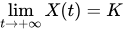
independently on X(0)>0. Note that, in absence of therapies etc.. usually it is X(0)<K, whereas, in presence of therapies, it may be X(0)>K;
- α is a constant related to the proliferative ability of the cells.
- log() refers to the natural log.
It is easy to verify that the dynamics of X(t) is governed by the Gompertz differential equation:
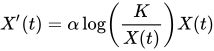
i.e. is of the form:

where F(X) is the instantaneous proliferation rate of the cellular population, whose decreasing nature is due to the competition for the nutrients due to the increase of the cellular population, similarly to the logistic growth rate. However, there is a fundamental difference: in the logistic case the proliferation rate for small cellular population is finite:

whereas in the Gompertz case the proliferation rate is unbounded:

As noticed by Steel[2] and by Wheldon[3], the proliferation rate of the cellular population is ultimately bounded by the cell division time. Thus, this might be an evidence that the Gompertz equation is not good to model the growth of small tumors. Moreover, more recently it has been noticed[4] that, including the interaction with immune system, Gompertz and other laws characterized by unbounded F(0) would preclude the possibility of immune surveillance.
Gompertz growth and logistic growth
The Gompertz differential equation
is the limiting case of the generalized logistic differential equation
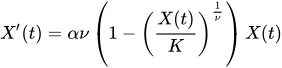
(where is a positive real number) since

- .

In addition, there is an inflection point in the graph of the generalized logistic function when
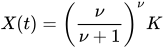
and one in the graph of the Gompertz function when
- .

Gomp-ex law of growth
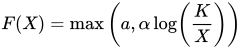
Based on the above considerations, Wheldon[3] proposed a mathematical model of tumor growth, called the Gomp-Ex model, that slightly modifies the Gompertz law. In the Gomp-Ex model it is assumed that initially there is no competition for resources, so that the cellular population expands following the exponential law. However, there is a critical size threshold such that for the growth follows the Gompertz Law:


so that:
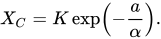
Here there are some numerical estimates[3] for :
- for human tumors
- for murine (mouse) tumors


See also
References
- ^ Laird A. K. (1964). "Dynamics of tumor growth". Br J of Cancer. 18 (3): 490–502. doi:10.1038/bjc.1964.55.
- ^ Steel, G.G. (1977). Growth Kinetics of Tumors. Oxford: Clarendon Press.
{{cite book}}: Cite has empty unknown parameter:|coauthors=(help) - ^ a b c Wheldon, T.E. (1988). Mathematical Models in Cancer Research. Bristol: Adam hilger.
{{cite book}}: Cite has empty unknown parameter:|coauthors=(help) - ^ d'Onofrio A. (2005). "A general framework for modeling tumor-immune system competition and immunotherapy: Mathematical analysis and biomedical inferences". Physica D. 208 (3–4): 220–235. doi:10.1016/j.physd.2005.06.032.
External links
Content Disclaimer
Informasi ini disarikan dari Wikipedia dan disajikan kembali untuk tujuan edukasi. Konten tersedia di bawah lisensi CC BY-SA 3.0. Kami tidak bertanggung jawab atas ketidakakuratan data yang bersumber dari kontribusi publik tersebut.
- The information displayed on this website is sourced in part or in whole from Wikipedia and has been adapted for the purpose of restating it. We strive to provide accurate and relevant information, however:
- There is no guarantee of absolute accuracy. Wikipedia is an open, collaborative project that can be edited by anyone, so information is subject to change.
- It is not intended to constitute professional advice. The content displayed is for informational and educational purposes only. For important decisions (e.g., medical, legal, or financial), please consult a professional.
- Content copyright. Wikipedia is licensed under the Creative Commons Attribution-ShareAlike License (CC BY-SA). This means that content may be reused with appropriate attribution and shared under a similar license.
- Responsible use. Any risk arising from the use of information from this website is entirely the responsibility of the user.