User:Sabub/sandbox
Computer Lib/Dream Machines possible sources
- Ready or not, computers are coming to the people: Inventing the PC.[1]
- Pioneer Spirits and the Lure of Technology: Vannevar Bush's Desk, Theodor Nelson's World
- Intertwingled: The Work and Influence of Ted Nelson
- Bastard Culture!: How User Participation Transforms Cultural Production
- The Curse of Xanadu (Wired article)
Add more to synopsis
In media/inspiration section?
Expand on neologisms section
Organize sources better.
Add background section?
Background
Prior to the initial release of Computer Lib/Dream Machines, Nelson was working on the first hypertext project, Project Xanadu, founded in 1960. An integral part to the Xanadu vision was computing technology and the freedom he believed came with it.[2] These ideas were later compiled and elaborated upon in the 1974 text, around the time when locally networked computers had appeared and Nelson found global networks as a space for the hypertext system.[3]
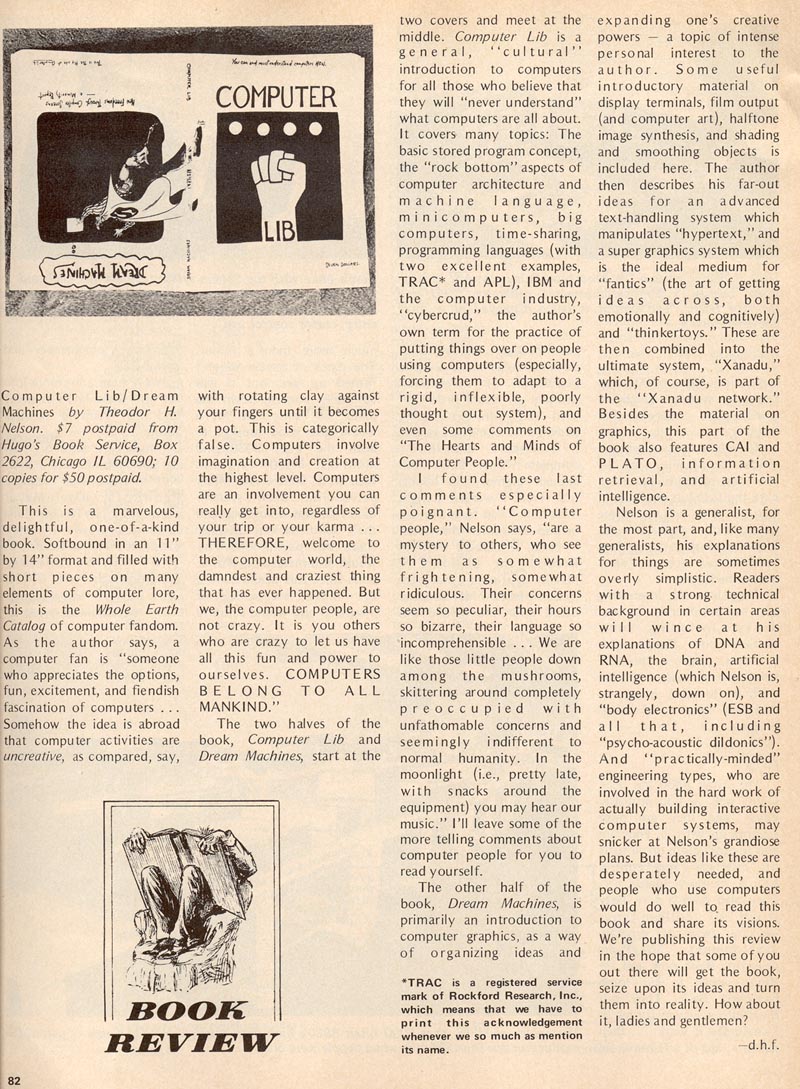
Published just before the release of the Altair 8800 kit, Computer Lib is often considered the first book about the personal computer.
Synopsis
Computer Lib
In Computer Lib. You can and must understand computers NOW, Nelson attempts to explain computers to the laymen during a time when personal computers had not yet become mainstream and anticipated the machine being open for anyone to use. Nelson writes about the need for people to understand computers more deeply than was generally promoted as computer literacy, which he considers a superficial kind of familiarity with particular hardware and software. His rallying cry "Down with Cybercrud" is against the centralization of computers such as that performed by IBM at the time, as well as against what he sees as the intentional untruths that "computer people" tell to non-computer people to keep them from understanding computers.
Dream Machines
In Dream Machines. New Freedom through Computer Screens, Nelson covers the flexible media potential of the computer, which was shockingly new at the time. He saw the use of hypermedia and hypertext, both terms he coined, being beneficial for creativity and education. He urged readers to look at the computer not as just a scientific machine, but as a interactive machine that can be accessible to anyone.
Format
Both the 1974 and 1987 editions have an unconventional layout, with two front covers. The Computer Lib cover features a raised fist in a computer. Once flipped over, the Dream Machines cover shows a man with a cape flying with a finger pointed to a screen. The division between the two sides are marked by text (for the other side) rotated 180°.
The book was stylistically influenced by Stewart Brand's Whole Earth Catalog. The text itself is broken up into many sections, with simulated pull-quotes, comics, side bars, etc., similar to a magazine layout.
According to Steven Levy, Nelson's format requirements for the book's "over-sized pages loaded with print so small you could hardly read it, along with scribbled notations, and manically amateurish drawings" may have contributed to the difficulty of finding a publisher for the first edition - Nelson paid 2,000 dollars out of his own pocket for the first print run of several hundred copies.[4]
Besides the Whole Earth Catalog, the layout also bore similarities to the People's Computer Company (PCC) newsletter, published by a Menlo Park based group of the same name, where Nelson's book would gain (as described by Levy) "a cult following ... Ted Nelson was treated like royalty at [PCC] potluck dinners."[4]
Neologisms
In Computer Lib, Nelson introduced a few words that he coined :
- cybercrud- "the author's own term for the practice of putting things over on people using computers (especially, forcing them to adapt to a rigid, inflexible, poorly thought out system)"[5]
- hypertext- originally coined in 1965, is text displayed which references other information that a user can access.< Nelson explores the term and its future in computers greatly within Computer Lib.
- intertwingularity- Nelson says "everything is deeply intertwingled". He says that all subjects and information are connected. The term comes from the merging of intertwined and intermingled.
Response and Influence
After its release, it drew an underground following from media theorists to computer hackers.[7]
It has since been referred to as "the most influential book in the history of computational media", as well as "the most important book in the history of new media" in The New Media Reader.
As the book came out before the first personal computer and their rise in popularity, Nelson has been credited with predicting how we interact with computers in terms of arts and entertainment, like video games. [8]
References
Citations
- ^ Ceruzzi, P. E. (2010-07-01). ""Ready or not, computers are coming to the people": Inventing the PC". OAH Magazine of History. 24 (3): 25–28. doi:10.2307/maghis/24.3.25. ISSN 0882-228X.
- ^ Kitzmann, Andreas (Fall 2001). "Pioneer Spirits and the Lure of Technology: Vannevar Bush's Desk, Theodor Nelson's World". Configurations. 9 (3): 441–459. doi:10.1353/con.2001.0018.
- ^ Wolf, Gary (1 June 1995). "The Curse of Xanadu". Wired. Retrieved 24 November 2019.
- ^ a b Levy 2010.
- ^ BYTE Magazine, October 1975
- ^ Struppa, Daniele C.; Dechow, Douglas R., eds. (2015). Intertwingled : the work and influence of Ted Nelson. Springer International Publishing. ISBN 978-3319169255. Retrieved 18 November 2019.
- ^ Packer, Randall; Jordan, Ken (2002). Multimedia: From Wagner to Virtual Reality. W. W. Norton & Company. ISBN 978-0-393-32375-7.
- ^ Wardrip-Fruin, Associate Professor in the Computer Science Department at the University of California Santa Cruz Noah; Wardrip-Fruin, Noah; Harrigan, Pat; Harrigan, Freelance Writer and Editor Pat (2004). First Person: New Media as Story, Performance, and Game. MIT Press. ISBN 978-0-262-23232-6.
{{cite book}}:|first4=has generic name (help)
Bibliography
- BYTE Magazine, October 1975
- Ceruzzi, P. E. (2010-07-01). ""Ready or not, computers are coming to the people": Inventing the PC". OAH Magazine of History. 24 (3): 25–28. doi:10.2307/maghis/24.3.25. ISSN 0882-228X.
- Levy, Steven (2010). "Chapter 8: Revolt in 2100". Hackers. O’Reilly.
- Rheingold, Howard (2000). Tools for Thought: The History and Future of Mind-expanding Technology. MIT Press. ISBN 9780262681155.
- Nelson, Theodor H. (1983). Computer lib : you can and must understand computers now. Nelson, Theodor H. ("First edition"--cover ed.). Nelson. ISBN 0893470023. OCLC 11182412.
- Nelson, Ted (1974). "Computer Lib / Dream Machines". In Wardrip-Fruin; Montfort (eds.). NMR. ISBN 9780486819556.
- Nielsen, Jakob (1995). "The History of Hypertext". Multimedia and Hypertext : the Internet and beyond. AP Professional. ISBN 0-12-518408-5. Retrieved 18 November 2019.
- Schäfer, Mirko Tobias (2011). Bastard Culture!: How User Participation Transforms Cultural Production. Amsterdam University Press. p. 62. ISBN 9789089642561.
- Struppa, Daniele C.; Dechow, Douglas R., eds. (2015). Intertwingled : the work and influence of Ted Nelson. Springer International Publishing. ISBN 978-3319169255. Retrieved 18 November 2019.
Content Disclaimer
Informasi ini disarikan dari Wikipedia dan disajikan kembali untuk tujuan edukasi. Konten tersedia di bawah lisensi CC BY-SA 3.0. Kami tidak bertanggung jawab atas ketidakakuratan data yang bersumber dari kontribusi publik tersebut.
- The information displayed on this website is sourced in part or in whole from Wikipedia and has been adapted for the purpose of restating it. We strive to provide accurate and relevant information, however:
- There is no guarantee of absolute accuracy. Wikipedia is an open, collaborative project that can be edited by anyone, so information is subject to change.
- It is not intended to constitute professional advice. The content displayed is for informational and educational purposes only. For important decisions (e.g., medical, legal, or financial), please consult a professional.
- Content copyright. Wikipedia is licensed under the Creative Commons Attribution-ShareAlike License (CC BY-SA). This means that content may be reused with appropriate attribution and shared under a similar license.
- Responsible use. Any risk arising from the use of information from this website is entirely the responsibility of the user.