User:Pcapasse/sandbox

Macroscopic Fundamental Diagram
A macroscopic fundamental diagram (MFD) is type of traffic flow fundamental diagram that relates space-mean flow, density and speed of an entire network with n number of links as shown in Figure 1. The MFD thus represents the capacity, , of the network in terms of vehicle density with being the maximum capacity of the network and being the jam density of the network. The maximum capacity or “sweet spot” of the network is the region at the peak of the MFD function.


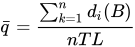
Flow
The space-mean flow, , across all the links of a given network can be expressed by:

, where B is the area in the time-space diagram shown in Figure 2.
Density
The space-mean density, , across all the links of a given network can be expressed by:

, where B is the area in the time-space diagram shown in Figure 2.

Speed
The space-mean speed, , across all the links of a given network can be expressed by:

, where B is the area in the space-time diagram shown in Figure 2.

Average Travel Time
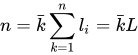
The MFD function can expressed in terms of the number of vehicles in the network such that:
where represents the total lane miles of the network.

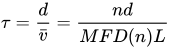
Let be the average distance driven by a user in the network. The average travel time () is:


Application of the MFD
In 2008, the traffic flow data of the city street network of Yokohama, Japan was collected using 500 fixed sensors and 140 mobile sensors. The study[1] revealed that city sectors with approximate area of 10km^2 are expected to have well-defined MFD functions. However, the observed MFD does not produce the full MFD function in the congested region of higher densities. Most beneficially though, the MFD function of a city network was shown to be independent of the traffic demand. Thus, through the continuous collection of traffic flow data the MFD for urban neighborhoods and cities can be obtained and used to for analysis and traffic engineering purposes. These MFD functions can aid agencies in improving network accessibility and help to reduce congestion by monitoring the number of vehicles in the network. In turn, using congestion pricing, perimeter control an other various traffic control methods, agencies can maintain optimum network performance at the "sweet spot" peak capacity. Agencies can also use the MFD to estimate average trip times for public information and engineering purposes.
References
- ^ Geroliminis, N; Daganzo, CF. “Existance of urban-scale macroscopic fundamental diagrams: Some experimental findings.” TRANSPORTATION RESEARCH PART B-METHODOLOGICAL; NOV, 2008; 42; 9; p759-p770
Content Disclaimer
Informasi ini disarikan dari Wikipedia dan disajikan kembali untuk tujuan edukasi. Konten tersedia di bawah lisensi CC BY-SA 3.0. Kami tidak bertanggung jawab atas ketidakakuratan data yang bersumber dari kontribusi publik tersebut.
- The information displayed on this website is sourced in part or in whole from Wikipedia and has been adapted for the purpose of restating it. We strive to provide accurate and relevant information, however:
- There is no guarantee of absolute accuracy. Wikipedia is an open, collaborative project that can be edited by anyone, so information is subject to change.
- It is not intended to constitute professional advice. The content displayed is for informational and educational purposes only. For important decisions (e.g., medical, legal, or financial), please consult a professional.
- Content copyright. Wikipedia is licensed under the Creative Commons Attribution-ShareAlike License (CC BY-SA). This means that content may be reused with appropriate attribution and shared under a similar license.
- Responsible use. Any risk arising from the use of information from this website is entirely the responsibility of the user.