User:Limulus
Interesting Items
Articles I've Done Significant Work On
(though not necessarily recently)

- Anderson Cooper
- Carl Linnaeus, and related articles:
- Flibe Energy and Closed-cycle gas turbine
- Gee Gee James
- Harris, Saskatchewan
- Internet Explorer for UNIX
- Judith Reisman
- Krampus (mostly images and IPC section)
- No-analog (ecology)
- Pandora's Promise
- Pirate Baby's Cabana Battle Street Fight 2006
- Toxicofera (formerly "Venom clade" :)
- Template:Actinides vs fission products
- Template:Ra to Es by HL
- Voodoo Science
Thorium
By 1946, only eight years after the discovery of nuclear fission, three fissile isotopes had been publicly identified for use as nuclear fuel:[1][2]
- Uranium-235, which is already fissile, but occurs as <1% of natural uranium
- Plutonium-239, which can be bred from non-fissile Uranium-238 (>99% of natural uranium)
- Uranium-233, which can be bred from non-fissile Thorium-232 (~100% of natural thorium; about four times more common than uranium[3])
Th-232, U-235 and U-238 are primordial nuclides, having existed in their current form for over 4.5 billion years, predating the formation of the Earth; they were forged in the cores of dying stars through the r-process and scattered across the galaxy by supernovas.[4] Their radioactive decay produces about half of the earth's internal heat.[5]
For technical (outlined in a section below) and historical reasons, the three are each associated with different reactor types. U-235 is the world's primary nuclear fuel and is usually used in light water reactors. U-238/Pu-239 has found the most use in liquid sodium fast breeder reactors. Th-232/U-233 is best suited to molten salt reactors (MSR).[3]
Alvin M. Weinberg pioneered the use of the MSR at Oak Ridge National Laboratory. The Aircraft Reactor Experiment in 1954 and Molten-Salt Reactor Experiment from 1965 to 1969 both used liquid fluoride salts; the latter notably demonstrated the use of U-233 as a fuel source.[6] Unfortunately for MSR research, Weinberg was fired and the MSR program closed down in the early 1970s,[7] after which research stagnated in the United States.[8][9]
-
 The earth's uranium and thorium originated in the death throes of ancient stars
 -
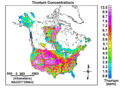 Thorium is relatively abundant in the earth's crust
 -
 Tiny crystals of Thorite, a thorium mineral, under magnification
 -
 Liquid FLiBe salt
 -
 Molten Salt Reactor at Oak Ridge


Sorensen-related
- Energy From Thorium Sorensen's website "Devoted to the discussion of thorium as a future energy resource, and the machine to extract that energy–the liquid-fluoride thorium reactor."
- Thorium Energy Alliance Conference Proceedings
- Kirk Sorensen - A Global Alternative @ TEAC4 Kirk Sorensen's presentation at Thorium Energy Alliance Conference #4 in Chicago.
- Manchester Report: Thorium nuclear power
- Uranium Is So Last Century — Enter Thorium, the New Green Nuke
- Forbes article: Is Thorium the Biggest Energy Breakthrough Since Fire? Possibly.
Thorium in India (map)
For Occurrence of thorium based on File:India-locator-map-thorium2012.svg updated with [1]

Selected Pictures I've Taken
-

-
 at the Harris Museum
 -

-


References
- ^ UP (29 September 1946). "Atomic Energy 'Secret' Put into Language That Public Can Understand". Pittsburgh Press. Retrieved 18 October 2011.
- ^ UP (21 October 1946). "Third Nuclear Source Bared". The Tuscaloosa News. Retrieved 18 October 2011.
- ^ a b Hargraves, Robert; Moir, Ralph (2010). "Liquid Fluoride Thorium Reactors" (PDF). American Scientist. 98 (4): 304–313.
{{cite journal}}: Unknown parameter|month=ignored (help) - ^ Synthesis of heavy elements
- ^ The KamLAND Collaboration (2011-07-17). "Partial radiogenic heat model for Earth revealed by geoneutrino measurements". Nature Geoscience. 4: 647–651. doi:10.1038/ngeo1205.
- ^ Rosenthal, M.; Briggs, R.; Haubenreich, P., Molten-Salt Reactor Program: Semiannual Progress Report for Period Ending August 31, 1971 (PDF), vol. ORNL-4728, Oak Ridge National Laboratory
- ^ H. G. MacPherson (1985-08-01). "The Molten Salt Reactor Adventure". Nuclear Science and Engineering. 90: 374–380.
- ^ Weinberg, Alvin (1997). The First Nuclear Era: The Life and Times of a Technological Fixer. Springer. ISBN 978-1563963582. Retrieved 12 November 2011.
- ^ "ORNL: THE FIRST 50 YEARS--CHAPTER 6: RESPONDING TO SOCIAL NEEDS". Retrieved 12 November 2011.
- ^ "RESERVES OF URANIUM AND THORIUM" (PDF). Department of Atomic Energy (India). 30 November 2016. Retrieved 18 January 2017.
Content Disclaimer
Informasi ini disarikan dari Wikipedia dan disajikan kembali untuk tujuan edukasi. Konten tersedia di bawah lisensi CC BY-SA 3.0. Kami tidak bertanggung jawab atas ketidakakuratan data yang bersumber dari kontribusi publik tersebut.
- The information displayed on this website is sourced in part or in whole from Wikipedia and has been adapted for the purpose of restating it. We strive to provide accurate and relevant information, however:
- There is no guarantee of absolute accuracy. Wikipedia is an open, collaborative project that can be edited by anyone, so information is subject to change.
- It is not intended to constitute professional advice. The content displayed is for informational and educational purposes only. For important decisions (e.g., medical, legal, or financial), please consult a professional.
- Content copyright. Wikipedia is licensed under the Creative Commons Attribution-ShareAlike License (CC BY-SA). This means that content may be reused with appropriate attribution and shared under a similar license.
- Responsible use. Any risk arising from the use of information from this website is entirely the responsibility of the user.