User:Kadamsujit
Name: Sujit Kadam
List of six things I have learned about Wikipedia/ Wikiversity are mentioned below:
- Wikipedia is a multilingual encyclopedia project supported by the non-profit Wikimedia Foundation.
- Wikipedia was launched in 2001 by Jimmy Wales and Larry Sanger.
- Wikipedia is ranked 7th among all websites on Alexa and it’s currently largest and most popular internet reference website.
- Wikipedia word originated from Hawaiian word ‘wiki’ meaning ‘quick’ and encyclopedia.
- Wikiversity is a sister project of Wikipedia started in 2006, made to help students learn various materials in different subjects.
- Wikiversity was a part of Wikibooks, the library of free textbooks.
Complex math formula:
I think Hypergoemetric series is one of the most complex math formula. The hypogeometric function is defined for |z|<1 by the series
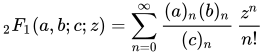
provided that c is not (equal to or less than zero) 0, -1, -2, ..... where Pochhammer symbol is defined by
(a)n = a(a+1)(a+2)....(a+n-1), (a)0 = 1.
Regarding other complex values of z it can be analytically continued along any path that avoids the branch points 0 and 1.
To get nice formulas, see w: Help:Displaying_a_formula(Thank you)
Description of what I think is wrong: Loss of Significance
The section “A better algorithm” in Loss of Significance is incorrect in Wikipedia. It’s incorrect in terms of formula and roots calculation. The detail errors are mentioned below:
- The formula used to calculate greater magnitude root X1 and smaller magnitude root X2 is used with incorrect (opposite) signs.
- As the formula used for greater magnitude root is used with opposite signs, it results into smaller magnitude root.
- There are also calculation errors in the example used in this section. The answer using the formula (incorrect formula) mentioned in Wikipedia actually gives X1 ≈ 0.0000001 and X2 ≈ -150. These roots are incorrect due to loss of significant digits. But in Wikipedia they have mentioned roots as X1 = -200.00000005 and X2 = 0.000000075. These roots are correct to a greater extent but doesn't comes out by applying formula mentioned in Wikipedia.
- Due to use of subtraction between two nearly equal numbers, the formula results into loss of significant digits.
Also in the section “Instability of the Quadratic equation” in Loss of Significance has a small calculation mistake. For a = 1, b =200, c= 0.000015; b2 – 4ac = 2002 – (4 * 1 *- 0.000015) = 40,000 + 6 * 10-5. But in Wikipedia, no multiplication operation is carried for ‘4ac’. Hence, the result of ‘4ac’ is ‘0.000015’.
Corrected version: A better algorithm section in Loss of significance
A better algorithm for solving quadratic equations is based on two observations: that one solution is always accurate when the other is not, and that given one solution of the quadratic, the other is easy to find.
If
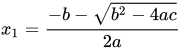
and

then we have the identity (one of Viète's formulas for a second degree polynomial)
- .

The algorithm is as follows. Use the quadratic formula to find the solution of greater magnitude, which does not suffer from loss of precision. Then use this identity to calculate the other root. Since no subtraction is involved, no loss of precision occurs. Applying this algorithm to our problem, and using 10-digit floating-point arithmetic, the solution of greater magnitude, as before, is x1 = − 200.00000001. The other solution is then x2 = c / ( − 200.00000001) = 0.0000000749, which is accurate.
References:
- Wikipedia. "Hypergeometric Function." Wikipedia, the Free Encyclopedia. Wikipedia, 16 Jun. 2005. Web. 10 Sept. 2010. <http://en.wikipedia.org/wiki/Gaussian_hypergeometric_series>.
- Wikipedia. "Wiki." Wikipedia, the Free Encyclopedia. Wikipedia, 09 Oct. 2001. Web. 10 Sept. 2010. <http://en.wikipedia.org/wiki/Wiki>.
Content Disclaimer
Informasi ini disarikan dari Wikipedia dan disajikan kembali untuk tujuan edukasi. Konten tersedia di bawah lisensi CC BY-SA 3.0. Kami tidak bertanggung jawab atas ketidakakuratan data yang bersumber dari kontribusi publik tersebut.
- The information displayed on this website is sourced in part or in whole from Wikipedia and has been adapted for the purpose of restating it. We strive to provide accurate and relevant information, however:
- There is no guarantee of absolute accuracy. Wikipedia is an open, collaborative project that can be edited by anyone, so information is subject to change.
- It is not intended to constitute professional advice. The content displayed is for informational and educational purposes only. For important decisions (e.g., medical, legal, or financial), please consult a professional.
- Content copyright. Wikipedia is licensed under the Creative Commons Attribution-ShareAlike License (CC BY-SA). This means that content may be reused with appropriate attribution and shared under a similar license.
- Responsible use. Any risk arising from the use of information from this website is entirely the responsibility of the user.