User:Harry Princeton/Tiling selection
This is a subset of dual co-uniform tilings by Tomruen which have a particular property, e.g. all clock tilings or all E tilings. Will be ordered by co-uniformity, then by dictionary VRP combination (OSTEIRrDFsCBH), then by wallpaper group.
Tiling Selection
There are 11+20+31+62+140=264 correctly-colored tilings. 🟥🟧🟨🟩🟦🟪🟫⬛⬜
| 1-Uniform | ||||
|---|---|---|---|---|

|

|

|

|

|

|

|

|

|

|

| ||||
| 2-Uniform | ||||

|

|

|

|

|

|

|

|

|

|

|

|

|

|

|

|

|

|

|

|
| 3-Uniform | ||||

|

|

|

|

|

|

|
 |

|

|

|

|

|

|

|

|

|

|

|

|

|

|

|

|

|

|

|

|

|

|

| ||||
| 4-Uniform | ||||

|

|

|

|

|

|

|

|

|

|

|

|

|

|

|

|

|

|

|

|

|

|

|

|

|

|

|

|

|

|

|

|

|

|

|

|

|

|

|

|

|

|

|

|

|

|

|

|

|

|

|

|

|

|

|

|

|

|

|

|

|

| |||
| 5-Uniform | ||||

|

|

|

|

|

|

|

|

|

|

|

|

|

|

|

|

|

|

|

|

|

|

|

|

|

|

|

|

|

|

|

|

|

|

|

|

|

|

|

|

|

|

|

|

|

|

|

|

|

|

|

|

|

|

|

|

|

|

|

|

|

|

|

|

|

|

|

|

|

|

|

|

|

|

|

|

|

|

|

|

|

|

|

|

|

|

|

|

|

|

|

|

|

|

|

|

|

|

|

|

|

|

|

|

|

|

|

|

|

|

|

|

|

|

|

|

|

|

|

|

|

|

|

|

|

|

|

|

|

|

|

|

|

|

|

|

|

|

|

|
| New Tilings | ||||||
|---|---|---|---|---|---|---|
|
|
|
|
|
|
|
|
| Old Tilings | ||||||

|

|

|

|

|

| |
Other Tilings
Asymmetric Covertex Figure Tilings
The covertex figure is the set of planigons surrounding a covertex, and comprise clocks (12), hexagrams (6), crosses (4), and fidget spinners (3). The floret pentagonal tiling is the only co-uniform tiling with asymmetric fidget spinners. The CB pgg tiling is the only 2 co-uniform tiling with asymmetric crosses. There are four 4-3 tilings with asymmetric hexagrams and one 4-3 with globally asymmetric hexagrams; and two 8-3 tilings with globally asymmetric clocks and one 12-5 tiling with asymmetric clocks. The covertex figures with * are globally asymmetric but (locally) symmetric:[1]

Finally, a tiling with all four types of asymmetric covertex figures (to scale as above):

Clock Tilings
The number of k-co-uniform clock tilings is given by 2, 3, 8, 18, 28, 48, 82, 128, 216, 359, 576, 931, ....[1] While the number of co-uniform tilings more than doubles for each k, the clock subset only increases by 1.65 times each.
There is a 12-co-uniform clock tiling where each clock has no (local) symmetry, but two 8-co-uniform clock tilings where each symmetric clock has no global symmetry. The 11-co-uniform clock tiling represents the interesting family OSTC.[1]
| 11-Uniform | 12-Uniform | |
|---|---|---|

|

|

|
Moreover, the other 12-co-uniform clock tiling is singular, up to minor insets of the 3D rhombi, in that it has wallpaper group pmg with 15° axes (e.g., the 3 planigon pairs are 150° apart). (1) the 3D rhombi cannot be elongated because the 45° symmetric (TC)2 4-covertices cannot be (STsB fails). (2) the clocks may not be inset without losing wallpaper symmetry (T is the only planigon allowing 15° axes). (3) the tiling cannot be converted into a cmm variant due to the nature of the (TC)2 4-covertices. (4) clocks cannot be substituted into all 3D rhombi after removing the original clocks due to a 30° offset between adjacent rhombi and co-edge parity.
Trihexagonal Tiling
A strictly trihexagonal tiling consists of vertices with at least one triangle and hexagon and is only made of triangles and hexagons. These vertices are 32.62, (3.6)2, 34.6 whose dual planigons are IRF. There exists seven 4-3 tilings:[2]

A trihexagonal tiling consists of vertices with at least one triangle and hexagon, so could contain 3.42.6, 3.4.6.4 as well, with family IRrDF. A unique 12-uniform tiling exists.[1]
A weakly trihexagonal tiling consists of vertices with at least one triangle or hexagon and is only made of triangles and hexagons (so could contain 63, 36 in addition to the strict case), with family EIRFH. There is one K5 tiling with this family.[2]
| Trihexagonal | Weakly Trihexagonal |
|---|---|

|

|
Every vertex contains at least one triangle or hexagon except for s (44), and there are two 22-13 tilings c.f. optimized tilings.
Orientable Tiling
A tiling is orientable if there exists a 90° rotation such that all of its triangles point up or down (without loss of generality). This entails that all hexagons are in the same orientation, if they exist, and ensures that the tilings are easier to comprehend. Orientable tilings contain all vertices except for 3.4.3.12, 3.4.6.4, 32.4.3.4, or TDC planigons. There are two classes of orientable tilings:
- Slab tiling – rows of triangles/hexagons separated by rows of squares, spanned by the planigon subset EIRrFsBH. There is a 13-8 tiling with all.[1]
- Dodecagonal stick – Bosconian-like tilings where trihexagonal regions are bounded by dodecagons and square lengths along the edges corresponding to a larger triangular tiling. These tilings are spanned by the subset 3SEIRrFBH, adding 3S to but removing s from slab tilings.
O is the dodecagonal stick having stick length 0 and the only time it appears in the second class. A 7-uniform dodecagonal stick contains IRF and a 12-uniform one contains EIRFH.[1] Two 16-uniform tilings each contain the whole family.
| Slab | Dodecagonal Sticks | |||
|---|---|---|---|---|
| 13-8 | 7-Uniform | 12-Uniform | 16-Uniform | 16-Uniform |

|

| |||
Planigon Combination
There exist tilings whose planigons are solely semiregular, starting from the Laves planigons themselves: iO3ERDFsCBH.
i (V4.82) can only exist by itself, O (V3.122) can only be alone unless with S or T, and E (V63) is singular without I. This leaves the family 3RDFsCBH. There are exactly 56 combinations of two or more planigons admitting co-uniform tilings from this family, out of 256–8–1=247 total.
| 3D | RF | DC | DB | FH | sB | CB |
| CH | BH | 3DC | RFB | RFH | DCB | DCH |
| DBH | FCH | FBH | sCB | sBH | CBH | 3DCB |
| 3DCH | RFsB | RFCB | RFBH | DFCB | DFBH | DsCB |
| DCBH | FsCB | FsBH | FCBH | sCBH | 3DsCB | 3DCBH |
| RDFCB | RDFBH | RFsCB | RFsBH | RFCBH | DFsCB | DFCBH |
| DsCBH | FsCBH | 3DFsCB | 3DFCBH | 3DsCBH | RDFsCB | RDFCBH |
| RFsCBH | DFsCBH | 3RDFsCB | 3RDFCBH | 3DFsCBH | RDFsCBH | 3RDFsCBH |

Planigon Edgesets
There is a 1:1 correspondence between edges in a uniform tiling and (co)edges in a co-uniform tiling. A planigon edgeset comprises the (co)edges corresponding to the vertex configuration edges constructing the planigon. Hence, it comprises the planigon and all (co)edges with one (co)vertex on the planigon. Edgesets are restricted so that the adjacent (co)edges must be completeable to adjacent plangions, forming planigon clouds (below).
For example, i (V42.8) edgeset is the union of the four edges of the 4 (co)vertex and the two sets of eight edges of the 8 (co)vertices. As i has only one tiling, its only has one edgeset. All other planigons have multiple edgesets, e.g., H (V36) has 44 edgesets, all of which may be embedded in (co)uniform tilings. Even with the planigon cloud subset restriction, not every edgeset may be embedded in a co-uniform tiling -- not every planigon toy can be extended (e.g., the fidget spinner SIr where S and I share the 3-3 edge).
- (Co)12 vertices have exacly one extension from within the plangion edgeset to clock. All possible corner combinations are 12-12-3 O, 6-12-4 3, 4-12-3 S, 3-12-3 T.
- (Co)6 vertices are covered by the isomorphism between hexagram and H (V36) cloud. All corner combinations are 12-6-4 3, 6-6-6 E, 6-6-3 I, 4-6-4 D, 4-6-3 r, 3-6-3 R/F.
- (Co)3 vertices of a planigon are adjacent to two plangion edges. Hence both new plangions of the fidget spinner extension must be adjacent to the original planigon. This means both new plangions already have four determined (co)vertices. All adjacent combinations: 12-3-12-12 O, 4-3-12-3 T, 3-3-12-4 S, 6-3-6-3 R, 3-3-6-6 I, 4-3-6-4 r, 3-3-6-3 F, 12-3-4-3 T, 3-3-4-12 S, 6-3-4-4 r, 4-3-4-6 D, 4-3-4-3 C, 3-3-4-4 B, 3-3-4-3 C, 12-3-3-4 S, 6-3-3-6 I, 6-3-3-3 F, 4-3-3-4 C, 4-3-3-3 B, 3-3-3-3 F/H.
- (Co)4 vertices: the only one left is 4-4-4 s.
_edgesets.png)
The list above shows the extension of planigon edgeset to cloud is unique up to 3-6-3 R/F of the hexagram or the (inset) 3-3-3-3 F/H (isomorphic pair). This means a plangion edgeset contains substantial information about the planigon cloud in which it resides. By similar reasoning, the (co)vertex edgesets decently describes possible planigon toys.
For comparison, a vertex configuration edgeset (corresponding to the planigon only) determines the vertex configuration up to major insets of dodecagons and insets of hexagons. And the whole vertex configuration only adequately describes the planigon within.
Pictured below are planigons formed by edge-to-edge correspondence from vertex configurations in the respective uniform tilings.[1] All edges of the planigons are perfect, e.g., no overlaps or bumps (but possibly stretches):

Edgeset to Cloud Relationship
As mentioned above, the planigon edgeset contains significant information about the planigon cloud in which it resides. All adjacent coregular polygons are determined except for V36 (H) and V34.6 (F) while sharing a 3-3 edge with the center planigon. Besides that, only corner coregular polygons may vary from the edgeset to the cloud.
Below are is an animation enumerating all planigon edgesets and all planigon clouds of V3.42.6 (r). There are 389 edgesets and 1935 clouds (as supposed to 44 and 110 for V36 H):
.gif)
Planigon Cloud
A vertex configuration contains the regular polygons surrounding a vertex, and the planigon cloud is the set of coregular polygons surrounding the planigon. The smallest n-co-uniform tiling required for each largest-area and smallest-area planigon cloud satisfies n≤13, with examples below:[1]

Isolated Planigons
When the planigon cloud does not contain the center planigon, the latter is isolated. No clock planigon may be isolated due to co-edge parity, as is the case with r (3.42.6). The other trapezoid I (32.62) must be paired whether or not adjacent to E (63), as any 3-6 edge to 6-6 edge transition about a 6 co-vertex can only be answered by I. In other words, any non-clock non-trapezoid planigon may be isolated.

Affine Linear Expansion Example
Four Cairo pentagons can form an equiangular hexagon cluster. Such a hexagon may be surrounded by a cloud of 1S+3T+1C around each half. Below is the affine linear expansion of a 15-uniform tiling containing these clouds:
_Affine_Linear_Expansion.gif)
Density
In a uniform tiling:
- The polygonal density is the ratio of number of planigons to number of regular polygons.
- The edge density is the average length of a dual edge.
- The area density is the average area of a planigon.
These densities only depend on the distribution of regular polygons and is unaffected by substitutions which preserve the distribution.
where n are regular polygon numbers and k are planigon numbers

A vertex figure containing an s-sided regular polygon corresponds to a planigon which intercepts 1/s of that regular polygon with 1/2–1/s of itself (as edges and dual edges are perpendicular, so only 1–2×1/4=1/2 revolution remains). In other words, each s-sided regular polygon contains equivalent to (1/2–1/s)/(1/s)=(s–2)/2=s/2–1 planigons, for all s, hence the first equality. Likewise, for r-sided planigons, the sum of fractions of regular polygons intercepted must be (r–2)/2=r/2–1 per the sum of angles in any r-sided polygon. The polygonal density is then the reciprocal of the average.
(n are regular polygon numbers)

A s-sided regular polygon has an apothem of length ½cot(π/s), which comprises only one of two parts of a dual edge. As each edge is counted twice, the s-sided regular polygon furnishes s/2 edges and s apothems (half dual edges) of combined measure (s/2)cot(π/s). Therefore the individual edge density is (s/2)cot(π/s)÷(s/2)=cot(π/s) but with a relative weight of s (e.g. cot(π/6)=√3 when s=6, hence 6√3 and 6 are included for n6).

The area density has the same numerator but different denominator (see the previous remark on edge densities of quadrilaterals as a special case). The area of an s-sided regular polygon is s/2×apothem=(s/2)cot(π/s) but is shared by an equivalent of s/2–1 planigons (from § polygonal density). Therefore, the area per planigon would be (s/2)cot(π/s)÷(s/2–1)=s/(s–2)×cot(π/s) and relatively weighted by s/2–1.
Properties
The polygonal density is the only density that can also depend on the distribution of planigons solely by number of sides. By regular polygon, dodecagon=5, hexagon=2, square=1, triangle=½. By planigon, triangles=2, quadrilaterals=1, pentagons=⅔, hexagons=½.
Since all planigons are tangential with incircle of unit diameter, quadrilateral edge measure is equal to its area. As all quadrilaterals besides s have area exceeding 1, quadrilateral edge density is generally greater than 1 despite having unit polygonal density.
- Setting unit polygonal density implies n3+4n6+10n12=2n3+2n6+2n12 or n3=2n6+8n12.
- Setting unit edge density implies √3n3+6√3n6+(24+12√3)d12=3n3+6n6+12n12 or (3–√3)n3=(6√3–6)n6+(12+12√3)d12 or n3=2√3n6+(12+8√3)d12.
- Setting unit area density implies √3n3+6√3n6+(24+12√3)d12=2n3+8n6+20n12 or (3–√3)n3=(6√3–8)n6+(4+12√3)d12 or n3=(2+4√3)n6+(44+28√3)d12.
With respect to n3 the expressions dominates when going down. Thus polygonal>1 → edge>1 → area>1. Interestingly, the latter implication isn't obvious from both sharing the same numerator. Moreover, when the polygonal=1 then edge=area, because the ensuing equality n3–2n6–8n12=0 and this expression is the difference between the denominators of area and edge.
Special Tilings
The s tiling has all unit densities and is the only such tiling. On the other extreme, there are three objectives:
- Maximize edge=area given poly=1.
- Maximize area and minimize poly given edge=1.
- Minimize edge and poly given area=1.
All three objectives omit hexagons (n6=0) as dodecagons have more pull. It remains to minimize n4 relative to n12 and n3. This is achieved using double sBH rows interspersed with O swaths for poly=1, and dodecagonal sticks SBH for edge=1 and area=1.
-
 A 68 co-uniform tiling for which poly=1 and edge=area≈1.5001, exceeding 1½.
 -
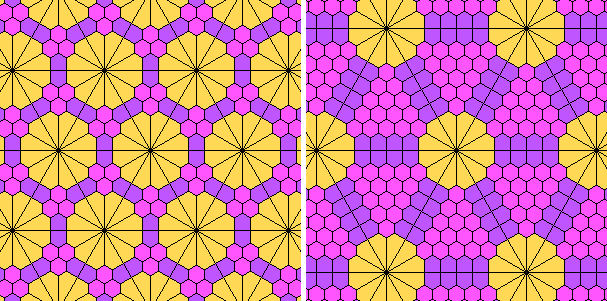 Left: a 3 co-uniform tiling for which poly=8/11, edge≈0.9984, area≈1.1856. Right: a 7 co-uniform tiling for which poly=11/18, edge≈0.75900, area≈1.0005.


Substitution
Substitution in a uniform tiling happens when replacing a cluster of regular polygons with another cluster that occupies the same combined shape. From left to right, up to down:
- Inset rolling — deltoidal hexagons are rotated 90°.
- (Dual of) Alternating between the two p6 configurations of six hexagons and twelve triangles within a hexagon of side length 3.
- Placing clocks in the two possible configurations within parallel chains of deltoidal hexagons.
- (Dual of) Increasing the central hexagonal bubbles within a rhombille web otherwise made of square lengths and triangle corners.
- Semi-fractalization — the planigons EIRFH may correspond to larger regions modified from rhombille web tilings if the number of 4 co-vertices along the web's edges is a multiple of 3.
- Full inset — all clocks are inset by deltoidal hexagons D, then all hexagrams are inset by hexagons H.
- Placing clock(s) in the two possible configurations within chains of three deltoidal hexagons.
- (Dual of) Six hexagons either adjacent to the center dodecagon or the six apothem dodecagons, all within a hexagonal formation of 12 edge-to-edge dodecagons, and filling the rest with squares and triangles.
- A seven clock swath where each clock shares edges or a single vertex with adjacent clocks (e.g. only 3 has the latter property), within a predetermined boundary.

All-Edge Tiling
There are 12 types of edges in a co-uniform tiling, of which 10 exist outside a singular case (i or 4.82). The edges are 3–3, 3–4, 3–6, 3–12, 4–4, 4–6, 4–12, 6–6, 6–12, 12–12.
Only O contains 12–12, only 3 contains 6–12. Since E must be paired with I, it is advantageous to use I only for 6–6. Any tiling with O3I necessarily contains the remaining edges (and S must bridge between O and 3).
A 6–12 adjacent to a 6–6 must be at least 120° away from the 12–12, otherwise the minimal trihexagonal region containing 6–6 will conflict with the two dodecagons. A120° separation admits a 18-uniform tiling with a trihexagonal region and elongated triangular borders (with a 180° separation as well). A 150° separation admits a 23-uniform tiling with two types of trihexagonal bubbles. But a 180° separation admits a 12-uniform tiling c.f. planigon.
| 3 Cases | 12-Uniform | |
|---|---|---|

|

|

|
n-Gonal subset
A 17-11 tiling contains all triangles O3E, a 20-11 tiling contains all quadrilaterals STIRrDs, and a K3 tiling contains all pentagons FCB. Finally, a K7 tiling contains all demiregular planigons.
| Triangle | Quadrilateral | Pentagon | Demiregular |
|---|---|---|---|

|

|

| |
Elongating the hexagonal borders of the triangle tiling yields the quadrilateral tiling (s replacing O), and both are derived from the 22-13 tilings c.f. planigon.[1]
There are infinitely many pentagonal tilings with CB (3².4.3.4, 3³.4²). One subfamily adds any number of 15°-slanted columns of Cairo pentagons between 15°-slanted stacks of Barn pentagons, with a 6-uniform example with wallpaper pg. Since neither FC nor FB can tile alone (nonetheless rFC and FBH are admissible), the remaining family is FCB (3⁴.6, 3².4.3.4, 3³.4²), which in fact has infinite size.[3]
F necessarily occurs in flower-like clusters of 6, surrounded by 6 Cairos and 6 Barns, within an "FCB hexagon" of side length 2+1/√3. There exists a 3, 5, 9, 11, 12-uniform pentagonal tiling with FCB, all with wallpaper p6m, and 8-uniform with p6.[2][1] Connecting the FCB hexagons with edges form triangular tilings of various edge length. Making the 5-uniform and 11-uniform triangular edges perpendicular generates an infinite FCB family isomorphic to the class of EIR tilings (minus its radial subset), where the 5-uniform edge corresponds to the √3 unit edge of E and the 11-uniform edge corresponds to the 2 unit diagonal of R. This can also be applied to the 9-uniform and 12-uniform triangular edges for another infinite family. One example from each is shown below, corresponding to the 2-uniform IR and 4-uniform EIR with wallpaper cmm, respectively:
| 6-Uniform | FCB (18-Uniform) | FCB (82-Uniform) |
|---|---|---|

|
.png)
|
.png)
|
Content Disclaimer
Informasi ini disarikan dari Wikipedia dan disajikan kembali untuk tujuan edukasi. Konten tersedia di bawah lisensi CC BY-SA 3.0. Kami tidak bertanggung jawab atas ketidakakuratan data yang bersumber dari kontribusi publik tersebut.
- The information displayed on this website is sourced in part or in whole from Wikipedia and has been adapted for the purpose of restating it. We strive to provide accurate and relevant information, however:
- There is no guarantee of absolute accuracy. Wikipedia is an open, collaborative project that can be edited by anyone, so information is subject to change.
- It is not intended to constitute professional advice. The content displayed is for informational and educational purposes only. For important decisions (e.g., medical, legal, or financial), please consult a professional.
- Content copyright. Wikipedia is licensed under the Creative Commons Attribution-ShareAlike License (CC BY-SA). This means that content may be reused with appropriate attribution and shared under a similar license.
- Responsible use. Any risk arising from the use of information from this website is entirely the responsibility of the user.