User:Duplico
| This is a Wikipedia user page. This is not an encyclopedia article or the talk page for an encyclopedia article. If you find this page on any site other than Wikipedia, you are viewing a mirror site. Be aware that the page may be outdated and that the user whom this page is about may have no personal affiliation with any site other than Wikipedia. The original page is located at https://en.wikipedia.org/wiki/User:Duplico. |
Me
Hi. I'm an undergraduate in Computer Science and Mathematics at the University of Tulsa in Tulsa, OK. My interests include Information Security, specifically Cryptography; Algorithms; Music, specifically Trumpet and Harmonica; Optimization; Numerical Analysis; and lunch. My work currently is comprised of Technical Writing and research in passive, signature-based protocol identification.
For some reason, my favorite algorithms are Boyer-Moore and Merkle-Hellman, and the latter is probably my favorite Wikipedia page for some reason. I have recently become enamored with Bloom filters.
Some games, computer or otherwise, that I enjoy include Risk, Monopoly, World of Warcraft, Nexus: The Kingdom of the Winds, Dark Ages, QuizQuiz (RIP), Arcanum: Of Steamworks and Magic Obscura, and Neverwinter Nights: Hordes of the Underdark.
To-Do List
Some articles I want to edit:
Lax-Wendroff method
In numerical analysis, the Lax–Wendroff method is a finite-difference method for approximating the solution to hyperbolic partial differential equations. The method is conditionally convergent, with second-order accuracy in both space and time.
Formula
Derivation
Convergence
Consistency
Stability
Suppose one has an equation of the following form:
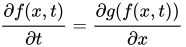
where x and t are independent variables, and the initial state, ƒ(x, 0) is given.
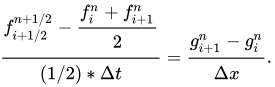
The first step in the Lax–Wendroff method calculates values for ƒ(x, t) at half time steps, tn + 1/2 and half grid points, xi + 1/2. In the second step values at tn + 1 are calculated using the data for tn and tn + 1/2.
First (Lax) step:
Second step:
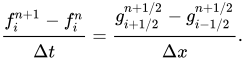
This method can be further applied to some systems of partial differential equations.
References
- P.D Lax (1960). "Systems of conservation laws". Commun. Pure Appl Math. 13 (2): 217–237. doi:10.1002/cpa.3160130205.
{{cite journal}}: Unknown parameter|coauthors=ignored (|author=suggested) (help) - Michael J. Thompson, An Introduction to Astrophysical Fluid Dynamics, Imperial College Press, London, 2006.
Content Disclaimer
Informasi ini disarikan dari Wikipedia dan disajikan kembali untuk tujuan edukasi. Konten tersedia di bawah lisensi CC BY-SA 3.0. Kami tidak bertanggung jawab atas ketidakakuratan data yang bersumber dari kontribusi publik tersebut.
- The information displayed on this website is sourced in part or in whole from Wikipedia and has been adapted for the purpose of restating it. We strive to provide accurate and relevant information, however:
- There is no guarantee of absolute accuracy. Wikipedia is an open, collaborative project that can be edited by anyone, so information is subject to change.
- It is not intended to constitute professional advice. The content displayed is for informational and educational purposes only. For important decisions (e.g., medical, legal, or financial), please consult a professional.
- Content copyright. Wikipedia is licensed under the Creative Commons Attribution-ShareAlike License (CC BY-SA). This means that content may be reused with appropriate attribution and shared under a similar license.
- Responsible use. Any risk arising from the use of information from this website is entirely the responsibility of the user.