User:Dnavarro
| This user is a member of the Association of Inclusionist Wikipedians.
The motto of the AIW is conservata veritate, which translates to "with the preserved truth". |

|
 | This user participates in WikiProject Philosophy. |
Mostly a lurker. An inclusionist, formerly somewhat harsh on notability issues, now trending towards the fence. One day I'll de-lurk properly and create sub-pages on some stylistic stances regarding Wikipedia, sp. math articles. The textbook - dictionary spectrum is a confusing issue, but I believe more in the Scholarpedia model (not the peer-reviewing, the narrative format) than in the mathworld.wolfram.com one.
Sandbox for editing equations from Differential diagnosis =
The probability that a presentation or condition would have occurred in the first place in an individual is not same as the probability that the presentation or condition has occurred in the individual, because the presentation has occurred by 100% certainty in the individual. Yet, the contributive probability fractions of each condition are assumed to be the same, relatively:
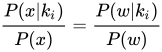
, where:
- P(x|k_i) is the probability that the presentation x is caused by condition i in the individual
- condition without further specification refers to any candidate condition
- P(x) is the probability that the presentation has occurred in the individual, which is 100%
- P(w|ki) is the probability that the presentation Would Have Occurred in the First Place in the Individual by condition i
- P(w) is the unconditional probability that the presentation Would Have Occurred in the First Place in the Individual
etc. etc.

The total probability of the presentation to have occurred in the individual can be approximated as the sum of the individual candidate conditions:

Also, the probability of the presentation to have been caused by any candidate condition is proportional to the probability of the condition, depending on what rate it causes the presentation:

, where:
- P(Presentation WHOIFPI by condition) is the probability that the presentation Would Have Occurred in the First Place in the Individual by condition
- P(Condition WHOIFPI) is the probability that the condition Would Have Occurred in the First Place in the Individual
- rCondition→presentation is the rate for which condition causes the presentation, that is, the fraction of people with condition that manifest with the presentation
The probability that a condition would have occurred in the first place in an individual is approximately equal to that of a population that is as similar to the individual as possible except for the current presentation, compensated where possible by relative risks given by known risk factor that distinguish the individual from the population:

, where:
- P(Condition WHOIFPI) is the probability that the condition Would Have Occurred in the First Place in the Individual
- RRcondition is the relative risk for condition conferred by known risk factors in the individual that are not present in the population
- P(Condition in population) is the probability that the condition occurs in a population that is as similar to the individual as possible except for the presentation
The following table demonstrates how these relations can be made for a series of candidate conditions:
| Candidate condition 1 | Candidate condition 2 | Candidate condition 3 | |
| P(Condition in population) | P(Condition 1 in population) | P(Condition 2 in population) | P(Condition 3 in population) |
| RRcondition | RR 1 | RR 2 | RR 3 |
| P(Condition WHOIFPI) | P(Condition 1 WHOIFPI) | P(Condition 2 WHOIFPI) | P(Condition 3 WHOIFPI) |
| rCondition→presentation | rCondition 1→presentation | rCondition 2→presentation | rCondition 3→presentation |
| P(Presentation WHOIFPI by condition) | P(Presentation WHOIFPI by condition 1) | P(Presentation WHOIFPI by condition 2) | P(Presentation WHOIFPI by condition 3) |
| P(Presentation WHOIFPI) = the sum of the probabilities in row just above | |||
| P(Presentation is caused by condition in individual) | P(Presentation is caused by condition 1 in individual) | P(Presentation is caused by condition 2 in individual) | P(Presentation is caused by condition 3 in individual) |
One additional "candidate condition" is the instance of there being no abnormality, and the presentation is only a (usually relatively unlikely) appearance of a basically normal state. Its probability in the population (P(No abnormality in population)) is complementary to the sum of probabilities of "abnormal" candidate conditions.
Content Disclaimer
Informasi ini disarikan dari Wikipedia dan disajikan kembali untuk tujuan edukasi. Konten tersedia di bawah lisensi CC BY-SA 3.0. Kami tidak bertanggung jawab atas ketidakakuratan data yang bersumber dari kontribusi publik tersebut.
- The information displayed on this website is sourced in part or in whole from Wikipedia and has been adapted for the purpose of restating it. We strive to provide accurate and relevant information, however:
- There is no guarantee of absolute accuracy. Wikipedia is an open, collaborative project that can be edited by anyone, so information is subject to change.
- It is not intended to constitute professional advice. The content displayed is for informational and educational purposes only. For important decisions (e.g., medical, legal, or financial), please consult a professional.
- Content copyright. Wikipedia is licensed under the Creative Commons Attribution-ShareAlike License (CC BY-SA). This means that content may be reused with appropriate attribution and shared under a similar license.
- Responsible use. Any risk arising from the use of information from this website is entirely the responsibility of the user.