Heisenberg uncertainty derivation explanation
Subtracting eqn.(32) from (31), we get

Therefore, Error in the measurement of the particle:
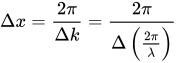
Now, based on deBroglie’s matter wave description, we can define a relatonship between the wavenumber [k] and the momentum [p] of the matter wave-particle:

Thus frome the above we have:
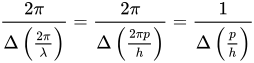
and because 'h' is a constant, we have:
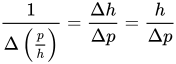
So now we have:

Note that this is true only if the probability distribution is normal. If it isn't  will be greater, as the normal distribution turns out to have the minimum possible product. This means that we can write our more general physical law as:
![{\displaystyle \Delta x.\Delta p\geq \hbar \left[={\frac {h}{2\pi }}\right]}](https://wikimedia.org/api/rest_v1/media/math/render/svg/8a551a4a8b9b6c2d698359e167350414abc8c4e7)
References:
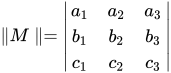
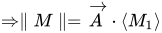
Proof of Determinant to Dot and Cross Product








Special Functions
Complete Fermi Dirac Integrals

Incomplete Fermi Dirac Integrals

Airy Functions and Derivatives


Clausen Functions

Normalized Hydrogenic Bound States

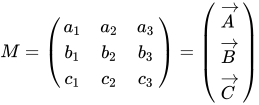
Where:







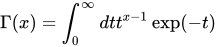
Gamma Functions
Psi (Digamma) Function

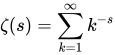
Riemann Zeta Function
Hurwitz Zeta Function
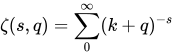
Eta Function

Transport Functions

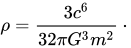
Schwarzschild Radius Mass-Density relation
MISC
Lagrangian
The equations of motion are obtained by means of an action principle, written as:

where the action,  , is a functional of the dependent variables
  with their derivatives and s itself
![{\displaystyle {\mathcal {S}}\left[\varphi _{i},{\frac {\partial \varphi _{i}}{\partial s}}\right]=\int {{\mathcal {L}}\left[\varphi _{i}[s],{\frac {\partial \varphi _{i}[s]}{\partial s^{\alpha }}},s^{\alpha }\right]\,\mathrm {d} ^{n}s}}](https://wikimedia.org/api/rest_v1/media/math/render/svg/806a1eaffde21583990421a02e7defb6db63f27f)
and where  denotes the set of n independent variables of the system, indexed by
The equations of motion obtained from this functional derivative are the Euler–Lagrange equations of this action. For example, in the classical mechanics of particles, the only independent variable is time, t. So the Euler-Lagrange equations are

Dynamical systems whose equations of motion are obtainable by means of an action principle on a suitably chosen Lagrangian are known as Lagrangian dynamical systems. Examples of Lagrangian dynamical systems range from the classical version of the Standard Model, to Newton's equations, to purely mathematical problems such as geodesic equations and Plateau's problem.
Deriving Hamilton's equations
We can derive Hamilton's equations by looking at how the Lagrangian changes as you change the time and the positions and velocities of particles

Now the generalized momenta were defined as  and Lagrange's equations tell us that
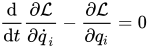
We can rearrange this to get

and substitute the result into the variation of the Lagrangian
![{\displaystyle \mathrm {d} {\mathcal {L}}=\sum _{i}\left[{\dot {p}}_{i}\mathrm {d} q_{i}+p_{i}\mathrm {d} {{\dot {q}}_{i}}\right]+{\frac {\partial {\mathcal {L}}}{\partial t}}\mathrm {d} t\,.}](https://wikimedia.org/api/rest_v1/media/math/render/svg/194566eb087e1d2f7ed3526a3bd44d0967efbe9d)
We can rewrite this as
![{\displaystyle \mathrm {d} {\mathcal {L}}=\sum _{i}\left[{\dot {p}}_{i}\mathrm {d} q_{i}+\mathrm {d} \left(p_{i}{{\dot {q}}_{i}}\right)-{{\dot {q}}_{i}}\mathrm {d} p_{i}\right]+{\frac {\partial {\mathcal {L}}}{\partial t}}\mathrm {d} t\,}](https://wikimedia.org/api/rest_v1/media/math/render/svg/5e19bc2f16249ec16bc74f9f5d94538767fbc8e7)
and rearrange again to get
![{\displaystyle \mathrm {d} \left(\sum _{i}p_{i}{{\dot {q}}_{i}}-{\mathcal {L}}\right)=\sum _{i}\left[-{\dot {p}}_{i}\mathrm {d} q_{i}+{{\dot {q}}_{i}}\mathrm {d} p_{i}\right]-{\frac {\partial {\mathcal {L}}}{\partial t}}\mathrm {d} t\,.}](https://wikimedia.org/api/rest_v1/media/math/render/svg/93f2b0171189d586fe57af770e5aae225330b783)
The term on the left-hand side is just the Hamiltonian that we have defined before, so we find that
![{\displaystyle \mathrm {d} {\mathcal {H}}=\sum _{i}\left[-{\dot {p}}_{i}\mathrm {d} q_{i}+{{\dot {q}}_{i}}\mathrm {d} p_{i}\right]-{\frac {\partial {\mathcal {L}}}{\partial t}}\mathrm {d} t=\sum _{i}\left[{\frac {\partial {\mathcal {H}}}{\partial q_{i}}}\mathrm {d} q_{i}+{\frac {\partial {\mathcal {H}}}{\partial p_{i}}}\mathrm {d} p_{i}\right]+{\frac {\partial {\mathcal {H}}}{\partial t}}\mathrm {d} t\,}](https://wikimedia.org/api/rest_v1/media/math/render/svg/000eb11ca7c23768362b9382bfcf5877db52d797)
where the second equality holds because of the definition of the partial derivatives. Associating terms from both sides of the equation above yields Hamilton's equations

Covariant Derivative
A covariant derivative is a (Koszul) connection on the tangent bundle and other tensor bundles. Thus it has a certain behavior on functions, on vector fields, on the duals of vector fields (i.e., covector fields), and most generally of all, on arbitrary tensor fields.
Functions
Given a function  , the covariant derivative
  coincides with the normal differentiation of a real function in the direction of the vector v, usually denoted by
  and by
  .
.
Vector fields
A covariant derivative  of a vector field
  in the direction of the vector
  denoted
  is defined by the following properties for any vector v, vector fields u, w and scalar functions f and g:
- is algebraically linear in so

- is additive in so

- obeys the product rule, i.e.
 where is defined above.
Note that at point p depends on the value of v at p and on values of u in a neighbourhood of p because of the last property, the product rule.
Covector fields
Given a field of covectors (or one-form)  , its covariant derivative
  can be defined using the following identity which is satisfied for all vector fields u

The covariant derivative of a covector field along a vector field v is again a covector field.
Tensor fields
Once the covariant derivative is defined for fields of vectors and covectors it can be defined for arbitrary tensor fields using the following identities where  and
and  are any two tensors:

and if and  are tensor fields of the same tensor bundle then

The covariant derivative of a tensor field along a vector field v is again a tensor field of the same type.
Christoffel symbols
The Christoffel symbols can be derived from the vanishing of the covariant derivative of the metric tensor  :
:

As a shorthand notation, the nabla symbol and the partial derivative symbols are frequently dropped, and instead a semi-colon and a comma are used to set off the index that is being used for the derivative. Thus, the above is sometimes written as

By permuting the indices, and resumming, one can solve explicitly for the Christoffel symbols as a function of the metric tensor:

where the matrix  is an inverse of the matrix
  , defined as (using the Kronecker delta, and Einstein notation for summation)
 .
Although the Christoffel symbols are written in the same notation as tensors with index notation, they are not tensors.
Indeed, they do not transform like tensors under a change of coordinates; see below.
.
Although the Christoffel symbols are written in the same notation as tensors with index notation, they are not tensors.
Indeed, they do not transform like tensors under a change of coordinates; see below.
NB. Note that most authors choose to define the Christoffel symbols in a holonomic basis, which is the convention followed here. In an anholonomic basis, the Christoffel symbols take the more complex form

where  are the commutation coefficients of the basis; that is,
![{\displaystyle [e_{k},e_{\ell }]=c_{k\ell }{}^{m}e_{m}\,\ }](https://wikimedia.org/api/rest_v1/media/math/render/svg/9c86ad296025edcd66c4ed938f5775caceb9c76a)
where ek are the basis vectors and ![{\displaystyle [,]\ }](https://wikimedia.org/api/rest_v1/media/math/render/svg/b0630a8c5bbd44987808585a22c7741385117041) is the Lie bracket. An example of an anholonomic basis with non-vanishing commutation coefficients are the unit vectors in spherical and cylindrical coordinates.
is the Lie bracket. An example of an anholonomic basis with non-vanishing commutation coefficients are the unit vectors in spherical and cylindrical coordinates.
The expressions below are valid only in a holonomic basis, unless otherwise noted.
-- 
-- ακαηκςh ναςhιςτh
Akanksh Vashisth