Universal embedding theorem
The universal embedding theorem, or Krasner–Kaloujnine universal embedding theorem, is a theorem from the mathematical discipline of group theory first published in 1951 by Marc Krasner and Lev Kaluznin.[1] The theorem states that any group extension of a group H by a group A is isomorphic to a subgroup of the regular wreath product A Wr H. The theorem is named for the fact that the group A Wr H is said to be universal with respect to all extensions of H by A.
Statement
Let H and A be groups, let K = AH be the set of all functions from H to A, and consider the action of H on itself by multiplication. This action extends naturally to an action of H on K, defined as where and g and h are both in H. This is an automorphism of K, so we can construct the semidirect product K ⋊ H, which is termed the regular wreath product, and denoted A Wr H or The group K = AH (which is isomorphic to ) is called the base group of the wreath product.


The Krasner–Kaloujnine universal embedding theorem states that if G has a normal subgroup A and H = G/A, then there is an injective homomorphism of groups such that A maps surjectively onto [2] This is equivalent to the wreath product A Wr H having a subgroup isomorphic to G, where G is any extension of H by A.


Proof
This proof comes from Dixon–Mortimer.[3]
Define a homomorphism whose kernel is A. Choose a set of (right) coset representatives of A in G, where Then for all x in G, For each x in G, we define a function such that Then the embedding is given by





We now prove that this is a homomorphism. If x and y are in G, then Now so for all u in H,


so fx fy = fxy. Hence is a homomorphism as required.
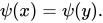
The homomorphism is injective. If then both fx(u) = fy(u) (for all u) and Then but we can cancel and from both sides, so x = y, hence is injective. Finally, precisely when in other words when (as ).



Generalizations and related results
- The Krohn–Rhodes theorem is a statement similar to the universal embedding theorem, but for semigroups. A semigroup S is a divisor of a semigroup T if it is the image of a subsemigroup of T under a homomorphism. The theorem states that every finite semigroup S is a divisor of a finite alternating wreath product of finite simple groups (each of which is a divisor of S) and finite aperiodic semigroups.
- An alternate version of the theorem exists which requires only a group G and a subgroup A (not necessarily normal).[4] In this case, G is isomorphic to a subgroup of the regular wreath product A Wr (G/Core(A)).
References
- ^ Kaloujnine & Krasner (1951a).
- ^ Dixon & Mortimer (1996, p. 47).
- ^ Dixon & Mortimer (1996, pp. 47–48).
- ^ Kaloujnine & Krasner (1951b).
Bibliography
- Dixon, John; Mortimer, Brian (1996). Permutation Groups. Springer. ISBN 978-0387945996.
- Kaloujnine, Lev; Krasner, Marc (1951a). "Produit complet des groupes de permutations et le problème d'extension de groupes II". Acta Sci. Math. Szeged. 14: 39–66. Archived from the original on 2024-11-19. Retrieved 2019-07-07.
- Kaloujnine, Lev; Krasner, Marc (1951b). "Produit complet des groupes de permutations et le problème d'extension de groupes III". Acta Sci. Math. Szeged. 14: 69–82.
- Praeger, Cheryl; Schneider, Csaba (2018). Permutation groups and Cartesian Decompositions. Cambridge University Press. ISBN 978-0521675062.
Content Disclaimer
Informasi ini disarikan dari Wikipedia dan disajikan kembali untuk tujuan edukasi. Konten tersedia di bawah lisensi CC BY-SA 3.0. Kami tidak bertanggung jawab atas ketidakakuratan data yang bersumber dari kontribusi publik tersebut.
- The information displayed on this website is sourced in part or in whole from Wikipedia and has been adapted for the purpose of restating it. We strive to provide accurate and relevant information, however:
- There is no guarantee of absolute accuracy. Wikipedia is an open, collaborative project that can be edited by anyone, so information is subject to change.
- It is not intended to constitute professional advice. The content displayed is for informational and educational purposes only. For important decisions (e.g., medical, legal, or financial), please consult a professional.
- Content copyright. Wikipedia is licensed under the Creative Commons Attribution-ShareAlike License (CC BY-SA). This means that content may be reused with appropriate attribution and shared under a similar license.
- Responsible use. Any risk arising from the use of information from this website is entirely the responsibility of the user.