Unit demand
In economics, a unit demand agent is an agent who wants to buy a single item, which may be of one of different types. A typical example is a buyer who needs a new car. There are many different types of cars, but usually a buyer will choose only one of them, based on the quality and the price.
If there are m different item-types, then a unit-demand valuation function is typically represented by m values , with representing the subjective value that the agent derives from item . If the agent receives a set of items, then his total utility is given by:


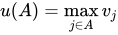
since he enjoys the most valuable item from and ignores the rest.
Therefore, if the price of item is , then a unit-demand buyer will typically want to buy a single item – the item for which the net utility is maximized.


Ordinal and cardinal definitions
A unit-demand valuation is formally defined by:
- For a preference relation: for every set there is a subset with cardinality , such that .
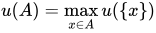
- For a utility function: For every set :[1]


Connection to other classes of utility functions
A unit-demand function is an extreme case of a submodular set function.
It is characteristic of items that are pure substitute goods.
See also
References
- ^ Koopmans, T. C.; Beckmann, M. (1957). "Assignment Problems and the Location of Economic Activities" (PDF). Econometrica. 25 (1): 53–76. doi:10.2307/1907742. JSTOR 1907742.
Content Disclaimer
Informasi ini disarikan dari Wikipedia dan disajikan kembali untuk tujuan edukasi. Konten tersedia di bawah lisensi CC BY-SA 3.0. Kami tidak bertanggung jawab atas ketidakakuratan data yang bersumber dari kontribusi publik tersebut.
- The information displayed on this website is sourced in part or in whole from Wikipedia and has been adapted for the purpose of restating it. We strive to provide accurate and relevant information, however:
- There is no guarantee of absolute accuracy. Wikipedia is an open, collaborative project that can be edited by anyone, so information is subject to change.
- It is not intended to constitute professional advice. The content displayed is for informational and educational purposes only. For important decisions (e.g., medical, legal, or financial), please consult a professional.
- Content copyright. Wikipedia is licensed under the Creative Commons Attribution-ShareAlike License (CC BY-SA). This means that content may be reused with appropriate attribution and shared under a similar license.
- Responsible use. Any risk arising from the use of information from this website is entirely the responsibility of the user.