Underprint

An underprint is anything printed underneath the main design of a stamp, banknote or similar item. Underprinting is used as a security measure to prevent forgery, or the cleaning of a postmark from a used stamp.[1] The most common form of underprinting is burelage which takes the form of a faint pattern of lines or dots. Underprinting may also take the form of single or repeating words, for instance the word CUSTOMS at one time appeared underprinted on British revenue stamps.[2]
Printing on the back
The term has also been used in philately to refer to advertising or other wording printed on the back of postage stamps.[3] However, this is thought to be an incorrect[4] use of the term, with the word backprint being seen as more correct.[5]
Gallery
-
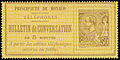 This telephone stamp of Monaco includes the underprinted repeating words POSTESETTTELEGRAPHSTELEPHONES.
 -
 A yellow repeating burelage underprint may be seen on this 1912 revenue stamp of Turkey.
 -
 British embossed revenue stamps underprinted CUSTOMS


See also

References

- ^ Mackay, James. Stamp Collecting: Philatelic Terms Illustrated. 4th edition. London: Stanley Gibbons, 2003, p. 161. ISBN 0852595573
- ^ Barefoot, John., ed. Great Britain Revenues. 4th edition. York: J. Barefoot Ltd., 2002, pp. 39-41. ISBN 0906845629
- ^ Protective Overprints and Underprints. Andy Donaldson, 2000-2013. Retrieved 27 June 2013. Archived here
- ^ Patrick, Douglas & Mary. The Hodder Stamp Dictionary. London: Hodder & Stoughton, 1973, p. 254. ISBN 0340171839
- ^ Sutton, R.J. & K.W. Anthony. The Stamp Collector's Encyclopaedia. 6th edition. London: Stanley Paul, 1966, p. 318.
 | This philatelic article is a stub. You can help Wikipedia by adding missing information. |
 | This money or currency-related article is a stub. You can help Wikipedia by adding missing information. |
Content Disclaimer
Informasi ini disarikan dari Wikipedia dan disajikan kembali untuk tujuan edukasi. Konten tersedia di bawah lisensi CC BY-SA 3.0. Kami tidak bertanggung jawab atas ketidakakuratan data yang bersumber dari kontribusi publik tersebut.
- The information displayed on this website is sourced in part or in whole from Wikipedia and has been adapted for the purpose of restating it. We strive to provide accurate and relevant information, however:
- There is no guarantee of absolute accuracy. Wikipedia is an open, collaborative project that can be edited by anyone, so information is subject to change.
- It is not intended to constitute professional advice. The content displayed is for informational and educational purposes only. For important decisions (e.g., medical, legal, or financial), please consult a professional.
- Content copyright. Wikipedia is licensed under the Creative Commons Attribution-ShareAlike License (CC BY-SA). This means that content may be reused with appropriate attribution and shared under a similar license.
- Responsible use. Any risk arising from the use of information from this website is entirely the responsibility of the user.