Two-vector
A two-vector or bivector[1] is a tensor of type and it is the dual of a two-form, meaning that it is a linear functional which maps two-forms to the real numbers (or more generally, to scalars).

The tensor product of a pair of vectors is a two-vector. Then, any two-form can be expressed as a linear combination of tensor products of pairs of vectors, especially a linear combination of tensor products of pairs of basis vectors. If f is a two-vector, then[2]
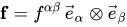
where the f α β are the components of the two-vector. Notice that both indices of the components are contravariant. This is always the case for two-vectors, by definition. A bivector may operate on a one-form, yielding a vector:
- ,

although a problem might be which of the upper indices of the bivector to contract with. (This problem does not arise with mixed tensors because only one of such tensor's indices is upper.) However, if the bivector is symmetric then the choice of index to contract with is indifferent.
An example of a bivector is the stress–energy tensor. Another one is the orthogonal complement[3] of the metric tensor.
Matrix notation
If one assumes that vectors may only be represented as column matrices and covectors as row matrices; then, since a square matrix operating on a column vector must yield a column vector, it follows that square matrices can only represent mixed tensors. However, there is nothing in the abstract algebraic definition of a matrix that says that such assumptions must be made. Then dropping that assumption matrices can be used to represent bivectors as well as two-forms. Example:

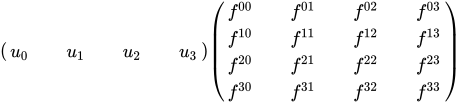

or .


If f is symmetric, i.e., , then .


See also
- Two-point tensor
- Bivector § Tensors and matrices (but note that the stress–energy tensor is symmetric, not skew-symmetric)
- Dyadics
References
- ^ Penrose, Roger (2004). The road to reality : a complete guide to the laws of the universe. New York: Random House, Inc. pp. 443–444. ISBN 978-0-679-77631-4. Note: This book mentions "bivectors" (but not "two-vectors") in the sense of tensors.
- ^ Schutz, Bernard (1985). A first course in general relativity. Cambridge, UK: Cambridge University Press. p. 77. ISBN 0-521-27703-5. Note: This book does not appear to mention "two-vectors" or "bivectors", only tensors.
- ^ Penrose, op. cit., §18.3
Content Disclaimer
Informasi ini disarikan dari Wikipedia dan disajikan kembali untuk tujuan edukasi. Konten tersedia di bawah lisensi CC BY-SA 3.0. Kami tidak bertanggung jawab atas ketidakakuratan data yang bersumber dari kontribusi publik tersebut.
- The information displayed on this website is sourced in part or in whole from Wikipedia and has been adapted for the purpose of restating it. We strive to provide accurate and relevant information, however:
- There is no guarantee of absolute accuracy. Wikipedia is an open, collaborative project that can be edited by anyone, so information is subject to change.
- It is not intended to constitute professional advice. The content displayed is for informational and educational purposes only. For important decisions (e.g., medical, legal, or financial), please consult a professional.
- Content copyright. Wikipedia is licensed under the Creative Commons Attribution-ShareAlike License (CC BY-SA). This means that content may be reused with appropriate attribution and shared under a similar license.
- Responsible use. Any risk arising from the use of information from this website is entirely the responsibility of the user.