Trigonometric functions of matrices
The trigonometric functions (especially sine and cosine) for complex square matrices occur in solutions of second-order systems of differential equations.[1] They are defined by the same Taylor series that hold for the trigonometric functions of complex numbers:[2]
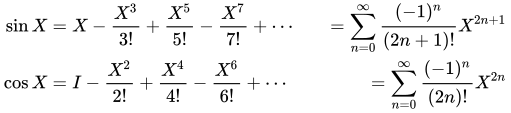
with Xn being the nth power of the matrix X, and I being the identity matrix of appropriate dimensions.
Equivalently, they can be defined using the matrix exponential along with the matrix equivalent of Euler's formula, eiX = cos X + i sin X, yielding
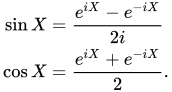
For example, taking X to be a standard Pauli matrix,
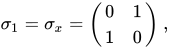
one has

as well as, for the cardinal sine function,

Properties
The analog of the Pythagorean trigonometric identity holds:[2]

If X is a diagonal matrix, sin X and cos X are also diagonal matrices with (sin X)nn = sin(Xnn) and (cos X)nn = cos(Xnn), that is, they can be calculated by simply taking the sines or cosines of the matrices's diagonal components.
The analogs of the trigonometric addition formulas are true if and only if XY = YX:[2]

Other functions
The tangent, as well as inverse trigonometric functions, hyperbolic and inverse hyperbolic functions have also been defined for matrices:[3]

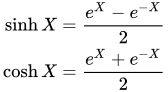
and so on.
References
- ^ Gareth I. Hargreaves; Nicholas J. Higham (2005). "Efficient Algorithms for the Matrix Cosine and Sine" (PDF). Numerical Analysis Report. 40 (461). Manchester Centre for Computational Mathematics: 383. Bibcode:2005NuAlg..40..383H. doi:10.1007/s11075-005-8141-0. S2CID 1242875.
- ^ a b c Nicholas J. Higham (2008). Functions of matrices: theory and computation. pp. 287f. ISBN 978-0-89871-777-8.
- ^ Scilab trigonometry.
Content Disclaimer
Informasi ini disarikan dari Wikipedia dan disajikan kembali untuk tujuan edukasi. Konten tersedia di bawah lisensi CC BY-SA 3.0. Kami tidak bertanggung jawab atas ketidakakuratan data yang bersumber dari kontribusi publik tersebut.
- The information displayed on this website is sourced in part or in whole from Wikipedia and has been adapted for the purpose of restating it. We strive to provide accurate and relevant information, however:
- There is no guarantee of absolute accuracy. Wikipedia is an open, collaborative project that can be edited by anyone, so information is subject to change.
- It is not intended to constitute professional advice. The content displayed is for informational and educational purposes only. For important decisions (e.g., medical, legal, or financial), please consult a professional.
- Content copyright. Wikipedia is licensed under the Creative Commons Attribution-ShareAlike License (CC BY-SA). This means that content may be reused with appropriate attribution and shared under a similar license.
- Responsible use. Any risk arising from the use of information from this website is entirely the responsibility of the user.