Triangular function

A triangular function (also known as a triangle function, hat function, or tent function) is a function whose graph takes the shape of a triangle. Often this is an isosceles triangle of height 1 and base 2 in which case it is referred to as the triangular function. Triangular functions are useful in signal processing and communication systems engineering as representations of idealized signals, and the triangular function specifically as an integral transform kernel function from which more realistic signals can be derived, for example in kernel density estimation. It also has applications in pulse-code modulation as a pulse shape for transmitting digital signals and as a matched filter for receiving the signals. It is also used to define the triangular window sometimes called the Bartlett window.
Definitions
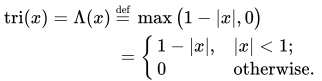
The most common definition is as a piecewise function:
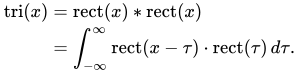
Equivalently, it may be defined as the convolution of two identical unit rectangular functions:
The triangular function can also be represented as the product of the rectangular and absolute value functions:


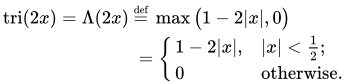
Note that some authors instead define the triangle function to have a base of width 1 instead of width 2:
In its most general form a triangular function is any linear B-spline:[1]

Whereas the definition at the top is a special case
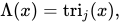
where , , and .


A linear B-spline is the same as a continuous piecewise linear function , and this general triangle function is useful to formally define as

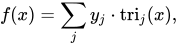
where for all integer . The piecewise linear function passes through every point expressed as coordinates with ordered pair , that is,


Scaling
For any parameter :

![{\displaystyle {\begin{aligned}\operatorname {tri} \left({\tfrac {t}{a}}\right)&={\tfrac {1}{\sqrt {a}}}\operatorname {rect} \left({\tfrac {t}{a}}\right)*{\tfrac {1}{\sqrt {a}}}\operatorname {rect} \left({\tfrac {t}{a}}\right)\\[1ex]&=\int _{-\infty }^{\infty }{\tfrac {1}{|a|}}\operatorname {rect} \left({\tfrac {\tau }{a}}\right)\cdot \operatorname {rect} \left({\tfrac {t-\tau }{a}}\right)\,d\tau \\&={\begin{cases}1-|t/a|,&|t|<|a|;\\0&{\text{otherwise}}.\end{cases}}\end{aligned}}}](https://wikimedia.org/api/rest_v1/media/math/render/svg/5479a6a8d00379fed37222b3149ee0066e16ae0b)
Fourier transform
The transform is easily determined using the convolution property of Fourier transforms and the Fourier transform of the rectangular function:
where is the normalized sinc function.
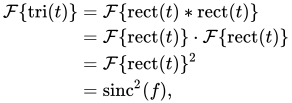

For the general form, we have:

See also
- Källén function, also known as triangle function
- Tent map
- Triangular distribution
- Triangle wave, a piecewise linear periodic function
- Trigonometric functions
References
Content Disclaimer
Informasi ini disarikan dari Wikipedia dan disajikan kembali untuk tujuan edukasi. Konten tersedia di bawah lisensi CC BY-SA 3.0. Kami tidak bertanggung jawab atas ketidakakuratan data yang bersumber dari kontribusi publik tersebut.
- The information displayed on this website is sourced in part or in whole from Wikipedia and has been adapted for the purpose of restating it. We strive to provide accurate and relevant information, however:
- There is no guarantee of absolute accuracy. Wikipedia is an open, collaborative project that can be edited by anyone, so information is subject to change.
- It is not intended to constitute professional advice. The content displayed is for informational and educational purposes only. For important decisions (e.g., medical, legal, or financial), please consult a professional.
- Content copyright. Wikipedia is licensed under the Creative Commons Attribution-ShareAlike License (CC BY-SA). This means that content may be reused with appropriate attribution and shared under a similar license.
- Responsible use. Any risk arising from the use of information from this website is entirely the responsibility of the user.