Transvectant
 | This article includes a list of references, related reading, or external links, but its sources remain unclear because it lacks inline citations. (May 2017) |
In mathematical invariant theory, a transvectant is an invariant formed from n invariants in n variables using Cayley's Ω process.
Definition
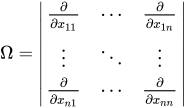
If Q1,...,Qn are functions of n variables x = (x1,...,xn) and r ≥ 0 is an integer then the rth transvectant of these functions is a function of n variables given bywhereis Cayley's Ω process, and the tensor product means take a product of functions with different variables x1,..., xn, and the trace operator Tr means setting all the vectors xk equal.

Examples
The zeroth transvectant is the product of the n functions.The first transvectant is the Jacobian determinant of the n functions.The second transvectant is a constant times the completely polarized form of the Hessian of the n functions.


When , the binary transvectants have an explicit formula:[1]which can be more succinctly written aswhere the arrows denote the function to be taken the derivative of. This notation is used in Moyal product.



Applications
First Fundamental Theorem of Invariant Theory ([2])—All polynomial covariants and invariants of any system of binary forms can be expressed as linear combinations of iterated transvectants.
References
- ^ Olver 1999, p. 88.
- ^ Olver 1999, p. 90.
- Olver, Peter J. (1999), Classical invariant theory, Cambridge University Press, ISBN 978-0-521-55821-1
- Olver, Peter J.; Sanders, Jan A. (2000), "Transvectants, modular forms, and the Heisenberg algebra", Advances in Applied Mathematics, 25 (3): 252–283, CiteSeerX 10.1.1.46.803, doi:10.1006/aama.2000.0700, ISSN 0196-8858, MR 1783553
Content Disclaimer
Informasi ini disarikan dari Wikipedia dan disajikan kembali untuk tujuan edukasi. Konten tersedia di bawah lisensi CC BY-SA 3.0. Kami tidak bertanggung jawab atas ketidakakuratan data yang bersumber dari kontribusi publik tersebut.
- The information displayed on this website is sourced in part or in whole from Wikipedia and has been adapted for the purpose of restating it. We strive to provide accurate and relevant information, however:
- There is no guarantee of absolute accuracy. Wikipedia is an open, collaborative project that can be edited by anyone, so information is subject to change.
- It is not intended to constitute professional advice. The content displayed is for informational and educational purposes only. For important decisions (e.g., medical, legal, or financial), please consult a professional.
- Content copyright. Wikipedia is licensed under the Creative Commons Attribution-ShareAlike License (CC BY-SA). This means that content may be reused with appropriate attribution and shared under a similar license.
- Responsible use. Any risk arising from the use of information from this website is entirely the responsibility of the user.