Transitus Fluvii
| Transitus Fluvii | |
|---|---|
 | |
| Script type | Alphabet
|
| Creator | Heinrich Cornelius Agrippa |
Period | 16th century |
| Languages | Derived from Hebrew |
| Related scripts | |
Parent systems | Hebrew
|
Sister systems | Celestial, Malachim |

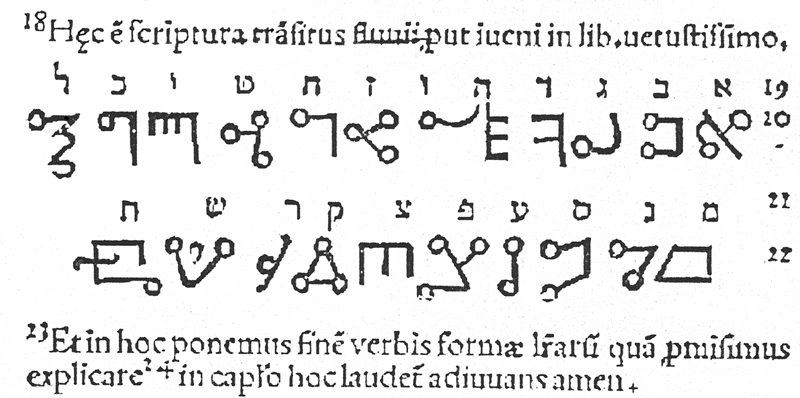
Transitus Fluvii ("passing through the river" in Latin) or Passage Du Fleuve (in French) is an occult alphabet consisting of 22 characters described by Heinrich Cornelius Agrippa in his Third Book of Occult Philosophy (Cologne, 1533, but written around 1510). It is derived from the Hebrew alphabet[1] and is similar to the Celestial and Malachim alphabets. The name may refer to the crossing of the Euphrates by the Jews on their return from the Babylonian captivity to rebuild the Temple in Jerusalem.[2]
This alphabet can also be found in Abraham de Balmis Peculium Abrae. Grammatica hebraea una cum latino, Venetiis, 1523, sig. B6v. as well as in Geoffroy Tory, Champ Fleury, Paris 1529, f. 76v ubi tamen: "Lettres Chaldaiques", and Giovanni Agostino Panteo's (Pantheus) Voarchadumia contra alchimiam, Venice, 1530, pp. 545–46.[3] Pantheus claims that, while the Hebrew alphabet was entrusted to Moses and Enochian to Enoch, the Transitus Fluvii was entrusted to Abraham.[4]
Appearances in popular culture
The alphabet is depicted in the movie The Blair Witch Project. It is also referenced in the book An Enemy at Green Knowe, part of the Green Knowe series by British author Lucy Boston.
References
- ^ Gettings, Fred. Dictionary of Occult, Hermetic and Alchemical Sigils. London; Boston: Routledge & Kegan Paul, 1981. ISBN 0-7100-0095-2.
- ^ Haywood, H. L.; Mackey, Albert Gallatin. Encyclopedia of Freemasonry Part 1 (1909). Kessinger Publishing, 2003. ISBN 0-7661-4719-3
- ^ V. Perrone Compagni, Cornelius Agrippa De occulta philosophia Libri tres, Leiden: E.J. Brill, 1992, p. 491. ISBN 978-90-04-09421-5.
- ^ Joannes Pantheus, Voarchadumia contra alchimiam, ars distincta ab archimia et sophia, cum additionibus, proportinonibus numeris et figuris opportuni. n.d. [1] Gallica – Bibliothèque nationale de France. 1550.
External links
- Heinrich Cornelius Agrippa's "De Occulta Philosophia" at Wikisource
- Pantheus Voarchadumia contra alchimiam at Gallica
- Passing the River alphabet at Omniglot
- Agrippa, Occult Philosophy Book 3 at esotericarchives
- Peculium Abrae at esotericarchives
 | This writing system–related article is a stub. You can help Wikipedia by adding missing information. |
.jpg) | This occult-related article is a stub. You can help Wikipedia by adding missing information. |
Content Disclaimer
Informasi ini disarikan dari Wikipedia dan disajikan kembali untuk tujuan edukasi. Konten tersedia di bawah lisensi CC BY-SA 3.0. Kami tidak bertanggung jawab atas ketidakakuratan data yang bersumber dari kontribusi publik tersebut.
- The information displayed on this website is sourced in part or in whole from Wikipedia and has been adapted for the purpose of restating it. We strive to provide accurate and relevant information, however:
- There is no guarantee of absolute accuracy. Wikipedia is an open, collaborative project that can be edited by anyone, so information is subject to change.
- It is not intended to constitute professional advice. The content displayed is for informational and educational purposes only. For important decisions (e.g., medical, legal, or financial), please consult a professional.
- Content copyright. Wikipedia is licensed under the Creative Commons Attribution-ShareAlike License (CC BY-SA). This means that content may be reused with appropriate attribution and shared under a similar license.
- Responsible use. Any risk arising from the use of information from this website is entirely the responsibility of the user.