Transition kernel
In the mathematics of probability, a transition kernel or kernel is a function in mathematics that has different applications. Kernels can for example be used to define random measures or stochastic processes. The most important example of kernels are the Markov kernels.
Definition
Let , be two measurable spaces. A function


![{\displaystyle \kappa \colon S\times {\mathcal {T}}\to [0,+\infty ]}](https://wikimedia.org/api/rest_v1/media/math/render/svg/f2f6d48846ae254d72ea28a3cab412fc1cdc64ad)
is called a (transition) kernel from to if the following two conditions hold:[1]


- For any fixed , the mapping

- is -measurable;

![{\displaystyle {\mathcal {S}}/{\mathcal {B}}([0,+\infty ])}](https://wikimedia.org/api/rest_v1/media/math/render/svg/7444a2cbc5b5dbf170b17c7f68a135c00252c75e)
- For every fixed , the mapping

- is a measure on .

Classification of transition kernels
Transition kernels are usually classified by the measures they define. Those measures are defined as
![{\displaystyle \kappa _{s}\colon {\mathcal {T}}\to [0,+\infty ]}](https://wikimedia.org/api/rest_v1/media/math/render/svg/f2c9e70c6ccefbfe3b000ff697c3b6ed37bd8705)
with

for all and all . With this notation, the kernel is called[1][2]

- a substochastic kernel, sub-probability kernel or a sub-Markov kernel if all are sub-probability measures
- a Markov kernel, stochastic kernel or probability kernel if all are probability measures
- a finite kernel if all are finite measures
- a -finite kernel if all are -finite measures
- a -finite kernel if can be written as a countable sum of finite kernels (so that in particular, all are -finite measures).
- a uniformly -finite kernel if there are at most countably many measurable sets in with for all and all .


Operations
In this section, let , and be measurable spaces and denote the product σ-algebra of and with


Product of kernels
Definition
Let be a s-finite kernel from to and be a s-finite kernel from to . Then the product of the two kernels is defined as[3][4]


![{\displaystyle \kappa ^{1}\otimes \kappa ^{2}\colon S\times ({\mathcal {T}}\otimes {\mathcal {U}})\to [0,\infty ]}](https://wikimedia.org/api/rest_v1/media/math/render/svg/51d3de728ea12c25432c0e4ecd06b73a4159d6a5)

for all .

Properties and comments
The product of two kernels is a kernel from to . It is again a s-finite kernel and is a -finite kernel if and are -finite kernels. The product of kernels is also associative, meaning it satisfies


for any three suitable s-finite kernels .

The product is also well-defined if is a kernel from to . In this case, it is treated like a kernel from to that is independent of . This is equivalent to setting


Composition of kernels
Definition
Let be a s-finite kernel from to and a s-finite kernel from to . Then the composition of the two kernels is defined as[5][3]

![{\displaystyle \kappa ^{1}\cdot \kappa ^{2}\colon S\times {\mathcal {U}}\to [0,\infty ]}](https://wikimedia.org/api/rest_v1/media/math/render/svg/e3103d9518c0ece3de6fbf016f6972d5d2b984dd)

for all and all .

Properties and comments
The composition is a kernel from to that is again s-finite. The composition of kernels is associative, meaning it satisfies

for any three suitable s-finite kernels . Just like the product of kernels, the composition is also well-defined if is a kernel from to .
An alternative notation is for the composition is [3]

Kernels as operators
Let be the set of positive measurable functions on .

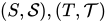
Every kernel from to can be associated with a linear operator
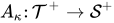
given by[6]
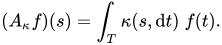
The composition of these operators is compatible with the composition of kernels, meaning[3]

References
- ^ a b Klenke, Achim (2008). Probability Theory. Berlin: Springer. p. 180. doi:10.1007/978-1-84800-048-3. ISBN 978-1-84800-047-6.
- ^ Kallenberg, Olav (2017). Random Measures, Theory and Applications. Switzerland: Springer. p. 30. doi:10.1007/978-3-319-41598-7. ISBN 978-3-319-41596-3.
- ^ a b c d e Kallenberg, Olav (2017). Random Measures, Theory and Applications. Switzerland: Springer. p. 33. doi:10.1007/978-3-319-41598-7. ISBN 978-3-319-41596-3.
- ^ a b Klenke, Achim (2008). Probability Theory. Berlin: Springer. p. 279. doi:10.1007/978-1-84800-048-3. ISBN 978-1-84800-047-6.
- ^ Klenke, Achim (2008). Probability Theory. Berlin: Springer. p. 281. doi:10.1007/978-1-84800-048-3. ISBN 978-1-84800-047-6.
- ^ Kallenberg, Olav (2017). Random Measures, Theory and Applications. Switzerland: Springer. pp. 29–30. doi:10.1007/978-3-319-41598-7. ISBN 978-3-319-41596-3.
Content Disclaimer
Informasi ini disarikan dari Wikipedia dan disajikan kembali untuk tujuan edukasi. Konten tersedia di bawah lisensi CC BY-SA 3.0. Kami tidak bertanggung jawab atas ketidakakuratan data yang bersumber dari kontribusi publik tersebut.
- The information displayed on this website is sourced in part or in whole from Wikipedia and has been adapted for the purpose of restating it. We strive to provide accurate and relevant information, however:
- There is no guarantee of absolute accuracy. Wikipedia is an open, collaborative project that can be edited by anyone, so information is subject to change.
- It is not intended to constitute professional advice. The content displayed is for informational and educational purposes only. For important decisions (e.g., medical, legal, or financial), please consult a professional.
- Content copyright. Wikipedia is licensed under the Creative Commons Attribution-ShareAlike License (CC BY-SA). This means that content may be reused with appropriate attribution and shared under a similar license.
- Responsible use. Any risk arising from the use of information from this website is entirely the responsibility of the user.