Telelift
 | This article has multiple issues. Please help improve it or discuss these issues on the talk page. (Learn how and when to remove these messages)
|

Company type | GmbH (Private company) |
|---|---|
| Industry | Engineering Logistics |
| Founded | 1964 |
| Headquarters | Maisach, Bavaria, Germany |
Area served | Worldwide |
| Products | Logistics systems, security systems |
| Website | www.telelift-logistics.com |

Telelift GmbH is a German engineering company operating worldwide which develops and installs advanced logistics systems (Monorail conveyor) for hospitals, libraries, industry- and security-related applications. The systems provide a transport automation of light materials handling and have no limits in number of operator stations for both sending, and receiving of goods, in closed and locked container vehicles.
Telelift has headquarters in Maisach, near Munich in Germany and three subsidiaries in Berlin, Stuttgart and Singapore.
History
Telelift was founded in 1964 in Munich. In the same year, the first of numerous patents was granted for an electric track vehicle system.[1] It has reached many places in areas/continents such as Europe, America, Asia, Middle East, and Australia/Oceania. A professional distribution brought hundreds of so-called "UniCar" systems to many hospitals, libraries,[2] and administration buildings. HSBC headquarters for example in London and Hong Kong operate large Telelift systems with hundreds of transport trolleys.[citation needed]
Other product line are the AGV (automated guided vehicle system) called "UniVan" which is installed in dozens of hospitals in Europe and Asia, and pneumatic tube systems.
In 1989, Thyssen bought Telelift GmbH,[3] integrated its own library automation system type "MultiLift" and added the Siemens track system type Simacom VT.[4] In 1999, a Swiss company bought Telelift GmbH and integrated it into their healthcare solutions group. In 2012, Telelift GmbH was sold and is privately owned again.[5]
To date, more than 1,500 Telelift systems have been installed in over 50 countries.
Products
Telelift develops and produces conveying systems for transporting goods of up to 500 kg in buildings and production plants. All systems utilise a three-dimensional traffic routing, with 100% system monitoring and Industry 4.0 qualified implementation.
Healthcare has the largest market share. About 650 systems have been installed in hospitals, to increase hygiene standards and optimize the number of transportation staff.[citation needed]
Other markets are libraries with more than 250,000 books, administration buildings with security demand, and industry applications (automotive and food industries).
-
 Modern 3D MultiCar system at Wolfsburg Volkswagen plant
 -
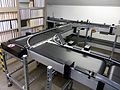 Conveyor belt for Books at Bavarian State Library
 -
 AGV in hospital
 -


.jpg)


External links
References
- ^ "History of Telelift". Winfried Oberstadt.
- ^ "Report of Hungarian National Library". Crystal Paul.
- ^ MM Industriemagazin Nr.40/99 Seite 10: Kauf der Thyssen Krupp Sparte Leichtfördertechnik durch Swisslog[permanent dead link], 4 October 1999.
- ^ LOGISTIK HEUTE vom Oktober 2012: Verkauf der Telelift an neuen Investor, 1 October 2012.
- ^ Telelift Portrait im Wirtschaftsforum Archived 2016-02-10 at the Wayback Machine, retrieved 10 February 2016.
Content Disclaimer
Informasi ini disarikan dari Wikipedia dan disajikan kembali untuk tujuan edukasi. Konten tersedia di bawah lisensi CC BY-SA 3.0. Kami tidak bertanggung jawab atas ketidakakuratan data yang bersumber dari kontribusi publik tersebut.
- The information displayed on this website is sourced in part or in whole from Wikipedia and has been adapted for the purpose of restating it. We strive to provide accurate and relevant information, however:
- There is no guarantee of absolute accuracy. Wikipedia is an open, collaborative project that can be edited by anyone, so information is subject to change.
- It is not intended to constitute professional advice. The content displayed is for informational and educational purposes only. For important decisions (e.g., medical, legal, or financial), please consult a professional.
- Content copyright. Wikipedia is licensed under the Creative Commons Attribution-ShareAlike License (CC BY-SA). This means that content may be reused with appropriate attribution and shared under a similar license.
- Responsible use. Any risk arising from the use of information from this website is entirely the responsibility of the user.