Talk:Wick's theorem
 | This article is rated Start-class on Wikipedia's content assessment scale. It is of interest to the following WikiProjects: | ||||||||||
| |||||||||||
.jpg)

This article was started by copying from S matrix. RJFJR 13:50, 2 November 2007 (UTC)
That is extremaly not correct! Index i in a_i numbers not the particles but energy levels. So for finite number of particles (N) there can be infinity of a_i, e.g. in harmonic oscilator. — Preceding unsigned comment added by 77.254.209.181 (talk) 18:28, 1 December 2012 (UTC)
Improvement of notation?
Personally, I find the notation used in this article hard to read.
Contractions are denoted by dot superscripts. Is this notation used in the literature? I have not seen it. I would strongly prefer reading contractions with lines joining the operators instead, but this seems hard to achieve with the limited LaTeX features in the Wikipedia math editor.
Normal ordering is denoted by colons. This notation I have seen before, but I think it is hard to read when the colons are mixed with the dot notation for contractions, \dots and \cdots and so on - there are so many dots close together that makes things hard to read.
What do others feel about this?
My suggestion:
- Try to find a way to write contractions in the limited LaTeX editor with lines joining the operators. Something close to or , but preferably even better, instead of .
- Write normal ordering with instead of .
- Write time ordering with , consistent with normal ordering.


Hersle (talk) 07:45, 22 June 2021 (UTC)
- I agree that an improvement of notation is needed. The expression is very confusing in my opinion and possibly also ambiguous... Can anyone explain how this expression should be interpreted? —Kri (talk) 16:21, 10 November 2021 (UTC)
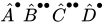
- "Is this notation used in the literature? I have not seen it", this is the notation of Wick's 1950 paper. While arguably not the best notation, it is not ambiguous, and it certainly does not lack precedent. 2601:19B:B00:87A0:DC82:73CD:965F:2B24 (talk) 23:31, 25 March 2022 (UTC)
Why?
It is impossible to understand for me why we do this. Now we have a bunch of contractions on the right side of the equation. What else can I do with the contractions to make this useful? The examples show how to use the theorem, but not really what's useful about it.
From the german entry I understand that the normal ordered products will just give 0, thus they can be taken out? There is then also some confusion about the use of normal ordering here? Why are the contracted products within the normal ordering colons in the examples? 2001:16B8:2CDB:A200:6F:9531:E0EB:35BA (talk) 14:53, 26 February 2023 (UTC)
Content Disclaimer
Informasi ini disarikan dari Wikipedia dan disajikan kembali untuk tujuan edukasi. Konten tersedia di bawah lisensi CC BY-SA 3.0. Kami tidak bertanggung jawab atas ketidakakuratan data yang bersumber dari kontribusi publik tersebut.
- The information displayed on this website is sourced in part or in whole from Wikipedia and has been adapted for the purpose of restating it. We strive to provide accurate and relevant information, however:
- There is no guarantee of absolute accuracy. Wikipedia is an open, collaborative project that can be edited by anyone, so information is subject to change.
- It is not intended to constitute professional advice. The content displayed is for informational and educational purposes only. For important decisions (e.g., medical, legal, or financial), please consult a professional.
- Content copyright. Wikipedia is licensed under the Creative Commons Attribution-ShareAlike License (CC BY-SA). This means that content may be reused with appropriate attribution and shared under a similar license.
- Responsible use. Any risk arising from the use of information from this website is entirely the responsibility of the user.