Talk:Hahn series
 | This article is rated Start-class on Wikipedia's content assessment scale. It is of interest to the following WikiProjects: | ||||||||||
| |||||||||||


Jumping to Conclusions
There is probably an error in the wiki page. well-ordered doesn't imply that the sum is finite (finitely many summands).
Jan Burse (talk) 23:01, 22 July 2018 (UTC)
- The result is actually true: if for some there are infinitely many ordered pairs with and , then since the supports of are well-ordered, there must be a srictly increasing such sequence of for instance elements for , which implies the existence of an infinite decreasing sequence of corresponding elements for , contradicting the hypothesis that the support of is well-ordered. What is harder to justify is that the support of is well-ordered, so maybe a reference should be added there. --Vincent Bagayoko (talk) 22:10, 11 August 2018 (UTC)





Are transseries really not just iterated Hahn series?
In the section Examples, transseries are mentionned with the comment
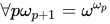
- "The construction of resembles (but is not literally) , ."


![{\displaystyle T_{n+1}=\mathbb {R} \left[\left[\varepsilon ^{T_{n}}\right]\right]}](https://wikimedia.org/api/rest_v1/media/math/render/svg/0029eafab96ed37f3f0e1a2ac5a3bfe966801c46)
I understand that transseries are not constructed like that. Yet it occurs to me that if at each step , one restricts the length of the sums to be below where and , then one obtains a field naturally isomorphic to : surreal numbers with birthdate below . This is an exponential differential field (with total exp and log), so why couldn't the unbounded length construction also be, and actually be naturally isomorphic to the field of EL (not LE) transseries? I wonder if that is the case... — Preceding unsigned comment added by Vincent Bagayoko (talk • contribs) 22:30, 5 September 2018 (UTC) Vincent Bagayoko (talk) 06:28, 6 September 2018 (UTC)




Content Disclaimer
Informasi ini disarikan dari Wikipedia dan disajikan kembali untuk tujuan edukasi. Konten tersedia di bawah lisensi CC BY-SA 3.0. Kami tidak bertanggung jawab atas ketidakakuratan data yang bersumber dari kontribusi publik tersebut.
- The information displayed on this website is sourced in part or in whole from Wikipedia and has been adapted for the purpose of restating it. We strive to provide accurate and relevant information, however:
- There is no guarantee of absolute accuracy. Wikipedia is an open, collaborative project that can be edited by anyone, so information is subject to change.
- It is not intended to constitute professional advice. The content displayed is for informational and educational purposes only. For important decisions (e.g., medical, legal, or financial), please consult a professional.
- Content copyright. Wikipedia is licensed under the Creative Commons Attribution-ShareAlike License (CC BY-SA). This means that content may be reused with appropriate attribution and shared under a similar license.
- Responsible use. Any risk arising from the use of information from this website is entirely the responsibility of the user.