Talk:Gram–Schmidt process
 | This article is rated C-class on Wikipedia's content assessment scale. It is of interest to the following WikiProjects: | ||||||||||
| |||||||||||


Extension to polynomials?
When working with polynomials and an arbitrary weight function, there is a recursive Gram-Schmidt orthonomalization technique. More details are provided below:
http://mathworld.wolfram.com/Gram-SchmidtOrthonormalization.html 70.162.89.24 (talk) 05:51, 30 August 2013 (UTC)
- Another example or two is needed, particularly something in a function (ie functional analysis) setting. For example, some simple polynomial examples with a suitable inner product. For example,
- , , .


- One covers examples like this in introductions to signal processing, so I imagine it's quite important in certain engineering fields. Also, this will produce orthogonal or orthonormal polynomials, making a nice connection to special functions. For example on the interval with the inner product , one recovers the Legendre polynomials.Improbable keeler (talk) 09:29, 18 January 2018 (UTC)
![{\displaystyle [-1,1]}](https://wikimedia.org/api/rest_v1/media/math/render/svg/51e3b7f14a6f70e614728c583409a0b9a8b9de01)

Determinant formula
I have two complaints about this section!
First of all, the section defines some vectors ei and then never mentions them again. Frankly, I have no idea what's going on there.
Secondly, the section contains the text: "Note that the expression for uk is a "formal" determinant, i.e. the matrix contains both scalars and vectors; the meaning of this expression is defined to be the result of a cofactor expansion along the row of vectors."
I highly doubt that this explanation will be the least bit enlightening to anyone who didn't already know what was going on, and I also doubt that the link would be very enlightening with a bit of additional context. (For instance, the text should indicate which row the Laplace expansion is being taken over - the last one - and then indicate the formula as a linear combination of the v's with coefficients combing from the corresponding minor determinants.) 2602:30A:C04C:5F30:805:108B:A61A:2175 (talk) 23:37, 3 August 2014 (UTC)
Francesco Caravelli: I have been trying very hard to find the determinant formula in the literature. There is no reference in the wiki page. Very frustrating! Update: I have found a similar formula in Gantmacher: Theory of matrices (1959) Volume 1, Pages 256-258.
— Preceding unsigned comment added by 204.121.137.208 (talk) 17:28, 16 March 2017 (UTC)
Untitled
The Matlab implementation for the Gram-Schmidt process is for a specific norm and inner product definition (here being the Standard Euclidean Inner Product and by it's extension the 2-norm). Should be updated to reflect that. — Preceding unsigned comment added by BlackMetalStats (talk • contribs) 00:19, 3 April 2017 (UTC)
Historical origins
The article originally said that the method had appeared in the work by both Laplace and Cauchy, citing the Cheney and Kincaid book. [1] But the book only mentions that Laplace was "familiar" with the method. I couldn't see a reference to Cauchy on Google Books, but I don't have a copy of the book. Arguably a better historical reference is needed.Improbable keeler (talk) 06:57, 18 January 2018 (UTC)
References
- ^ Cheney, Ward; Kincaid, David (2009). Linear Algebra: Theory and Applications. Sudbury, Ma: Jones and Bartlett. pp. 544, 558. ISBN 978-0-7637-5020-6.
The definition of projection is INCORRECT+Proof
If we consider , I proof the set you get isn't orthogonal to ech other. Let's proof:
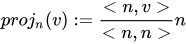
For the field we consider Complex Numbers. If then we begin by compute .



Now see what happen when :


Now the is number in field so we can get it out of bracket as define [1].

and that ISN'T Zero in Complex Vector Space; But if you write the correct form which is every think make sense.

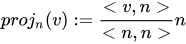
Firouzyan (talk) 21:35, 15 May 2019 (UTC)
I believe in the above there's a missing complex conjugation.
I've edited accordingly (changing it back to the pre-2019 state, I think).

Scott Lawrence (talk) 03:37, 5 September 2024 (UTC)
Apologies; I've just realized that I've run into this difference of convention between physics and the rest of the world. Changing the page back, but I'll add a short note somewhere to save other poor souls the effort.
Scott Lawrence (talk) 03:52, 5 September 2024 (UTC)
References
- ^ "Inner product space", Wikipedia, 2019-04-30, retrieved 2019-05-15
Content Disclaimer
Informasi ini disarikan dari Wikipedia dan disajikan kembali untuk tujuan edukasi. Konten tersedia di bawah lisensi CC BY-SA 3.0. Kami tidak bertanggung jawab atas ketidakakuratan data yang bersumber dari kontribusi publik tersebut.
- The information displayed on this website is sourced in part or in whole from Wikipedia and has been adapted for the purpose of restating it. We strive to provide accurate and relevant information, however:
- There is no guarantee of absolute accuracy. Wikipedia is an open, collaborative project that can be edited by anyone, so information is subject to change.
- It is not intended to constitute professional advice. The content displayed is for informational and educational purposes only. For important decisions (e.g., medical, legal, or financial), please consult a professional.
- Content copyright. Wikipedia is licensed under the Creative Commons Attribution-ShareAlike License (CC BY-SA). This means that content may be reused with appropriate attribution and shared under a similar license.
- Responsible use. Any risk arising from the use of information from this website is entirely the responsibility of the user.