Talk:Euler's formula
 | This  level-4 vital article is rated B-class on Wikipedia's content assessment scale. level-4 vital article is rated B-class on Wikipedia's content assessment scale.It is of interest to the following WikiProjects: | ||||||||||
| |||||||||||


It seems better to merge Integration using Euler's formula into this page or move to wikibooks.--SilverMatsu (talk) 15:18, 4 September 2021 (UTC)
- Oppose. If a reader is interested by this subject, it is probably because they want to integrate a trigonometric function, not because they are searching for applications of Euler's formula. D.Lazard (talk) 16:17, 4 September 2021 (UTC)
- Comment. Apparently an article is lacking, which lists the classes of functions for which there is an algorithm for computing the antiderivative. This method of integration could appear there for the integration of rational functions of trigonometric functions (as an alternative of half angle substitution), and for the integration of polynomials in x, and (followed by integrations by parts; for this class of functions, I don't know any alternative). D.Lazard (talk) 16:17, 4 September 2021 (UTC)
- The wikibooks seem to have the following page; wikibooks:Calculus/Integration techniques--SilverMatsu (talk) 16:55, 4 September 2021 (UTC)


Remove Three-dimensional visualization
I propose to remove the picture from the article for the following reasons
- the picture is not referenced in the text
- the picture has German labels
- the meaning of the inset scale increasing from zero to 4pi is not obvious
- use of for a real angle
- use of j for the imaginary unit in contrast to the notation used in the article.
- the picture doe not add anything to the information already depicted in the other figures.

141.89.116.54 (talk) 12:38, 12 November 2021 (UTC)
- I add
- The picture is not understandable for most readers of this article.
- I have removed the picture. D.Lazard (talk) 12:54, 12 November 2021 (UTC)
Relation to trigonometry
Euler's formula#Use of the formula to define the logarithm of complex numbers contains the rather weak statement
Finally, the other exponential law
which can be seen to hold for all integers k, together with Euler's formula, implies several trigonometric identities, as well as de Moivre's formula.
(Emphasis added.)

I believe that #Relationship to trigonometry should contain a much stronger; while http://mason.gmu.edu/~smetz3/humor/Euler.pdf is intended as a humorous T-shirt, it was inspired by my HS Trigonometry class, in which I never bothered to memorize the identities, but just worked them out as I needed. Perhaps
The definitions of the trigonometric functions and the standard identities for exponentials, together with Euler's formula, are sufficient to easily derive most trigonometric identities.
would be an appropriate addition. Or is that TMI? --Shmuel (Seymour J.) Metz Username:Chatul (talk) 13:34, 22 June 2022 (UTC)
- I like it.--Bob K (talk) 02:36, 23 June 2022 (UTC)
Is that theta or x?
'x' is used instead of 'theta' in many parts of the article. Isn't the use of 'theta' more common? Bera678 (talk) 14:32, 23 December 2023 (UTC)
- Please, do not introduce incoherencies as you did, by changing "x" into "theta" in a formula, and keeping "x" in the beginning of the sentence and in the end of the paragraph. This said, "theta" is possibly more common in pure trigonometry, that is when the variable represents explicitly an angle. "Phi" is also commonly used in some contexts, such as in electrical engineering (and in the infobox of the article). But "x" is more common in calculus and mathematical analysis, where it needs not representing an angle. However, in all cases, any letter would be mathematically correct.
- It is thus correct to use "x" everywhere, except when talking of polar coordinates. So the whole article uses coherent notation except the infobox and the section § Using differentiation, where "x" would be more coherent than "theta". However, there is no real harm to leave this section as it is. D.Lazard (talk) 16:14, 23 December 2023 (UTC)
False rearrangement in series proof
I don't think that the line "The rearrangement of terms is justified because each series is absolutely convergent" is great here because the above manipulations aren't rearrangements at all. A rearrangement would entail just one infinite series. What we have can't be written as a relabeling based on a permutation of the naturals.
Although this splitting of a series into the series of its odd and even terms certainly feels like a rearrangement, it's really just bracketing. This bracketing is justified because the original series is absolutely convergent, and the result relies on this and that the two subseries are each convergent (they needn't be absolutely convergent).
I think that it would be more appropriate to say "The splitting of terms is justified because each series is convergent, and the original series is absolutely convergent." OisinDavey (talk) 20:41, 18 February 2024 (UTC)
- You are right. Since no one had corrected it in the meantime I made a change. BlaBorKort (talk) 09:10, 14 March 2026 (UTC)
Translation, please.
Could someone write a translation of the article in a way that us "C" students can understand? Nosehair2200 (talk) 20:54, 21 August 2024 (UTC)
- It would be helpful if you could pick one item that was particularly confusing. There are not many people here who have the time to rewrite the article but there are a few that could polish one small part. Constant314 (talk) 21:21, 21 August 2024 (UTC)
Variable z is in the wrong place for the limit formula
With f(z)=e^z=lim[n->infinity] you now have (1+z/n)^n but this should be (1+1/n)^(n*z) and the fact that it isn't becomes really clear when you do the math for the derivative. — Preceding unsigned comment added by Emilehobo (talk • contribs) 15:28, 23 September 2024 (UTC)
- Your formula is correct only for real z. It cannot be used for defining the exponential function, since it contains a an exponent that is not an integer, and the exponentiation with non-integer exponents requires the exponential function for being defined. D.Lazard (talk) 16:22, 23 September 2024 (UTC)
- Okay. I figured I needed to do a bit of math with my calculator for backup for the real numbers of 1 and -1 that are also a part of the formula, but it does check out was what I thought, but then I realized z doesn't equal 1 or -1, so how do you handle that? Isn't it written wrong?
- I'm worried about the conflicting definitions a bit and think it might benefit clarification to contrast the two views of the use of e also in the limit definition. The plain English guy up above has a point.
- One difficulty I don't see the answer for yet is whether you treat "infinity" as an even or an odd number, which probably has major implications also.
- Where do I find how you handle (e^(i*psi))^k also, because now it just says it multiplies your angular momentum with k, but how do you make sure people reading the work instantly recognize it and don't mistake it for regular e^k or e^-k? The limit function doesn't seem to differentiate and I think it might have implications.
- The main problem I think is that the exact same thing on paper can now mean two things, so maybe differentiate between the two by calling one "e" and the other "e_psi" also? (Underscore = subscript.)
- Out of curiosity, for determining e, has anyone ever tried: SUM[forall p=prime]:p^-1 ? Emilehobo (talk) 20:05, 23 September 2024 (UTC)
- You can think of the exponential as a kind of limit of power functions. A power function for any arbitrary wraps the complex plane around the origin, conformally mapping the flat plane onto a cone with a singularity at the origin (the vertex of the cone). If is an integer, then the the unit circle gets completely wrapped around times. To make things more consistent from (a portion of) one cone to another, we can offset the points we examine to the multiplicative identity 1, and divide by to normalize the scale at that point. The exponential function is what you get when you take the limit as the cone becomes infinitely pointy, turning it into a cylinder. This moves the origin vertex away to infinity, but we still have nice behavior near 1. –jacobolus (t) 17:58, 23 September 2024 (UTC)
- I'm not saying you're right or wrong, but this is an encyclopedia... There are also a lot of conflicting statements in what you say, which is really cool in terms of metaphores that you are now using, but for instance a limit limits and exponentials for numbers greater than one very quickly want to go to infinity without halt... But I do seriously love someone explaining math like Jim Morrison would. You are definitely beautifully wicked. Emilehobo (talk) 21:08, 23 September 2024 (UTC)


Circular reasoning in proof by differentiation
In the first proof listed, namely the one using differentiation, there might be a circular reasoning. Both the sine and cosine functions can easily be proven to be differentiable by using the Cauchy-Riemann equations, but although I have been searching a lot, I can't seem to find a proof of the differentiability of the natural exponential function for complex numbers without using Euler's formula. Do anyone know such a proof? Tøger Holm Lyngbo (talk) 12:45, 14 December 2024 (UTC)
- You can see Exponential function § Derivatives and differential equations: all given definitions and their equivalence proof extend verbatim to the complex case, excepted the definition as inverse of the logarithm. Also, the definition through power series implies complex differentiability as it is the case for every analytic function. D.Lazard (talk) 16:05, 14 December 2024 (UTC)
about hatnote
Edit permalink/1280169638, reverted by permalink/1280172228, added a bunch of text about Euler's polyhedron formula. The {{about}} template links to List of things named after Leonhard Euler § Formulas, which includes Euler's polyhedral formula for planar graphs or polyhedra: v − e + f = 2, a special case of the Euler characteristic in topology
. Is it important enough to warrant including it in the hatnote, or is the existing link enough? -- Shmuel (Seymour J.) Metz Username:Chatul (talk) 13:41, 13 March 2025 (UTC)
- Isn't the polyhedra formula a totally unrelated formula to the formula discussed in this article? Constant314 (talk) 14:08, 13 March 2025 (UTC)
- It seemss that Chatul does not challenge the revert. Instead they ask the question and whether the formula on polyhedra deserves a special mention in the hatnote. My opinion that the answer must be no, for two reasons: firstly, the formula is better known as "Euler's characteristic formula" or simply "Euler characteristic". Secondly, giving a special importance to Euler characteristic, requires a consensus; otherwise, this would be WP:Original synthesis. D.Lazard (talk) 14:42, 13 March 2025 (UTC)
- So, we already have an article on the polyhedra formula. If the reverted material has a reliable source, it could go there. Constant314 (talk) 14:57, 13 March 2025 (UTC)
- Correct. I've usually seen it referred to as Euler's formula, but it has a variety of names. -- Shmuel (Seymour J.) Metz Username:Chatul (talk) 15:06, 13 March 2025 (UTC)
- If you think it is important enough to add it as an explicit item in the existing hatnote, that would be fine with me. Constant314 (talk) 17:52, 13 March 2025 (UTC)
- I don't think hatnotes are original research (they are navigational aides, not encyclopedia content), but it seems unnecessary to call this out specifically. There are a lot of Euler "formulas". –jacobolus (t) 22:38, 16 March 2025 (UTC)
- Well, Euler's Seven Bridges of Königsberg problem and polyhedral formula are arguably the originas of algebraic topology/ -- Shmuel (Seymour J.) Metz Username:Chatul (talk) 13:06, 17 March 2025 (UTC)
- It seemss that Chatul does not challenge the revert. Instead they ask the question and whether the formula on polyhedra deserves a special mention in the hatnote. My opinion that the answer must be no, for two reasons: firstly, the formula is better known as "Euler's characteristic formula" or simply "Euler characteristic". Secondly, giving a special importance to Euler characteristic, requires a consensus; otherwise, this would be WP:Original synthesis. D.Lazard (talk) 14:42, 13 March 2025 (UTC)
TWO MORE PROOFS!?
Hello, I'm Kenay , still learning English, and yes, two more proofs (for now). I attempted to edit the page, but someone undid it.
The first one isn't very famous. I remember seeing it on a video, but lost it. So this is my recreation of what I saw, please tell me any mistakes I made
btw here are some properties I used:
- by polar coordinates.
![{\displaystyle z=\left|z\right|\cdot \left(\cos(\arg[z])+i\sin(\arg[z])\right)}](https://wikimedia.org/api/rest_v1/media/math/render/svg/0c711114ccc4ffb096d9e2140911f4251a81d7ca)
- There's no such that . Instead (will be used for exponents).


![{\displaystyle \arg[a+bi]=\operatorname {atan} \left[{\frac {b}{a}}\right]}](https://wikimedia.org/api/rest_v1/media/math/render/svg/92acac8d602b992eab4fa03390b4981a0e0345ca)

![{\displaystyle \arg[z^{n}]=n\cdot \arg[z]+2\pi k}](https://wikimedia.org/api/rest_v1/media/math/render/svg/57bcfa6abec4e12a59b84ab761e8f7515056eae7)
- , so with a very small we can say .


Using the Limit Definition
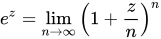
This unusual proof uses the Limit Definition of complex exponentiation.
Start with the standard definition:
Calculating the modulus of :
We remember , so we can use that too:
- and thus
Lastly, since , the fact that tells us .
Calculating the argument of :
- , where is very, very small. We can use the arctangent approximation for small values.
- .
Inside , setBut remember and
And, once again, we've shown Euler's formula:


![{\displaystyle \left|e^{i\theta }\right|=\lim _{n\to \infty }\left(1+{\frac {\theta ^{2}}{n^{2}}}\right)^{n/2}=\lim _{n\to \infty }\left[\left(1+{\frac {\theta ^{2}}{n^{2}}}\right)^{n^{2}}\right]^{\frac {1}{2n}}}](https://wikimedia.org/api/rest_v1/media/math/render/svg/13aacb3f3198ea2af4ca83f9d45c75d1c86f6ffc)


![{\displaystyle \left|e^{i\theta }\right|=\lim _{n\to \infty }\left[\left(1+{\frac {\theta ^{2}}{n^{2}}}\right)^{n^{2}}\right]^{\frac {1}{2n}}=\lim _{n\to \infty }\left[e^{\theta ^{2}}\right]^{\frac {1}{2n}}}](https://wikimedia.org/api/rest_v1/media/math/render/svg/ecc09b7f5a8fcca684e7f5db0868654e51f9d5df)
![{\displaystyle \left|e^{i\theta }\right|=\lim _{n\to \infty }\left[e^{\theta ^{2}}\right]^{\frac {1/n}{2}}=\left[e^{\theta ^{2}}\right]^{\frac {0}{2}}=[not\,zero]^{0}=1}](https://wikimedia.org/api/rest_v1/media/math/render/svg/b61d67beeff0cf0c5b8731024847cf5a167abf82)
![{\displaystyle \arg \left[e^{i\theta }\right]=\lim _{n\to \infty }\arg \left[\left(1+{\frac {i\theta }{n}}\right)^{n}\right]=\lim _{n\to \infty }n\cdot \arg \left[\left(1+{\frac {i\theta }{n}}\right)\right]+2\pi k}](https://wikimedia.org/api/rest_v1/media/math/render/svg/6392e5d5d7ceda6402767d30ffd9c08b1f038908)
![{\displaystyle \arg \left[e^{i\theta }\right]=\lim _{n\to \infty }n\cdot \operatorname {atan} \left({\frac {\frac {\theta }{n}}{1}}\right)+2\pi k=\lim _{n\to \infty }n\cdot \operatorname {atan} \left({\frac {\theta }{n}}\right)+2\pi k}](https://wikimedia.org/api/rest_v1/media/math/render/svg/660fb74aa8f345737104467bd3e1531866d84791)

![{\displaystyle \arg \left[e^{i\theta }\right]\simeq \lim _{n\to \infty }{\cancel {n}}\cdot \left({\frac {\theta }{\cancel {n}}}\right)+2\pi k=\theta +2\pi k}](https://wikimedia.org/api/rest_v1/media/math/render/svg/71969297f2130836ca1de0943a7332f56239d587)


![{\displaystyle \arg[e^{i\theta }]\simeq \theta +2\pi k}](https://wikimedia.org/api/rest_v1/media/math/render/svg/54f545f3f063730a465585ee5614312beb82556f)


(thanks to whoever made that cool green line)
Ok, so as you saw I just abused notation with some functions, but nothing bad, right?. I'm readin this, and I'm surprised I got the same result as the user above me (D.Lazard), where he uses differential equations just like me
Oh well, enough talking! If they won't write it in LaTeX, I will!
Using the Limit Definition
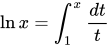
We'll get to the same result of Roger Cotes, but with calculus instead of geometry.
Start remembering that the natural logarithm is the integration of :
Now, define , and calculate the derivative of :
Now, divide both sides by , and integrate.
We can see when .
And replacing both and , we get Euler's formula:








2001:1388:5C5:3B67:F94F:7CC3:4F63:1DC1 (talk) 21:45, 28 October 2025 (UTC)
- If you want to add proofs to an article, you need to cite a specific "reliable source" (Wikipedia jargon more or less meaning, in this context, something from a peer-reviewed paper or book). –jacobolus (t) 23:08, 28 October 2025 (UTC)
- The article doesn't need more proofs. See WP:NOTTEXTBOOK. Constant314 (talk) 00:11, 29 October 2025 (UTC)
Hello jacobolus, Kenay again. I kind of made the second proof myself, so... Do they really need a reliable source, when you can check them yourself?
Also, Constant314, while I understand there'd be too many proofs, I wanted to save these here on Wikipedia so anyone can see such uncommon proofs (I'm tired of the Taylor Series one), y'know, just to make the Proofs section more interesting.
It may sound unrelated (it is), but I opened a question to try organize all of Euler's proofs here: https://math.stackexchange.com/questions/5109403/how-many-independent-branches-proofs-of-eulers-formula-are-there. (I'm so bad explaining...) I'll try to keep this section up to date, so if anyone knows about a geometric proof of Euler's formula, please write it here!.
— Preceding unsigned comment added by ~2025-33464-29 (talk) 20:51, 23 November 2025 (UTC)
- Yes, you generally need a "reliable source" for anything you add to Wikipedia, including proofs. Proofs you made up yourself are considered "original research" and are not allowed in Wikipedia articles. –jacobolus (t) 21:15, 23 November 2025 (UTC)
- All Wikipedia content must be either paraphrased from reliable sources or quoted from reliable public domain sources. That's it. That is all that is allowed. With regard to paraphrasing a proof, you can do some minor manipulation. For example, if the source uses ω but the rest of the article uses f, you can substitute 2πf for ω. You can use the associative, communitive, and distributive operations. You can switch between (, [, and {. Constant314 (talk) 21:38, 23 November 2025 (UTC)
- There's no bright line, and the range of acceptable manipulation depends on the context and subject, but I also think it's fine in some cases to e.g. provide a sketch of a proof given in full in a reliable source or flesh out additional details of a proof (for accessibility) given as a sketch in a reliable source; consolidate the proof of a lemma into the proof of the main theorem or pull a tricky step out as a separate lemma; translate a proof about a more general class of objects into concrete terms for a more specific case; rewrite a proof originally expressed in terms of an obscure notation/formalism into a more familiar one; combine a few published proof variants that are essentially the same into a clearer expression of the idea, borrowing pieces from the two separate versions; etc. But there should always be a published source, and it should be clear to an expert reader who examines the source that what is written in the article is supported by the source. –jacobolus (t) 22:16, 23 November 2025 (UTC)
Content Disclaimer
Informasi ini disarikan dari Wikipedia dan disajikan kembali untuk tujuan edukasi. Konten tersedia di bawah lisensi CC BY-SA 3.0. Kami tidak bertanggung jawab atas ketidakakuratan data yang bersumber dari kontribusi publik tersebut.
- The information displayed on this website is sourced in part or in whole from Wikipedia and has been adapted for the purpose of restating it. We strive to provide accurate and relevant information, however:
- There is no guarantee of absolute accuracy. Wikipedia is an open, collaborative project that can be edited by anyone, so information is subject to change.
- It is not intended to constitute professional advice. The content displayed is for informational and educational purposes only. For important decisions (e.g., medical, legal, or financial), please consult a professional.
- Content copyright. Wikipedia is licensed under the Creative Commons Attribution-ShareAlike License (CC BY-SA). This means that content may be reused with appropriate attribution and shared under a similar license.
- Responsible use. Any risk arising from the use of information from this website is entirely the responsibility of the user.