Talk:Disphenoid
 | This article is rated Start-class on Wikipedia's content assessment scale. It is of interest to the following WikiProjects: | ||||||||||
| |||||||||||


References
The Coxeter book is upstairs now. I will add a detailed citation tomorrow. -- Dominus 04:37, 17 December 2006 (UTC)
Digonal disphenoid

It says a disphenoid is a tetrahedron with 4 identical isosceles triangle faces. I'm wondering if there's a name for a tetrahedron with two sets of isosceles triangle faces, instead of fitting within a square cuboid, rather a general cuboid of all different lengths, so 4 edges are equal length and the remaining two edges can be different lengths. SockPuppetForTomruen (talk) 19:58, 2 February 2009 (UTC)
- It looks like this shape is called a digonal disphenoid, as described in the vertex figures of the bitruncated tesseract and bitruncated_120-cell.
- NOTE: If this is correct, it would contradict the definition here which says a disphenoid has 4 identical triangles. SockPuppetForTomruen (talk) 22:04, 2 February 2009 (UTC)
- This contradicts the definition of disphenoid. This should not be called a special case of a disphenoid. If a disphenoid is defined to have 4 congruent faces, it makes no sense to say that a special case is one with two pairs of congruent faces which are not all congruent. Other characterizations of the disphenoid contradict the inclusion of "digonal disphenoids" as disphenoids. I was going to cite this page but I can't because of this error.50.177.1.160 (talk) 21:04, 13 December 2013 (UTC)
Definitions in relation to their symmetry:
- A sphenoid tetrahedron has a single mirror symmetry (*11),
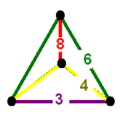 , Cantitruncated 8-cell vertex figure
 - A (digonal) disphenoid tetrahedron has two normal mirror symmetry (*222),
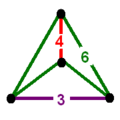 , Bitruncated tesseract vertex figure
 - A (tetragonal) disphenoid tetrahedron has 2 normal mirrors and 2-fold rotation symmetry (2*2),
 , Bitruncated 5-cell vertex figure


rhombic disphenoid
It seems like a rhombic disphenoid would fit inside 4 vertices of a general cuboid, with its 6 edges being diagonals of the cuboid faces. If the cuboid had 3 different edge lengths, then you'd have scalene triangle faces in the disphenoid. I'll make a picture if I confirm this is true. SockPuppetForTomruen (talk) 22:05, 4 February 2009 (UTC)
 (222) symmetry
Here's a not so great picture showing the rhombic dispenoid, apparently with exactly 3 sets of edge lengths, in upposite pairs. I labeled them with ABC, being the lengths of te cuboid sides, and AB implying length sqrt(A*A+B*B).SockPuppetForTomruen (talk) 23:14, 4 February 2009 (UTC)
Here's another attempt to show the varied forms, this time as 2D diagrams, edges colored by equal edge lengths. SockPuppetForTomruen (talk) 21:11, 5 February 2009 (UTC)

This article is no longer a stub
This is a short article, but it seems to me that it is not a stub; it covers the subject reasonably completely. I would like to remove the stub notice, if nobody objects. —Mark Dominus (talk) 17:27, 21 December 2011 (UTC)
- I tend to prefer non-stubs to have multiple text sections but it looks like it's long enough that some section headings could be added without much difficulty. —David Eppstein (talk) 17:30, 21 December 2011 (UTC)
Content Disclaimer
Informasi ini disarikan dari Wikipedia dan disajikan kembali untuk tujuan edukasi. Konten tersedia di bawah lisensi CC BY-SA 3.0. Kami tidak bertanggung jawab atas ketidakakuratan data yang bersumber dari kontribusi publik tersebut.
- The information displayed on this website is sourced in part or in whole from Wikipedia and has been adapted for the purpose of restating it. We strive to provide accurate and relevant information, however:
- There is no guarantee of absolute accuracy. Wikipedia is an open, collaborative project that can be edited by anyone, so information is subject to change.
- It is not intended to constitute professional advice. The content displayed is for informational and educational purposes only. For important decisions (e.g., medical, legal, or financial), please consult a professional.
- Content copyright. Wikipedia is licensed under the Creative Commons Attribution-ShareAlike License (CC BY-SA). This means that content may be reused with appropriate attribution and shared under a similar license.
- Responsible use. Any risk arising from the use of information from this website is entirely the responsibility of the user.