Talk:Cardinality of the continuum
 | This  level-5 vital article is rated B-class on Wikipedia's content assessment scale. level-5 vital article is rated B-class on Wikipedia's content assessment scale.It is of interest to the following WikiProjects: | ||||||||||
| |||||||||||


Cardinality
Examples of cardinality 196.249.99.211 (talk) 17:58, 22 December 2021 (UTC)
Continuum Hypothesis
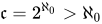
The second source clearly stated it is undecidable that . However, it is only briefly mentioned once at the end of the introduction that most of this section is dependent on the continuum hypothesis. The "intuitive" property section depends on Cardinal arithmetic, which appears to be dependent on GCH. For now, I proposed to merge the last paragraph of the introduction into the first paragraph and suggest experts in this field to add more clarifications (on assumptions in addition to ZF set theory). --Yangwenbo99 (talk) 11:12, 14 February 2023 (UTC)

- As far as I can see, nothing in the article depends on CH. You seem to have a misimpression about what CH actually is, which might explain the confusion.
- The continuum hypothesis is not , which is just a theorem of ZFC. The continuum hypothesis is , which is a different claim. --Trovatore (talk) 17:24, 14 February 2023 (UTC)
- When the cardinality of the reals is first mentioned in the article the statement is simply that the cardinality of the continuum is
- with an epitaph that "this was proved by Cantor". It would be more correct to say that Cantor showed that the cardinality of the reals is greater than the cardinality of the naturals and the former equals the power set of the latter follows from the continuum hypothesis added to ZFC set theory. As Trovatore correctly points out, the above identity is a theorem of ZFC+CH. However simply stating it's veracity before any mention of ZFC+CH renders this article into the land of not mathematics. Izmirlig (talk) 12:41, 25 June 2024 (UTC)


- Note that
- is provable in ZF, it doesn't need CH or even choice. CH is the nonexistence of an x such that
- CRGreathouse (t | c) 15:59, 25 June 2024 (UTC)
I really don't understand why Izmirlig's error is so prevalent, but let's say this clearly: The fact that the cardinality of the reals is the same as the cardinality of the powerset of the naturals is a theorem of ZFC. It does not depend in any way on the continuum hypothesis. This is not subtle, this is not a matter of opinion; this is as straightforward as it gets. --Trovatore (talk) 19:53, 25 June 2024 (UTC)

Reverted contrib
Hi @Engr. Smitty,
Why was this contribution reverted? Oneequalsequalsone (talk) 00:18, 17 October 2023 (UTC)
- I'm not the person you pinged, but I don't think it's true, is it? I'm pretty sure, for any , you have is a compact Hausdorff space without isolated points, but clearly we can make it have cardinality bigger than the continuum. --Trovatore (talk) 00:41, 17 October 2023 (UTC)
- Thanks! I'm fairly new to this space (no pun intended) and trying to piece things together Oneequalsequalsone (talk) 13:27, 17 October 2023 (UTC)


References with broken links
Several of the links have broken references. 97.113.221.223 (talk) 01:07, 21 November 2024 (UTC)
duBois-Reymond and the anti-diagonal argument
How about a section on 19'th century mathematics including that the anti-diagonal argument and other proofs were already written before being re-written in "set theory" the Mengenlehre or later ZF. Many of these inputs as derivations were well known and even in the literature, and if they were so clear and simple must have been obvious. 97.113.221.223 (talk) 01:09, 21 November 2024 (UTC)
Content Disclaimer
Informasi ini disarikan dari Wikipedia dan disajikan kembali untuk tujuan edukasi. Konten tersedia di bawah lisensi CC BY-SA 3.0. Kami tidak bertanggung jawab atas ketidakakuratan data yang bersumber dari kontribusi publik tersebut.
- The information displayed on this website is sourced in part or in whole from Wikipedia and has been adapted for the purpose of restating it. We strive to provide accurate and relevant information, however:
- There is no guarantee of absolute accuracy. Wikipedia is an open, collaborative project that can be edited by anyone, so information is subject to change.
- It is not intended to constitute professional advice. The content displayed is for informational and educational purposes only. For important decisions (e.g., medical, legal, or financial), please consult a professional.
- Content copyright. Wikipedia is licensed under the Creative Commons Attribution-ShareAlike License (CC BY-SA). This means that content may be reused with appropriate attribution and shared under a similar license.
- Responsible use. Any risk arising from the use of information from this website is entirely the responsibility of the user.