Talk:Brain types
 | This article was nominated for deletion on 31 January 2009 (UTC). The result of the discussion was kept. |
 | This article has not yet been rated on Wikipedia's content assessment scale. It is of interest to the following WikiProjects: | ||||||||||
| |||||||||||


Untitled
Marked this article as pseudoscience. In fact, this "theory" has absolutly no scientific ground, only fraud claims as already noted by APA members. IMHO, position of this article should be much stronger, because I see only commercial purpose of such information, and no science. Waiting for NPOV comment :)
Please read these references:
http://www.americanboardofsportpsychology.org/Portals/24/BrainTypingSANDBEK.doc
http://www.listserv.uga.edu/cgi-bin/wa?A2=ind0208&L=spssx-l&D=0&P=8229
http://www.listserv.uga.edu/cgi-bin/wa?A2=ind0208&L=spssx-l&P=8791
Unex 01:08, 19 December 2006 (UTC)
==============================
NPOV comment/response: The recent edit of this article attempts to foist anti-brain-typing opinion on Wikipedia, which is indeed against NPOV policy. Brain typing has neither been entirely proven or disproven at this juncture, so editing the article to say it is 'pseudoscience' is highly assumptive. Providing the disputing views of the APA is fine, but editing the article to say things like it 'cannot' be proven just reveal a clear agenda. Make room for both sides of the coin.
--Khendra1984 14:50, 27 December 2006 (UTC)
==============================
Addendum: The links given are also not necessarily unbiased. Sandbek himself, with his appearances on the Oprah Winfrey show, sounds just as likely to be a commercialist as anyone connected to brain types (who do have some scientific supporters as well, including James H. Fallon, Daniel Amen, Nancy Snyderman, Vic Braden and Bob Arnot). The only notable skeptics who have come out openly against brain types seem to be other people in the sport psychology field (Carlstedt, Sandbek, et al.), who have a vested interest in making their products look better. I prefer this link distinguishing science from pseudoscience:
http://www.sfu.ca/~beyerste/research/articles/02SciencevsPseudoscience.pdf
--Khendra1984 09:38, 29 December 2006 (UTC) --- This link is dead; I have found an alternative one: http://www.quackwatch.com/01QuackeryRelatedTopics/pseudo.html
Thanks for your comment.
Yes, I agree, saying 'cannot' is not correct. But to be honest, I really doubt about the purpose of Brain types to be validated science. I didn't go deep into theoretical grounds of Brain types - in fact, I couldn't found any _concrete_ and scientific paper neither in scientific databases nor in the internet at all - but current states of the author and his web page is populistic and orientated to commercial benefit without any mentioning about real/concrete scientific works (neither in past nor in future).
Of course, articles should be neutral, but I don't think that Wikipedia should be compliant to commercialist which tend to be lying (essentialy that stated APA, and IMHO it quite clear even without APA).
I apologize for my strong words, but in this POV, I would like to defend psychology (with which I am familiar, and such theories like MBTI and socionics) which suffers from such "scientists" influence. Unex 01:09, 2 January 2007 (UTC)
According to professional protocol, I feel it has been unprofessional, unfortunate, and a noteworthy injustice for Sandbek to formally and publically criticize Niednagel and Brain Typing without ever having taken the time to speak with him, or to meet with him (or any of BTI's employees) personally. This seems to demonstrate a prejudicial approach to his research. How accurate can an investigation be from that vantage point? I have noticed that those who assail Brain Typing and Niednagel have only scrutinized and/or participated from a distance. The record shows that those who have personally associated with Niednagel find merit and benefit from his principles.
I find that skeptics are not always wrong, but often go too far. That seems to be the case here. If you study another personality typing system - Socionics - you will find that the notion of fluid versus stiff motor movements appears in Socionics in a similar way to what Niednagel proposes. This is odd, considering that both systems are based on Jungian personality typing! If you consider the fact that this is one of the traits that Niednagel "eyeballs" in order to determine his Brain Types, it would seem strange that he would be relying on cold reading if it is in both Jungian systems (Socionics also wasn't introduced to the West until lately - long after Niednagel began Brain Typing - and much of the two systems is not the same, so it would be surprising if Niednagel went so far to steal the idea). A much more fair argument against Niednagel is that, given the complexity of the human genome and the diversity of traits (and even anomalies) one finds in cognitive psychology, it seems hard to believe that human personality could be this simple. (For instance, that there are only 16 types of people.) Therefore, Niednagel *might* be perceiving a vague pattern to human personality, but there also might be much more to how it works. In this case, the cited article against Niednagel is not fair because it strikes a "low blow" against him, instead of investigating the scientific and logical validity of his claims. I would suggest that a more fair approach be taken in presenting his theory than using articles which appear to have some unfair bias in them - even if the bias is mild.
--jason_m2 22:59, 24 January 2013 (UTC) — Preceding unsigned comment added by 24.57.208.140 (talk)
I look at my above post and I was not clear: I think Brain Typing is pseudoscience, but I find it wrong to accuse Niednagel of cold-reading. Because this notion of typing based on motor movements appears in two different personality systems that measure almost the same traits, and because these notions were discovered independently, I think that the accusations are false. I would say that the theory is pseudoscience and is developed only for commercial purposes, but one cannot conclude that he is dishonest because of this. I believe the article on cold-reading is therefore misleading.
--jason_m2 07:19, 29 August 2020 (UTC) — Preceding unsigned comment added by 2001:1970:5C6B:8800:943B:4FC5:157D:EBB2 (talk)
Yes, Jason, I've followed the Brain Type system and Niednagel for years, and they definitely honestly believe in what they profess. As for it being pseudoscientific, I do think they do need to continue to establish actual brain and genetic studies to support their claims, or else it will continue to be viewed as such. Niednagel is very elderly and probably won't live to see verification of his system's claims, but as of 2020, his system basically still just rides on his own claims that he's able to analyze objective reality. That will not be enough to convince the scientific community or the public at large (their latest antivaxxer articles on their web site are doing them no favors, for those still reading their web site articles). The people who carry on with his system will have to continue working with experts in the genome, neuroscience, etc. to establish a basis for this, and not just rely on word-of-mouth, reputation in the sports world, written articles, claims, etc. I think he and his associates were onto something interesting with some use, but they still have a long way to go. (And they need to not alienate potential contacts in the scientific community with antivaxx nonsense.) --Khendra1984 — Preceding unsigned comment added by 107.201.52.47 (talk) 02:18, 9 February 2021 (UTC)
Proposed move to "Brain typing"
How do other interested parties feel about this? --N Shar (talk · contribs) 09:37, 2 February 2009 (UTC)
- I am okay with this - brain types or brain typing are interchangeable for me. --Khendra1984 (talk) 04:09, 3 February 2009 (UTC)
- Going to move after the AfD is closed, to avoid confusion. --N Shar (talk · contribs) 07:38, 4 February 2009 (UTC)
MBTI references
Should we remove all MBTI references? This was suggested to me on http://en.wikipedia.org/wiki/User_talk:Khendra1984 --Khendra1984 (talk) 04:08, 3 February 2009 (UTC)
- User:ThreeOfCups has already removed most of the mentions of the MBTI; the only one left is in a sentence that explicitly distinguishes brain typing and the MBTI. I think the current situation of this is fine, myself. --N Shar (talk · contribs) 04:41, 3 February 2009 (UTC)
- Yes, upon double checking, it looks good. I think this article meets all the general standards now. Thanks. --Khendra1984 (talk) 06:09, 3 February 2009 (UTC)
Wall of text
|
|---|
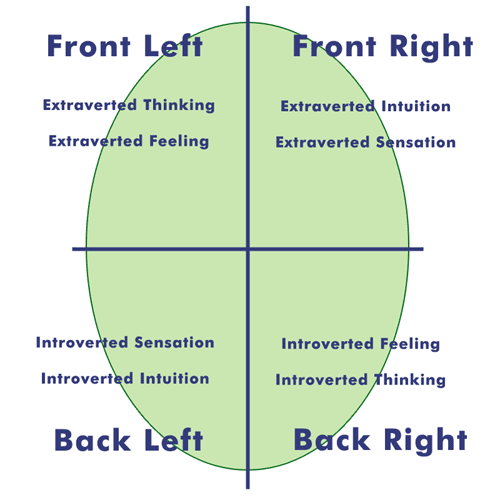
Types and The Brain: The [Pseudo?]Science Behind MBTIWhen Carl Jung wrote about the cognitive functions, he did not have the technological resources we have today to study parts of the brain, so he relied largely on anecdotal evidence from interactions with people. Now, neuroscience has evolved to the point where we can pinpoint certain aspects of the brain that are responsible for personality and behavior. This has allowed people like Jonathan Niednagel and Lenore Thomson to expand upon Jung's original theories and give an added dimension to personality typing. However, science hasn't proven everything, and a lot of the theories surrounding MBTI are still not evidence-based as of yet. I will point out that neither myself, Niednagel, nor Thomson are neuroscientists; it is the work of others that has led them to develop their theories. I also do not currently have access to the original research articles that formed the basis of these theories, but I do have a copy of Niednagel's book, Your Key To Sports Success, which has a chapter on the neuroscience behind typing. Most of my information will come from that chapter, as well as the page on Niednagel's web site, "Brain Types & The Brain". Front and Back: Extraversion and Introversion Niednagel associates Extraversion with the front of the brain (anterior to the central sulcus) and Introversion with the back of the brain (posterior to the central sulcus). Most of the areas in the brain that initiate action and speech are located in the front of the brain, while the back of the brain gathers and processes data. Here are some lines from Niednagel's site regarding Extraversion: --personality—the prefrontal cortex is the most significant area for creating one’s outward “personality”. --Expressing language through conversation/speech (activated by Brocas [left anterior forebrain]). In general, Extraverts speak more and louder than Introverts. (Nurturing, environment, and genetic variances also affect speech patterns; thus explaining most speech differences among Extraverts [and Introverts].) A University of California medical school used PET scans to examine brain regions of people while speaking. They looked at the brain while they (1) made nonsense syllables, (2) recited the months of the year, and (3) recited a briefly memorized prose passage. While both the "mindless" recitation of the months and the prose passage used Wernicke's area (the top back part of the temporal lobe), ONLY the prose showed activity in Broca's area. The conclusion: rote memorized verbal tasks require little thought or sophisticated cortical activity. Bookheimer, S., et al. 2000. Neurology, Vol 55(8), 1151-1157. --voluntary motor movements (activated by primary motor cortex—anterior to central sulcus). Moving the body is an Extraverted (energy-expending) function, activated by the motor cortex. --high degree of “attention” to outside world (principally a function of the anterior forebrain—especially right superior frontal gyrus) --expressing emotion (left anterior forebrain) --dopamine (a neurotransmitter that says “do it” is primarily in anterior forebrain. --cingulate gyrus—regarded as the volition and will center (located in anterior forebrain); it causes humans to act. In addition, Extraverts are innately designed to expend energy whereas Introverts conserve it. --planning—an integral part of taking action and expending energy. Planning involves maintaining one main goal while working on sub-goals for that main goal. This is apparently one of the unique human brain functions. The National Institutes of Health in Bethesda, Maryland has published findings that show that that particular task is performed in the most anterior part of the frontal lobes called the fronto- polar prefrontal cortex. Koechlin et. al, Nature 1999, vol 399(6732) 148-151. And here are the points regarding Introversion: --understanding and comprehension of language (processed in left temporal lobe—Wernickes) --5 senses (taking in world around self) --touch and pressure (parietal lobe—which controls the primary sensory cortex. Behind the primary sensory cortex is a large association area that controls fine sensation—weight, size, shape, etc.) --smell and sound (temporal lobe) --sight (occipital lobe) --long-term memory—stored primarily posterior to central sulcus --neuroscientists now suspect there are 4 separate memory systems in the brain (rather than one as long believed). Conscious memory of facts and events—hippocampus; associative learning (like Pavlovian conditioning)—cerebellum; emotional memories—amygdala; memories of learned skills—basal ganglia. These are posterior brain regions. --In Alzheimer’s disease, long-term memory fades as the posterior brain cells die --self awareness (parietal lobe) --Introverts conserve energy whereas Extraverts expend it. --reading (posterior region) Dr. Kenneth Pugh, Psychiatrist and Medical Researcher at Yale, has been studying the neural pathways which are generated in good readers. When the brain is asked to go from the listening and speaking modes to the visual spatial, yet abstract production of reading, new relationships between regions in the cortex are formed. This is true for all written languages. Skilled readers have engineered neural networks, which take the visual sensory input from "eye to meaning" in about 150 milliseconds. This is done through the dominant path of the eye to three posterior gyrus (areas in the back half of the cortex). The lingual, fusiform and angular gyrus collaborate to convert letters into meaning. Left and Right: Judging and Perceiving It had been thought that the left side of the brain was associated with Thinking and Sensing, while the right side of the brain was associated with Feeling and Intuition. More recent studies, though, have shown that aspects of all four are located in both hemispheres. For example, while verbal logic comes from the left hemisphere (and especially Broca's area in the left anterior), the right hemisphere is superior in spatial and synthetic reasoning. The left frontal region expresses emotion, while the amygdala (located in the posterior) is responsible for emotional memory. The understanding of abstract words comes from Wernicke's, in the left posterior region of the brain, while the right anterior part is responsible for intonation, mental imagery, and the understanding of metaphor. Here's what Niednagel has to say about the left side of the brain: Judging (J): Structure, organization, seeking closure, local/detailed, methodical, and analytic (step-by-step). --the left brain is essentially the Judging hemisphere (unknown to Jung and Myers) --left brain performs sequential analysis, approaching matters methodically --left brain performs sequential body functions—which are mechanical, inflexible, rigid --left brain is orchestrated to a state of “local” bias --the “J” left brain is the conscious hemisphere, more in touch with the moment. It is time driven, clock driven—especially the SJs. And here's what he has to say about the right side of the brain: --right brain is principally the Perceiving hemisphere --it’s involved in parallel/pattern processing --right brain processing is tilted towards the “global” --performs holistic body functions—which are smooth, graceful --the “P” right brain is the subconscious hemisphere; it is has greater difficulty paying attention. This explains why the vast majority of persons diagnosed with ADD are right-brained dominant Ps. The right-brained “P” is process-oriented rather than time/clock driven. --as reported above, many who suffer right-brain strokes can understand the literal meaning of sentences--their left brain can still decode the words--but they can no longer get jokes or allusions. An intact right brain is needed to make the more playful connections. -- the current assumptions about the relationship between handedness and lateralization are oversimplified. This is especially evident in left handed people who demonstrate use of their "non-dominate hand" in many more activities than right handed people. In addition, it is worth noting that, even though J's may be left-brain dominant and P's may be right-brain dominant, we all are capable of using both hemispheres. We will, if possible, prefer one over the other, however. A study out of Duke University shows that, if at all possible, our brain will solve tasks by processing information in only one hemisphere. We see this on simple problem solving tasks. However, as the tasks get more complex, the brain will always choose to process by coordinating information between the two hemispheres. Weissman and Banich (2000). Neuropsychology, vol 14(1), 41-59. So What Hasn't Been Proven? As I've mentioned above, Thinking, Feeling, Sensing, and Intuition are all located in both the left and right hemispheres of the brain, with specific aspects in each. Thomson organizes the functions as follows (note that Thomson is making an approximation here; science hasn't specifically pinpointed the functions to these specific regions): Front-Left: Te, Fe Front-Right: Se, Ne Back-Left: Si, Ni Back Right: Ti, Fi Interestingly, each region of the brain is associated with two functions. According to this, Ti and Fi are in the same part of the brain, so how can we neurologically tell the difference between the two? Niednagel primarily uses motor movements to distinguish between SFs, STs, NFs, and NTs. Motor movements are initiated from the primary motor cortex, with specific regions of the cortex correlating to specific regions of the body. Niednagel's theory is that SFs specialize in the gross motor region (from the toes to the elbow), STs specialize in the fine motor region (from the wrist to the eye), NFs specialize in the "language" region (face to swallowing), and NTs specialize in the cerebral cortex (separate from the fine motor cortex). While science has pinpointed specific areas of the primary motor cortex to specific muscles in the body, the association between the middle two letters of one's type and their motor skills comes largely from anecdotal evidence (basically Niednagel observed that certain people of the same personality type had the same motor skill arrangement). Effectively, we have only really proven the existence of two of the four letters of the type code: E vs. I and J vs. P. Brain Typing is a system based on the Myers-Briggs types that's primarily used for typing athletes. Nonetheless, it can be applied to anyone, and it has some interesting peculiarities. Supposedly, the types roughly correlate with the Myers-Briggs personalities. Here are the basics of the system: - Introversion = low energy level. Extraversion = high energy level. - Intuition = abstract thinker/poor motor skills. Sensation = concrete/empirical thinker/strong motor skills. - Thinking = adeptness with the inanimate world/reasons well under pressure. Feeling = adeptness with the animate world/doesn't reason well under pressure. - Perceiving = right-brain dominance/spatially skilled/fluid motor movements. Judging = left-brain dominance/verbal/mechanical motor movements. This leads to eight groups of people: 1. NFJs - language skilled (diction). 2. NFPs - language skilled (intonation). 3. NTJs - logical abstraction skilled (drawing conclusions). 4. NTPs - logical abstraction skilled (planning). 5. STJs - fine motor skilled (manual dexterity). 6. STPs - fine motor skilled (hand positioning). 7. SFJs - gross motor skilled (body control). 8. SFPs - gross motor skilled (rhythm). In addition, each type has some concrete skills/features: INTJs - skilled at learning foreign languages. - verbally analytical. - tend to be thin. Examples: Howard Huges, Phil Jackson, Abraham Lincoln, Ted Kaczynski. ENTJs - best debaters (never give in). - best leaders. Examples: John F. Kennedy, George W. Bush, Bill Clinton. INFJs - skilled at writing. Examples: Leigh Steinberg. ENFJs - skilled at public speaking. Examples: Dick Vermeil, Ron Howard, George H. W. Bush. ENTPs - adept at visualization. - best actors. - best comedians. - have high pain thresholds. - most likely to be a thrill-seeking personality. - most likely to be diagnosed with ADHD (with the other EPs ranking second) Examples: Jim Carrey, Bill Gates, Robin Williams. INTPs - most likely to be gifted academically. E.g., excel at subjects such as mathematics, physics, philosophy, etc. - most adept at theoretical logic. Examples: Albert Einstein, Arthur Ashe, William F. Buckley Jr. INFPs - have the most graceful motor movements. - most talented musically. Examples: Tiger Woods, Michael Jackson. ENFPs - most acrobatic. - the best visualizers. - tend to have problems with weight. - have the highest pain threshold. Examples: Oprah Winfrey, Ted Danson, Martin Short. ISTJs - thinnest of the types. Examples: Queen Elizabeth II, Pat Nixon. ESTJs - have the hardest time thinking flexibly. Examples: Richard Nixon, Harry Truman. ISFJs - "skilled at repeated sequential procedures, yielding tangible results." (That sounds like fun - it's almost as if they're saying, "Hey, you're skilled at being a robot.") Examples: None. (Usually not well-known). ESFJs - (I'm not sure what they're skilled at - they really don't list anything). Examples: Princess Diana, Barbara Bush. ISTPs - most mechanically and athletically inclined. Examples: Michael Jordan, Mike Tyson, Gen. H. Norman Schwarzkopf. ESTPs - "smooth operators" - one of the best to operate under pressure. - tend to want to be physically fit. Examples: Arnold Schwarzenegger, Sylvestor Stallone, Joe Montana. ISFPs - most rhythmic (make the best dancers, etc.). Examples: Janet Jackson. ESFPs - have the hardest time keeping their anger in check (i.e., worst inhibitions). - have the most problem with weight. Examples: Elvis Presley, Ivana Trump.
Cons: - seems to be superficial (i.e., is based more on athletics). - doesn't correlate highly with personality traits. - seems to reek of something similar to eugenics. - reeks of pseudo-science. So let's test this theory. How many INTJs here are thin? How many of you have studied foreign languages and have excelled? (I know that I'm not an INTJ, since I stink at foreign languages - too much rote memorization for me). — Preceding unsigned comment added by 84.228.184.142 (talk) 17:35, 17 November 2015 (UTC)
— Preceding unsigned comment added by 84.228.123.51 (talk) 17:48, 12 November 2015 (UTC) Default Visual Identification: body language/movements of the typesI've realized that most people don't understand the diffrent body movements that each type has. I have mentioned this before but people have pretty much had the opinion of, "Well, you haven't really explained this and I don't know what it is". This is my chance to try and explain it. Keep in mind a lot of this information can be found at BrianTypes.com. First let me try to differentiate between Sensing and Intuitive types. Sensors are more solid and compact (and on the negative side, stiff). Intuitives are more loose, acrobatic and have more of a "stretch" (on the negative side they are disjointed). Then let's break up the types into four groups; SF, ST, NF, and NT. I will specifically try to explain the diffrent movements within each group. SF The SF's are dominant in the gross motor areas. That means they have the best control over the toes, ankle, knee, hip, trunk, and shoulder. The SF types use their whole body when moving. Say if they are throwing something, you will see their arm move with their entire body.
ST The ST's are dominant in the fine motor areas. Fine motor are the smaller muscle groups as opposed to the large muscle groups. These guys have best control over the elbow, wrist, hand, fingers, neck and eyes. Their movements look somewhat similar to the SF's, except their whole body isn't "connected" as much as the SF, and they finish more with these fine muscles.
NF The NF's are the next group down the list. Like I said before, they are looser and freer in their movements. They still choose fine over gross movements, but aren't as compact as the ST's. The NF's strongest muscles are in the face, lips, jaw and tongue. Because of this they can be language skilled.
NT The NT's are the furthest from the motor cortex. The will be the most disjointed of the types. You will be able to see that they rely more heavily on the fine motor movements because they are least gifted in the gross ones. Sometimes, if they are swinging a bat or something, they will fall back onto their back leg for support. They are also good speechers and are abstract thinkers.
Judgers are considered left brain dominant. They have more body control and also have more dexterity. Judgers are more mechanical; their movements seem to be step by step and placed perfectly on purpose. Percievers are considered more right brain dominant. They have more body rythm and are better at positioning. They will have more fluid motions and can seem more bouncy. Percievers have more hollistic movements. Introversion vs. Extraversion Introverts are energy conserving and Extraverts are energy expending. An Introvert will try to be conservative with their movements. They also store up energy and are more intense; they let out all their energy when they need it. Extraverts will be constantly using up energy but aren't as focused or intense as the Introverts. — Preceding unsigned comment added by 84.228.230.71 (talk) 08:58, 28 February 2016 (UTC) Brain typingBrain typing is a system based on the Myers-Briggs types that's primarily used for typing athletes. Nonetheless, it can be applied to anyone, and it has some interesting peculiarities. Supposedly, the types roughly correlate with the Myers-Briggs personalities. Here are the basics of the system: - Introversion = low energy level. Extraversion = high energy level. - Intuition = abstract thinker/poor motor skills. Sensation = concrete/empirical thinker/strong motor skills. - Thinking = adeptness with the inanimate world/reasons well under pressure. Feeling = adeptness with the animate world/doesn't reason well under pressure. - Perceiving = right-brain dominance/spatially skilled/fluid motor movements. Judging = left-brain dominance/verbal/mechanical motor movements. This leads to eight groups of people: 1. NFJs - language skilled (diction). 2. NFPs - language skilled (intonation). 3. NTJs - logical abstraction skilled (drawing conclusions). 4. NTPs - logical abstraction skilled (planning). 5. STJs - fine motor skilled (manual dexterity). 6. STPs - fine motor skilled (hand positioning). 7. SFJs - gross motor skilled (body control). 8. SFPs - gross motor skilled (rhythm). In addition, each type has some concrete skills/features: INTJs - skilled at learning foreign languages. - verbally analytical. - tend to be thin. Examples: Howard Huges, Phil Jackson, Abraham Lincoln, Ted Kaczynski. ENTJs - best debaters (never give in). - best leaders. Examples: John F. Kennedy, George W. Bush, Bill Clinton. INFJs - skilled at writing. Examples: Leigh Steinberg. ENFJs - skilled at public speaking. Examples: Dick Vermeil, Ron Howard, George H. W. Bush. ENTPs - adept at visualization. - best actors. - best comedians. - have high pain thresholds. - most likely to be a thrill-seeking personality. - most likely to be diagnosed with ADHD (with the other EPs ranking second) Examples: Jim Carrey, Bill Gates, Robin Williams. INTPs - most likely to be gifted academically. E.g., excel at subjects such as mathematics, physics, philosophy, etc. - most adept at theoretical logic. Examples: Albert Einstein, Arthur Ashe, William F. Buckley Jr. INFPs - have the most graceful motor movements. - most talented musically. Examples: Tiger Woods, Michael Jackson. ENFPs - most acrobatic. - the best visualizers. - tend to have problems with weight. - have the highest pain threshold. Examples: Oprah Winfrey, Ted Danson, Martin Short. ISTJs - thinnest of the types. Examples: Queen Elizabeth II, Pat Nixon. ESTJs - have the hardest time thinking flexibly. Examples: Richard Nixon, Harry Truman. ISFJs - "skilled at repeated sequential procedures, yielding tangible results." (That sounds like fun - it's almost as if they're saying, "Hey, you're skilled at being a robot.") Examples: None. (Usually not well-known). ESFJs - (I'm not sure what they're skilled at - they really don't list anything). Examples: Princess Diana, Barbara Bush. ISTPs - most mechanically and athletically inclined. Examples: Michael Jordan, Mike Tyson, Gen. H. Norman Schwarzkopf. ESTPs - "smooth operators" - one of the best to operate under pressure. - tend to want to be physically fit. Examples: Arnold Schwarzenegger, Sylvestor Stallone, Joe Montana. ISFPs - most rhythmic (make the best dancers, etc.). Examples: Janet Jackson. ESFPs - have the hardest time keeping their anger in check (i.e., worst inhibitions). - have the most problem with weight. Examples: Elvis Presley, Ivana Trump.
Cons: - seems to be superficial (i.e., is based more on athletics). - doesn't correlate highly with personality traits. - seems to reek of something similar to eugenics. - reeks of pseudo-science. So let's test this theory. How many INTJs here are thin? How many of you have studied foreign languages and have excelled? (I know that I'm not an INTJ, since I stink at foreign languages - too much rote memorization for me). — Preceding unsigned comment added by 84.228.230.71 (talk) 09:05, 28 February 2016 (UTC) |




Content Disclaimer
Informasi ini disarikan dari Wikipedia dan disajikan kembali untuk tujuan edukasi. Konten tersedia di bawah lisensi CC BY-SA 3.0. Kami tidak bertanggung jawab atas ketidakakuratan data yang bersumber dari kontribusi publik tersebut.
- The information displayed on this website is sourced in part or in whole from Wikipedia and has been adapted for the purpose of restating it. We strive to provide accurate and relevant information, however:
- There is no guarantee of absolute accuracy. Wikipedia is an open, collaborative project that can be edited by anyone, so information is subject to change.
- It is not intended to constitute professional advice. The content displayed is for informational and educational purposes only. For important decisions (e.g., medical, legal, or financial), please consult a professional.
- Content copyright. Wikipedia is licensed under the Creative Commons Attribution-ShareAlike License (CC BY-SA). This means that content may be reused with appropriate attribution and shared under a similar license.
- Responsible use. Any risk arising from the use of information from this website is entirely the responsibility of the user.