Talk:Binomial distribution
 | This  level-4 vital article is rated B-class on Wikipedia's content assessment scale. level-4 vital article is rated B-class on Wikipedia's content assessment scale.It is of interest to the following WikiProjects: | ||||||||||||||||||||
| |||||||||||||||||||||


 | Text and/or other creative content from this version of BinomialDistribution/Revisited was copied or moved into Binomial distribution with this edit on 23 November 2001. The former page's history now serves to provide attribution for that content in the latter page, and it must not be deleted as long as the latter page exists. |

Clarifications
If you go to previous versions and look at the first one, 02/15/2001, which is yours?, you will see :
1). q (1-p), maybe a typo?
2). And the formula for the numbers of ways of picking X items out of N items was:
N!/X!/(N-X)!. This is plain wrong. Yes, after requesting a change for a week, I changed it.
3).There were also wording problems. RoseParks.
I see now the problem. (1-p) was intended as a parenthetical definition. I guess N1/X!/(N-X)! worked in my programming codes so I couldn't see the ambiguity. How would you calculate N!/X!/(N-X)!? From right to left? On the other hand, Today is 02/20/2001, so I think your "requesting a change for a week" is a bit off. Today is only the 20th by my calendar. In any case, the criticism has led to something better. Dick Beldin---- In answer to your question on how you evaluate, N!/X!/(X-N)!, this is ambiguous. In any easy example.
2/4/12 is ambiguous since
- (2/4)/12= 2/48=1/24 while
- 2/(4/12)= 24/4= 6.
Multiplication is associative over the reals. If you look at division as the inverse operation of multplication, i.e. 2/4/12=2*4^1*12^1=1/24 you are okay. If you look at division in the ordinary sense, you must specify the order of operations.RoseParks
I agree that an expression with successive divisions appears ambiguous. Most mathematicians I know do indeed consider division as the inverse of multiplication and many programming languages explicitly specify that multiplication and divisions are performed left to right. You are correct, it is not a universal convention. In addition, the vertical placement of numerator and denominator is clearer. Dick Beldin — Preceding unsigned comment added by Conversion script (talk • contribs) 14:51, 25 February 2002 (UTC)
Accessibility
Would it be possible to write an introductory section that gives just a conceptual description of what the binomial distribution is about, before we enter the maths? Like tossing a coin, or drawing marbles from a box, and replacing the drawn marble each time (and mixing the box up again)? --JN466 02:18, 3 July 2011 (UTC)
- Good idea. The lead sort of introduces it, but there should be room for a more detailed overview. Sources shouldn't be too tricky to find. Alzarian16 (talk) 04:20, 3 July 2011 (UTC)
- @Jayen466 Yes I find many articles like this on Wikipedia, that are of basic principles but are competely opaque to those who have not already been taught the subject. I'm used to looking up and learning a few of the highlighted terms in most articles, but any that involve highly jargonated subjects like maths, linguistics, atomic physics etc, that are all 'explained' with multi-factored equations that are explained by more multifactored equations, and jargon words for simple things, are completely impossible to read and a barrier to learning! Ideally, a source of knowledge for all, like Wikipedia, should start pages with introductions that explain the principle without assuming prior knowledge. I came here to check what someone meant by saying a graph was a binomial distribution: I'm used to looking at graphs but not familiar with the opaque words that describe their shape. I do not want to spend all night reading what every odd word and symbol means: I just want to know what is binomial about a distribution of votes for two candidates with a bit of a gap at 50%, and then carry on reading that article: not this weird mathematicians only impenetrable 'explanation'. 86.138.99.25 (talk) 21:51, 27 February 2025 (UTC)
- Just in case ... there's also bimodal distribution, which is a bit more accessible of a concept and is maybe what your someone was saying. —Quantling (talk | contribs) 22:18, 27 February 2025 (UTC)
Fisher information is actually expected Fisher information
Hi all, it seems to me that what is described here as the Fisher information is actually the expected Fisher information, i.e. expectation of the Fisher information (where the expectation is taken with respect to the data)[1]
The actual Fisher information is:
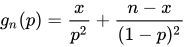
For a derivation of the Fisher information, see example 2.10 of this book,[2] and for a derivation of how taking the expectation leads to see example 4.1 of the same book.
![{\displaystyle {\text{E}}_{X}[g_{n}(p)]={\frac {n}{p(1-p)}}}](https://wikimedia.org/api/rest_v1/media/math/render/svg/fa56038c5c509bda52b8d75c3a109305f5f3416b)
Should we change that in the page? Best
Ddreif (talk) 18:44, 14 November 2021 (UTC)
References
- ^ Held, L., Sabanés Bové, D. (2014). Applied Statistical Inference. Springer Berlin Heidelberg. doi:10.1007/978-3-642-37887-4. ISBN 978-3-642-37886-7.
- ^ Held, L., Sabanés Bové, D. (2014). Applied Statistical Inference. Springer Berlin Heidelberg. doi:10.1007/978-3-642-37887-4. ISBN 978-3-642-37886-7.
Wiki Education Foundation-supported course assignment
 This article was the subject of a Wiki Education Foundation-supported course assignment, between 27 August 2021 and 19 December 2021. Further details are available on the course page. Peer reviewers: Ziyanggod, C.Hua Wang, Jiang1725.
Above undated message substituted from Template:Dashboard.wikiedu.org assignment by PrimeBOT (talk) 15:44, 16 January 2022 (UTC)
Consistent capitalization required on same page
In some places the article uses Binomial (not at start of sentence) and in others binomial. Universemaster1 (talk) 14:01, 28 May 2022 (UTC)
India Education Program course assignment
 This article was the subject of an educational assignment supported by Wikipedia Ambassadors through the India Education Program.
The above message was substituted from {{IEP assignment}} by PrimeBOT (talk) on 19:51, 1 February 2023 (UTC)
Why are equations suddenly not showing?
Something in Firefox? Found it: text color must be black. OveGjerlow (talk) 19:09, 20 September 2023 (UTC)
Interpretation
I think some parts should be more accented in the first sentences of the interpretation section. I mean the sentence:
The binomial distribution is concerned with the probability of obtaining any of these sequences, meaning the probability of obtaining one of them
which is important, so should be almost repeated at the beginning, for example:
This probability formula means the probability of obtaining k successes in n trials for all possible combinations.
Then you can leave the rest: The formula can be understood as follows ...
Also, I know that Wikipedia has a unique problem with writing in plain language, but I would add a simple descriptive example that is easy to grasp: If we have a fair coin (p = 0.5) and two trials (n = 2), then if we want to get 2 heads (k = 2), there is only one possibility to achieve this (2! / (2!*0!) = 1), and since we need to get heads twice, it means that P = 0.5*0.5 = 0.25 (which is the same by our formula: P = 1*0.5^2*0.5^(2-2) = 0.25). Pawel.jamiolkowski (talk) 16:36, 15 July 2024 (UTC)
floor(np) in Definitions
I don't understand how the conclusion at the end of the Probability mass function subsection of the Definitions section (M = floor(np)) was derived.
Suppose n=10 and p=0.99. Then floor(np)=9 and the inequalities indicated are not all satisfied.
M-p < np <= M+1-p
becomes
8.01 < 9.9 <= 9.01
The last inequality is incorrect.
~2026-90779-3 (talk) 13:07, 10 February 2026 (UTC)
- Indeed, that was incorrect, I removed it. A WP:TROUT for you, Cosmia Nebula. Tercer (talk) 14:24, 10 February 2026 (UTC)
- Thanks. I was losing my mind trying to understand until I did a simple trial. ~2026-90779-3 (talk) 15:03, 10 February 2026 (UTC)
- @~2026-90779-3, in case you're interested: assume that is an integer such that This is indeed equivalent to as was claimed. If we assume and apply the floor function to this inequality, we get note that one the "<" became a "≤", because the floor function is non-decreasing but it is not increasing. Now, this last inequality is equivalent to meaning that could be either or What you found is an example where one has to take for <math>M<math> to satisfy the inequalities — and, indeed, 9.01 ≤ 9.9 ≤ 10.01. Malparti (talk) 15:42, 10 February 2026 (UTC)
- Thanks. I was losing my mind trying to understand until I did a simple trial. ~2026-90779-3 (talk) 15:03, 10 February 2026 (UTC)




Conditional probability proof
The conditional distribution proof is a neat algebra exercise. But a simpler and more intuitive proof which conveys why it is true is simply to note that:
- the probability of a ball hitting the second basket on each trial is a bernoulli trial with probability p*q - the probability it hits the first basket multiplied by the probability it hits the second basket - the binomial distribution is the distribution of successes in n bernoulli trials - therefore the numbers of balls hitting the second basket is distributed as Binom(n, p*q). Venpopov (talk) 13:09, 6 March 2026 (UTC)
Content Disclaimer
Informasi ini disarikan dari Wikipedia dan disajikan kembali untuk tujuan edukasi. Konten tersedia di bawah lisensi CC BY-SA 3.0. Kami tidak bertanggung jawab atas ketidakakuratan data yang bersumber dari kontribusi publik tersebut.
- The information displayed on this website is sourced in part or in whole from Wikipedia and has been adapted for the purpose of restating it. We strive to provide accurate and relevant information, however:
- There is no guarantee of absolute accuracy. Wikipedia is an open, collaborative project that can be edited by anyone, so information is subject to change.
- It is not intended to constitute professional advice. The content displayed is for informational and educational purposes only. For important decisions (e.g., medical, legal, or financial), please consult a professional.
- Content copyright. Wikipedia is licensed under the Creative Commons Attribution-ShareAlike License (CC BY-SA). This means that content may be reused with appropriate attribution and shared under a similar license.
- Responsible use. Any risk arising from the use of information from this website is entirely the responsibility of the user.