Talk:Analytic capacity
 | This article is rated Start-class on Wikipedia's content assessment scale. It is of interest to the following WikiProjects: | ||||||||||
| |||||||||||


Things to be added
2.3 Proof that H1(E)=0 implies gamma(E)=0 2.4 Proof that dim H>1 implies gamma(E)>0 Carolus m 23:19, 18 September 2007 (UTC)
Apparently the classical Painlevé problem has been recently solved by Xavier Tolsa. Someone who knows more about it than myself might like to add some words about this. 75.45.178.71 (talk) 06:59, 17 February 2009 (UTC)
mistakes
if we assume additionally that E is connected. In this case, is simply connected and open.

but isn't this simply false? consider E to be the closed unit disc or even a point. the complement is not simply connected. also, the switching between E and K in this article makes it look very bad and confusing. the whole article deserves a careful reread by an expert. - 99.249.178.235 01:00, 7 November 2007 (UTC)
Not quite. You consider the complement in the Riemann sphere (that was not quite clear, I have amended it accordingly). There is still an issue when you consider -- the complement is not simply connected, since it is connected. The trick is to apply the Riemann Mapping Theorem to the unbounded component of and map the rest to 0. I will amend the article accordingly and unify notation. Carolus m 16:25, 16 November 2007 (UTC)

This article switches freely from E to K and is thus very confusing. I concur that this article needs a careful review and cleanup by an expert. Rljacobson (talk) 03:56, 28 January 2008 (UTC)
- I changed every E to K, which I'm pretty sure doesn't create any new problems. 75.45.178.71 (talk) 06:54, 17 February 2009 (UTC)
It is a bad idea to redefine the notion of simple connectivity. It is better to just make a subset of the Riemann sphere. Moreover, simple-connectivity is not really proven. The fact that the complement of is connected is proven in great detail, but to deduce that is simply connected you need to either do some work or quote some theorem. I will search for the right thing to quote there. Oded (talk) 15:16, 18 June 2008 (UTC)

The statements in the section Analytic capacity#Additional properties assuming finite connectivity seem to be plainly wrong. Oded (talk) 15:40, 18 June 2008 (UTC)
Alternate definition
The Encyclopedia of Math (bottom of article on Capacity of a set) gives an alternate definition:
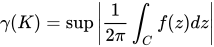
where C is a contour enclosing K and the sup is taken over the same conditions as this article (f analytic outside K, f is bounded by 1, f(infty) vanishes). Seems plausible to me that this is a valid alternative definition, and (to me) it seems to be easier to grok. Hmmm. Whatever. I just added it to the article. 67.198.37.16 (talk) 06:30, 4 February 2024 (UTC)
Content Disclaimer
Informasi ini disarikan dari Wikipedia dan disajikan kembali untuk tujuan edukasi. Konten tersedia di bawah lisensi CC BY-SA 3.0. Kami tidak bertanggung jawab atas ketidakakuratan data yang bersumber dari kontribusi publik tersebut.
- The information displayed on this website is sourced in part or in whole from Wikipedia and has been adapted for the purpose of restating it. We strive to provide accurate and relevant information, however:
- There is no guarantee of absolute accuracy. Wikipedia is an open, collaborative project that can be edited by anyone, so information is subject to change.
- It is not intended to constitute professional advice. The content displayed is for informational and educational purposes only. For important decisions (e.g., medical, legal, or financial), please consult a professional.
- Content copyright. Wikipedia is licensed under the Creative Commons Attribution-ShareAlike License (CC BY-SA). This means that content may be reused with appropriate attribution and shared under a similar license.
- Responsible use. Any risk arising from the use of information from this website is entirely the responsibility of the user.