Stone–Geary utility function
The Stone–Geary utility function takes the form where is utility, is consumption of good , and and are parameters.
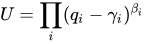


For , the Stone–Geary function reduces to the generalised Cobb–Douglas function.

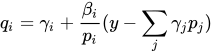
The Stone–Geary utility function gives rise to the Linear Expenditure System.[1] In case of the demand function equals where is total expenditure, and is the price of good .



The Stone–Geary utility function was first derived by Roy C. Geary,[2] in a comment on earlier work by Lawrence Klein and Herman Rubin.[3] Richard Stone was the first to estimate the Linear Expenditure System.[4]
References
- ^ Varian, Hal (1992). "Estimating consumer demands". Microeconomic Analysis (Third ed.). New York: Norton. pp. 212. ISBN 0-393-95735-7.
- ^ Geary, Roy C. (1950). "A Note on 'A Constant-Utility Index of the Cost of Living'". Review of Economic Studies. 18 (2): 65–66. JSTOR 2296107.
- ^ Klein, L. R.; Rubin, H. (1947–1948). "A Constant-Utility Index of the Cost of Living". Review of Economic Studies. 15 (2): 84–87. JSTOR 2295996.
- ^ Stone, Richard (1954). "Linear Expenditure Systems and Demand Analysis: An Application to the Pattern of British Demand". Economic Journal. 64 (255): 511–527. JSTOR 2227743.
Further reading
- Neary, J. Peter (1997). "R.C. Geary's Contributions to Economic Theory" (PDF). In Conniffe, D. (ed.). R.C. Geary, 1893–1983: Irish Statistician. Dublin: Oak Tree Press. Archived from the original (PDF) on 2005-03-25.
- Silberberg, Eugene; Suen, Wing (2001). "Empirical Estimation and Functional Forms". The Structure of Economics: A Mathematical Analysis (Third ed.). Boston: Irwin McGraw-Hill. pp. 357–363. ISBN 0-07-234352-4.
Content Disclaimer
Informasi ini disarikan dari Wikipedia dan disajikan kembali untuk tujuan edukasi. Konten tersedia di bawah lisensi CC BY-SA 3.0. Kami tidak bertanggung jawab atas ketidakakuratan data yang bersumber dari kontribusi publik tersebut.
- The information displayed on this website is sourced in part or in whole from Wikipedia and has been adapted for the purpose of restating it. We strive to provide accurate and relevant information, however:
- There is no guarantee of absolute accuracy. Wikipedia is an open, collaborative project that can be edited by anyone, so information is subject to change.
- It is not intended to constitute professional advice. The content displayed is for informational and educational purposes only. For important decisions (e.g., medical, legal, or financial), please consult a professional.
- Content copyright. Wikipedia is licensed under the Creative Commons Attribution-ShareAlike License (CC BY-SA). This means that content may be reused with appropriate attribution and shared under a similar license.
- Responsible use. Any risk arising from the use of information from this website is entirely the responsibility of the user.