Squirmer

The squirmer is a model for a spherical microswimmer swimming in Stokes flow. The squirmer model was introduced by James Lighthill in 1952 and refined and used to model Paramecium by John Blake in 1971.[1] [2] Blake used the squirmer model to describe the flow generated by a carpet of beating short filaments called cilia on the surface of Paramecium. Today, the squirmer is a standard model for the study of self-propelled particles, such as Janus particles, in Stokes flow.[3]
Velocity field in particle frame
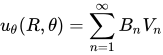
Here we give the flow field of a squirmer in the case of a non-deformable axisymmetric spherical squirmer (radius ).[1][2] These expressions are given in a spherical coordinate system.



Here are constant coefficients, are Legendre polynomials, and .
One finds .
The expressions above are in the frame of the moving particle. At the interface one finds and .





|
 |
 |
 |
 |
 |
|
 |
 |
 |
|
 |
| Velocity field of squirmer and passive particle (top row: lab frame, bottom row: swimmer frame, ). | |||||


Swimming speed and lab frame
By using the Lorentz Reciprocal Theorem, one finds the velocity vector of the particle . The flow in a fixed lab frame is given by :




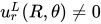
with swimming speed . Note, that and .


Structure of the flow and squirmer parameter
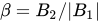
The series above are often truncated at in the study of far field flow, . Within that approximation, , with squirmer parameter . The first mode characterizes a hydrodynamic source dipole with decay (and with that the swimming speed ). The second mode corresponds to a hydrodynamic stresslet or force dipole with decay .[4] Thus, gives the ratio of both contributions and the direction of the force dipole. is used to categorize microswimmers into pushers, pullers and neutral swimmers.[5]





| Swimmer Type | pusher | neutral swimmer | puller | shaker | passive particle |
| Squirmer Parameter | |||||
| Decay of Velocity Far Field | |||||
| Biological Example | E. coli | Paramecium | Chlamydomonas reinhardtii |


The above figures show the velocity field in the lab frame and in the particle-fixed frame. The hydrodynamic dipole and quadrupole fields of the squirmer model result from surface stresses, due to beating cilia on bacteria, or chemical reactions or thermal non-equilibrium on Janus particles. The squirmer is force-free. On the contrary, the velocity field of the passive particle results from an external force, its far-field corresponds to a "stokeslet" or hydrodynamic monopole. A force-free passive particle doesn't move and doesn't create any flow field.
See also
References
- ^ a b Lighthill, M. J. (1952). "On the squirming motion of nearly spherical deformable bodies through liquids at very small reynolds numbers". Communications on Pure and Applied Mathematics. 5 (2): 109–118. doi:10.1002/cpa.3160050201. ISSN 0010-3640.
- ^ a b Blake, J. R. (1971). "A spherical envelope approach to ciliary propulsion". Journal of Fluid Mechanics. 46 (1): 199–208. Bibcode:1971JFM....46..199B. doi:10.1017/S002211207100048X. ISSN 0022-1120. S2CID 122519123.
- ^ Bickel, Thomas; Majee, Arghya; Würger, Alois (2013). "Flow pattern in the vicinity of self-propelling hot Janus particles". Physical Review E. 88 (1) 012301. arXiv:1401.7311. Bibcode:2013PhRvE..88a2301B. doi:10.1103/PhysRevE.88.012301. ISSN 1539-3755. PMID 23944457. S2CID 36558271.
- ^ Happel, John; Brenner, Howard (1981). Low Reynolds number hydrodynamics. Mechanics of fluids and transport processes. Vol. 1. doi:10.1007/978-94-009-8352-6. ISBN 978-90-247-2877-0. ISSN 0921-3805.
- ^ Downton, Matthew T; Stark, Holger (2009). "Simulation of a model microswimmer". Journal of Physics: Condensed Matter. 21 (20) 204101. Bibcode:2009JPCM...21t4101D. doi:10.1088/0953-8984/21/20/204101. ISSN 0953-8984. PMID 21825510. S2CID 35850530.
Content Disclaimer
Informasi ini disarikan dari Wikipedia dan disajikan kembali untuk tujuan edukasi. Konten tersedia di bawah lisensi CC BY-SA 3.0. Kami tidak bertanggung jawab atas ketidakakuratan data yang bersumber dari kontribusi publik tersebut.
- The information displayed on this website is sourced in part or in whole from Wikipedia and has been adapted for the purpose of restating it. We strive to provide accurate and relevant information, however:
- There is no guarantee of absolute accuracy. Wikipedia is an open, collaborative project that can be edited by anyone, so information is subject to change.
- It is not intended to constitute professional advice. The content displayed is for informational and educational purposes only. For important decisions (e.g., medical, legal, or financial), please consult a professional.
- Content copyright. Wikipedia is licensed under the Creative Commons Attribution-ShareAlike License (CC BY-SA). This means that content may be reused with appropriate attribution and shared under a similar license.
- Responsible use. Any risk arising from the use of information from this website is entirely the responsibility of the user.