Specific pump power
Specific Pump Power (SPP) is a metric in fluid dynamics that quantifies the energy-efficiency of pump systems. It is a measure of the electric power that is needed to operate a pump (or collection of pumps), relative to the volume flow rate. It is not constant for a given pump, but changes with both flow rate and pump pressure. This term 'SPP' is adapted from the established metric Specific fan power (SFP) for fans (blowers).[1] It is commonly used when measuring the energy efficiency of buildings.[2][3]
Definition
The SPP for a specific operating point (combination of flow rate and pressure rise) for a pump system is defined as:
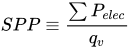
where:
- is the electrical power used by the pump (or sum of all pumps in a system or subsystem) [kW]
- is the volumetric flow rate of fluid passing through the pump (or system) [m3/s], Some countries use [l/s]


Just as for SFP (i.e. fan power), SPP is also related to pump pressure (pump head) and the pump system efficiency, as follows:
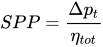
where:
- is the rise in total pressure across the pump system, aka. pump head [kPa]. This is a property of the fluid circuit in which the pump is placed.
- is the overall efficiency of the pump system [-]. This is the combined product of multiple losses, including bearing friction, impeller fluid dynamic losses, leakage losses (backflow), all losses in the motor (friction, magnetic losses, copper losses, stray load), and losses in the speed control electronics (for variable-speed pumps). The pump system efficiency is therefore not fixed, but depends on the operating point (flow and pressure).


This equation is simply an application of Bernoulli's principle in the case where the inlet and outlet have the same diameter and same height. Observe that SPP is not a property of the pump alone, but is also dependent on the pressure drop of the circuit that the pump circulates fluid through. Thus, in order to minimize energy use for pump system, one must reduce the system pressure drop (e.g. use large diameter pipes and low flow rates) in addition to selecting pumps with good intrinsic efficiency (hydrodynamically efficient with an efficient motor).
Applying the above equations enables us to estimate electrical power consumption in a number of ways:

where:
- is the hydraulic power () [kW]


See also
References
- ^ CAROLINE MARKUSSON. Efficiency of building related pump and fan operation Application and system solutions (Thesis). Chalmers University of Technology. CiteSeerX 10.1.1.851.7564.
- ^ A zero emission concept analysis of a single family house (PDF) (Report). Retrieved 16 May 2018.
- ^ "Technical Assessment of the Combined Heat and Power Plant at the Oregon Institute of Technology, Klamath Falls, Oregon" (PDF). GRC Transactions. 36. 2012. Retrieved 16 May 2018.
Content Disclaimer
Informasi ini disarikan dari Wikipedia dan disajikan kembali untuk tujuan edukasi. Konten tersedia di bawah lisensi CC BY-SA 3.0. Kami tidak bertanggung jawab atas ketidakakuratan data yang bersumber dari kontribusi publik tersebut.
- The information displayed on this website is sourced in part or in whole from Wikipedia and has been adapted for the purpose of restating it. We strive to provide accurate and relevant information, however:
- There is no guarantee of absolute accuracy. Wikipedia is an open, collaborative project that can be edited by anyone, so information is subject to change.
- It is not intended to constitute professional advice. The content displayed is for informational and educational purposes only. For important decisions (e.g., medical, legal, or financial), please consult a professional.
- Content copyright. Wikipedia is licensed under the Creative Commons Attribution-ShareAlike License (CC BY-SA). This means that content may be reused with appropriate attribution and shared under a similar license.
- Responsible use. Any risk arising from the use of information from this website is entirely the responsibility of the user.