Small boundary property
In mathematics, the small boundary property is a property of certain topological dynamical systems. It is dynamical analog of the inductive definition of Lebesgue covering dimension zero.
Definition
Consider the category of topological dynamical system (system in short) consisting of a compact metric space and a homeomorphism . A set is called small if it has vanishing orbit capacity, i.e., . This is equivalent to: where denotes the collection of -invariant measures on .


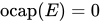



The system is said to have the small boundary property (SBP) if has a basis of open sets whose boundaries are small, i.e., for all .




Can one always lower topological entropy?
Small sets were introduced by Michael Shub and Benjamin Weiss while investigating the question "can one always lower topological entropy?" Quoting from their article:[1]
"For measure theoretic entropy, it is well known and quite easy to see that a positive entropy transformation always has factors of smaller entropy. Indeed the factor generated by a two-set partition with one of the sets having very small measure will always have small entropy. It is our purpose here to treat the analogous question for topological entropy... We will exclude the trivial factor, where it reduces to one point."
Recall that a system is called a factor of , alternatively is called an extension of , if there exists a continuous surjective mapping which is eqvuivariant, i.e. for all .




Thus Shub and Weiss asked: Given a system and , can one find a non-trivial factor so that ?

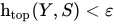
Recall that a system is called minimal if it has no proper non-empty closed -invariant subsets. It is called infinite if .

Lindenstrauss introduced SBP and proved:[2]
Theorem: Let be an extension of an infinite minimal system. The following are equivalent:
- has the small-boundary property.
- , where denotes mean dimension.
- For every , , there exists a factor so and .
- where is an inverse limit of systems with finite topological entropy for all .







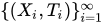

Later this theorem was generalized to the context of several commuting transformations by Gutman, Lindenstrauss and Tsukamoto.[3]
Systems with no non-trivial finite entropy factors
Let and be the shift homeomorphism
![{\displaystyle X=[0,1]^{\mathbb {Z} }}](https://wikimedia.org/api/rest_v1/media/math/render/svg/45decd15647fd72d387ea6a03752af73e9f16a19)

This is the Baker's map, formulated as a two-sided shift. It can be shown that has no non-trivial finite entropy factors.[2] One can also find minimal systems with the same property.[2]
References
- ^ Shub, Michael, and B. Weiss. "Can one always lower topological entropy?." Ergodic Theory and Dynamical Systems 11.3 (1991): 535–546.
- ^ a b c Lindenstrauss, Elon (1999-12-01). "Mean dimension, small entropy factors and an embedding theorem". Publications Mathématiques de l'Institut des Hautes Études Scientifiques. 89 (1): 227–262. doi:10.1007/BF02698858. ISSN 0073-8301.
- ^ Gutman, Yonatan, Elon Lindenstrauss, and Masaki Tsukamoto. "Mean dimension of -actions." Geometric and Functional Analysis 26.3 (2016): 778–817.

Content Disclaimer
Informasi ini disarikan dari Wikipedia dan disajikan kembali untuk tujuan edukasi. Konten tersedia di bawah lisensi CC BY-SA 3.0. Kami tidak bertanggung jawab atas ketidakakuratan data yang bersumber dari kontribusi publik tersebut.
- The information displayed on this website is sourced in part or in whole from Wikipedia and has been adapted for the purpose of restating it. We strive to provide accurate and relevant information, however:
- There is no guarantee of absolute accuracy. Wikipedia is an open, collaborative project that can be edited by anyone, so information is subject to change.
- It is not intended to constitute professional advice. The content displayed is for informational and educational purposes only. For important decisions (e.g., medical, legal, or financial), please consult a professional.
- Content copyright. Wikipedia is licensed under the Creative Commons Attribution-ShareAlike License (CC BY-SA). This means that content may be reused with appropriate attribution and shared under a similar license.
- Responsible use. Any risk arising from the use of information from this website is entirely the responsibility of the user.