Six factor formula
The six-factor formula is used in nuclear engineering to determine the multiplication of a nuclear chain reaction in a non-infinite medium.
| Symbol | Name | Meaning | Formula | Typical thermal reactor value |
|---|---|---|---|---|
| Thermal fission factor (eta) | neutrons produced from fission/absorption in fuel isotope | 1.65 | ||
| Thermal utilization factor | neutrons absorbed by the fuel isotope/neutrons absorbed anywhere | 0.71 | ||
| Resonance escape probability | fission neutrons slowed to thermal energies without absorption/total fission neutrons | 0.87 | ||
| Fast fission factor (epsilon) | total number of fission neutrons/number of fission neutrons from just thermal fissions | 1.02 | ||
| Fast non-leakage probability | number of fast neutrons that do not leak from reactor/number of fast neutrons produced by all fissions | 0.97 | ||
| Thermal non-leakage probability | number of thermal neutrons that do not leak from reactor/number of thermal neutrons produced by all fissions | 0.99 |



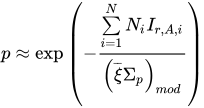

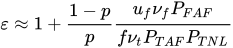



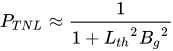
The symbols are defined as:[2]
- , and are the average number of neutrons produced per fission in the medium (2.43 for uranium-235).
- and are the microscopic fission and absorption cross sections for fuel, respectively.
- and are the macroscopic absorption cross sections in fuel and in total, respectively.
- is the macroscopic fission cross-section.
- is the number density of atoms of a specific nuclide.
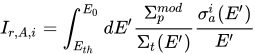
- is the resonance integral for absorption of a specific nuclide.
- is the average lethargy gain per scattering event.
- Lethargy is defined as decrease in neutron energy.
- (fast utilization) is the probability that a fast neutron is absorbed in fuel.
- is the probability that a fast neutron absorption in fuel causes fission.
- is the probability that a thermal neutron absorption in fuel causes fission.
- is the geometric buckling.
- is the diffusion length of thermal neutrons.
- where is the diffusion coefficient.
- is the age to thermal.
- is the evaluation of where is the energy of the neutron at birth.




![{\displaystyle \tau =\int _{E_{th}}^{E'}dE''{\frac {1}{E''}}{\frac {D(E'')}{{\overline {\xi }}\left[D(E''){B_{g}}^{2}+\Sigma _{t}(E')\right]}}}](https://wikimedia.org/api/rest_v1/media/math/render/svg/46740576c97170f8a677df00cb76237bceeed065)


Multiplication
The multiplication factor, k, is defined as (see nuclear chain reaction):
- k = number of neutrons in one generation/number of neutrons in preceding generation
- If k is greater than 1, the chain reaction is supercritical, and the neutron population will grow exponentially.
- If k is less than 1, the chain reaction is subcritical, and the neutron population will exponentially decay.
- If k = 1, the chain reaction is critical and the neutron population will remain constant.
See also
References
- ^ Duderstadt, James; Hamilton, Louis (1976). Nuclear Reactor Analysis. John Wiley & Sons, Inc. ISBN 0-471-22363-8.
- ^ Adams, Marvin L. (2009). Introduction to Nuclear Reactor Theory. Texas A&M University.
Content Disclaimer
Informasi ini disarikan dari Wikipedia dan disajikan kembali untuk tujuan edukasi. Konten tersedia di bawah lisensi CC BY-SA 3.0. Kami tidak bertanggung jawab atas ketidakakuratan data yang bersumber dari kontribusi publik tersebut.
- The information displayed on this website is sourced in part or in whole from Wikipedia and has been adapted for the purpose of restating it. We strive to provide accurate and relevant information, however:
- There is no guarantee of absolute accuracy. Wikipedia is an open, collaborative project that can be edited by anyone, so information is subject to change.
- It is not intended to constitute professional advice. The content displayed is for informational and educational purposes only. For important decisions (e.g., medical, legal, or financial), please consult a professional.
- Content copyright. Wikipedia is licensed under the Creative Commons Attribution-ShareAlike License (CC BY-SA). This means that content may be reused with appropriate attribution and shared under a similar license.
- Responsible use. Any risk arising from the use of information from this website is entirely the responsibility of the user.