Shaping codes
 | This article has multiple issues. Please help improve it or discuss these issues on the talk page. (Learn how and when to remove these messages)
|


In digital communications shaping codes are a method of encoding that changes the distribution of signals to improve efficiency.
Description
Typical digital communication systems uses M-quadrature amplitude modulation (QAM) to communicate through an analog channel (specifically a communication channel with Gaussian noise). For higher bit rates (M) the minimum signal-to-noise ratio (SNR) required by a QAM system with Error Correcting Codes is about 1.53 dB higher than minimum SNR required by a Gaussian source(>30% more transmitter power) as given in the Shannon–Hartley theorem
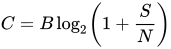
where:
- C is the channel capacity in bits per second;
- B is the bandwidth of the channel in hertz;
- S is the total signal power over the bandwidth and
- N is the total noise power over the bandwidth.
- S/N is the signal-to-noise ratio of the communication signal to the Gaussian noise interference expressed as a straight power ratio rather than in decibels.
This 1.53 dB difference is known as the shaping gap. Typically, a digital system will encode bits with uniform probability to maximize the entropy. Shaping codes act as a buffer between digital sources and the modulator. They will receive uniformly distributed data and convert it to a Gaussian-like distribution before presenting it to the modulator. Shaping codes are helpful in reducing transmit power and thus reducing the cost of the power amplifier and the interference caused to other users in the vicinity.
Application
Some of the methods used for shaping are described in the trellis shaping paper by Dr. G. D. Forney Jr.[1]
Shell mapping, a technique used in signal shaping, is employed in V.34 modems to achieve a shaping gain of approximately 0.8 dB.[2] Most shaping techniques described in the literature seek to reduce transmitted signal power while maintaining the same information rate. Such techniques may also find applications in wireless networks where interference from other nodes is the principal limitation.
References
- ^ Forney, G.D. (1992). "Trellis shaping". IEEE Transactions on Information Theory. 38 (2): 281–300. Bibcode:1992ITIT...38..281F. doi:10.1109/18.119687. S2CID 37984132.
- ^ Fischer, Robert F. H. (2005-01-28). Precoding and Signal Shaping for Digital Transmission. John Wiley & Sons. ISBN 9780471727729.
Content Disclaimer
Informasi ini disarikan dari Wikipedia dan disajikan kembali untuk tujuan edukasi. Konten tersedia di bawah lisensi CC BY-SA 3.0. Kami tidak bertanggung jawab atas ketidakakuratan data yang bersumber dari kontribusi publik tersebut.
- The information displayed on this website is sourced in part or in whole from Wikipedia and has been adapted for the purpose of restating it. We strive to provide accurate and relevant information, however:
- There is no guarantee of absolute accuracy. Wikipedia is an open, collaborative project that can be edited by anyone, so information is subject to change.
- It is not intended to constitute professional advice. The content displayed is for informational and educational purposes only. For important decisions (e.g., medical, legal, or financial), please consult a professional.
- Content copyright. Wikipedia is licensed under the Creative Commons Attribution-ShareAlike License (CC BY-SA). This means that content may be reused with appropriate attribution and shared under a similar license.
- Responsible use. Any risk arising from the use of information from this website is entirely the responsibility of the user.