Sachdev–Ye–Kitaev model
In condensed matter physics and black hole physics, the Sachdev–Ye–Kitaev (SYK) model is an exactly solvable model initially proposed by Subir Sachdev and Jinwu Ye,[1] and later modified by Alexei Kitaev to the present commonly used form.[2][3] The model is believed to bring insights into the understanding of strongly correlated materials and it also has a close relation with the discrete model of AdS/CFT. Many condensed matter systems, such as quantum dot coupled to topological superconducting wires,[4] graphene flake with irregular boundary,[5] and kagome optical lattice with impurities,[6] are proposed to be modeled by it. Some variants of the model are amenable to digital quantum simulation,[7] with pioneering experiments implemented in nuclear magnetic resonance.[8]
Model
Let be an integer and an even integer such that , and consider a set of Majorana fermions which are fermion operators satisfying conditions:


- Hermitian ;
- Clifford relation .

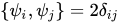
Let be random variables whose expectations satisfy:

- ;
- .

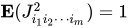
Then the SYK model is defined as
- .

Note that sometimes an extra normalization factor is included.
The most famous model is when :

- ,

where the factor is included to coincide with the most popular form.

See also
References
- ^ Sachdev, Subir; Ye, Jinwu (1993-05-24). "Gapless spin-fluid ground state in a random quantum Heisenberg magnet". Physical Review Letters. 70 (21): 3339–3342. arXiv:cond-mat/9212030. Bibcode:1993PhRvL..70.3339S. doi:10.1103/PhysRevLett.70.3339. PMID 10053843. S2CID 1103248.
- ^ "Alexei Kitaev, Caltech & KITP, A simple model of quantum holography (part 1)". online.kitp.ucsb.edu. Retrieved 2019-11-02.
- ^ "Alexei Kitaev, Caltech, A simple model of quantum holography (part 2)". online.kitp.ucsb.edu. Retrieved 2019-11-02.
- ^ Chew, Aaron; Essin, Andrew; Alicea, Jason (2017-09-29). "Approximating the Sachdev-Ye-Kitaev model with Majorana wires". Phys. Rev. B. 96 (12) 121119. arXiv:1703.06890. Bibcode:2017PhRvB..96l1119C. doi:10.1103/PhysRevB.96.121119. S2CID 119222270.
- ^ Chen, Anffany; Ilan, R.; Juan, F.; Pikulin, D.I.; Franz, M. (2018-06-18). "Quantum Holography in a Graphene Flake with an Irregular Boundary". Phys. Rev. Lett. 121 (3) 036403. arXiv:1802.00802. Bibcode:2018PhRvL.121c6403C. doi:10.1103/PhysRevLett.121.036403. PMID 30085787. S2CID 51940526.
- ^ Wei, Chenan; Sedrakyan, Tigran (2021-01-29). "Optical lattice platform for the Sachdev-Ye-Kitaev model". Phys. Rev. A. 103 (1) 013323. arXiv:2005.07640. Bibcode:2021PhRvA.103a3323W. doi:10.1103/PhysRevA.103.013323. S2CID 234363891.
- ^ García-Álvarez, L.; Egusquiza, I.L.; Lamata, L.; del Campo, A.; Sonner, J.; Solano, E. (2017). "Digital Quantum Simulation of Minimal AdS/CFT". Physical Review Letters. 119 (4) 040501. arXiv:1607.08560. Bibcode:2017PhRvL.119d0501G. doi:10.1103/PhysRevLett.119.040501. PMID 29341740. S2CID 5144368.
- ^ Luo, Z.; You, Y.-Z.; Li, J.; Jian, C.-M.; Lu, D.; Xu, C.; Zeng, B.; Laflamme, R. (2019). "Quantum simulation of the non-fermi-liquid state of Sachdev-Ye-Kitaev model". npj Quantum Information. 5: 53. arXiv:1712.06458. Bibcode:2019npjQI...5...53L. doi:10.1038/s41534-019-0166-7. S2CID 195344916.
Content Disclaimer
Informasi ini disarikan dari Wikipedia dan disajikan kembali untuk tujuan edukasi. Konten tersedia di bawah lisensi CC BY-SA 3.0. Kami tidak bertanggung jawab atas ketidakakuratan data yang bersumber dari kontribusi publik tersebut.
- The information displayed on this website is sourced in part or in whole from Wikipedia and has been adapted for the purpose of restating it. We strive to provide accurate and relevant information, however:
- There is no guarantee of absolute accuracy. Wikipedia is an open, collaborative project that can be edited by anyone, so information is subject to change.
- It is not intended to constitute professional advice. The content displayed is for informational and educational purposes only. For important decisions (e.g., medical, legal, or financial), please consult a professional.
- Content copyright. Wikipedia is licensed under the Creative Commons Attribution-ShareAlike License (CC BY-SA). This means that content may be reused with appropriate attribution and shared under a similar license.
- Responsible use. Any risk arising from the use of information from this website is entirely the responsibility of the user.