Roe solver
The Roe approximate Riemann solver, devised by Phil Roe, is an approximate Riemann solver based on the Godunov scheme and involves finding an estimate for the intercell numerical flux or Godunov flux at the interface between two computational cells and , on some discretised space-time computational domain.


Roe scheme
Quasi-linear hyperbolic system
A non-linear system of hyperbolic partial differential equations representing a set of conservation laws in one spatial dimension can be written in the form
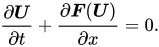
Applying the chain rule to the second term we get the quasi-linear hyperbolic system
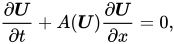
where is the Jacobian matrix of the flux vector .


Roe matrix
The Roe method consists of finding a matrix that is assumed constant between two cells. The Riemann problem can then be solved as a truly linear hyperbolic system at each cell interface. The Roe matrix must obey the following conditions:

- Diagonalizable with real eigenvalues: ensures that the new linear system is truly hyperbolic.
- Consistency with the exact jacobian: when we demand that
- Conserving:



Phil Roe introduced a method of parameter vectors to find such a matrix for some systems of conservation laws.[1]
Intercell flux
Once the Roe matrix corresponding to the interface between two cells is found, the intercell flux is given by solving the quasi-linear system as a truly linear system.
See also
References
- ^ P. L. Roe (1981). "Approximate Riemann solvers, parameter vectors and difference schemes". Journal of Computational Physics. 43 (2): 357–372. Bibcode:1981JCoPh..43..357R. doi:10.1016/0021-9991(81)90128-5.
Further reading
- Toro, E. F. (1999), Riemann Solvers and Numerical Methods for Fluid Dynamics, Springer-Verlag.
Content Disclaimer
Informasi ini disarikan dari Wikipedia dan disajikan kembali untuk tujuan edukasi. Konten tersedia di bawah lisensi CC BY-SA 3.0. Kami tidak bertanggung jawab atas ketidakakuratan data yang bersumber dari kontribusi publik tersebut.
- The information displayed on this website is sourced in part or in whole from Wikipedia and has been adapted for the purpose of restating it. We strive to provide accurate and relevant information, however:
- There is no guarantee of absolute accuracy. Wikipedia is an open, collaborative project that can be edited by anyone, so information is subject to change.
- It is not intended to constitute professional advice. The content displayed is for informational and educational purposes only. For important decisions (e.g., medical, legal, or financial), please consult a professional.
- Content copyright. Wikipedia is licensed under the Creative Commons Attribution-ShareAlike License (CC BY-SA). This means that content may be reused with appropriate attribution and shared under a similar license.
- Responsible use. Any risk arising from the use of information from this website is entirely the responsibility of the user.