Recursive tree
 | This article includes a list of references, related reading, or external links, but its sources remain unclear because it lacks inline citations. (July 2023) |
In graph theory, a recursive tree (i.e., unordered tree) is a labeled, rooted tree. A size-n recursive tree's vertices are labeled by distinct positive integers 1, 2, …, n, where the labels are strictly increasing starting at the root labeled 1. Recursive trees are non-planar, which means that the children of a particular vertex are not ordered; for example, the following two size-3 recursive trees are equivalent: 3/1\2 = 2/1\3.
Recursive trees also appear in literature under the name Increasing Cayley trees.
Properties
The number of size-n recursive trees is given by

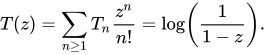
Hence the exponential generating function T(z) of the sequence Tn is given by
Combinatorically, a recursive tree can be interpreted as a root followed by an unordered sequence of recursive trees. Let F denote the family of recursive trees. Then

where denotes the node labeled by 1, × the Cartesian product and the partition product for labeled objects.


By translation of the formal description one obtains the differential equation for T(z)

with T(0) = 0.
Bijections
There are bijective correspondences between recursive trees of size n and permutations of size n − 1.
Applications
Recursive trees can be generated using a simple stochastic process. Such random recursive trees are used as simple models for epidemics.
References
- Analytic Combinatorics, Philippe Flajolet and Robert Sedgewick, Cambridge University Press, 2008.
- Varieties of Increasing Trees, Francois Bergeron, Philippe Flajolet, and Bruno Salvy. In Proceedings of the 17th Colloquium on Trees in Algebra and Programming, Rennes, France, February 1992. Proceedings published in Lecture Notes in Computer Science vol. 581, J.-C. Raoult Ed., 1992, pp. 24–48.
- Profile of random trees: correlation and width of random recursive trees and binary search trees, Michael Drmota and Hsien-Kuei Hwang, Adv. Appl. Prob., 37, 1–21, 2005.
- Profiles of random trees: Limit theorems for random recursive trees and binary search trees, Michael Fuchs, Hsien-Kuei Hwang, Ralph Neininger., Algorithmica, 46, 367–407, 2006.
Content Disclaimer
Informasi ini disarikan dari Wikipedia dan disajikan kembali untuk tujuan edukasi. Konten tersedia di bawah lisensi CC BY-SA 3.0. Kami tidak bertanggung jawab atas ketidakakuratan data yang bersumber dari kontribusi publik tersebut.
- The information displayed on this website is sourced in part or in whole from Wikipedia and has been adapted for the purpose of restating it. We strive to provide accurate and relevant information, however:
- There is no guarantee of absolute accuracy. Wikipedia is an open, collaborative project that can be edited by anyone, so information is subject to change.
- It is not intended to constitute professional advice. The content displayed is for informational and educational purposes only. For important decisions (e.g., medical, legal, or financial), please consult a professional.
- Content copyright. Wikipedia is licensed under the Creative Commons Attribution-ShareAlike License (CC BY-SA). This means that content may be reused with appropriate attribution and shared under a similar license.
- Responsible use. Any risk arising from the use of information from this website is entirely the responsibility of the user.